

Currently Empty: ₹0.00
Full Stack Developer Roadmap in 2026: Skills, Salary, Jobs & Step-by-Step Career Path
January 2, 2026
Introduction
The Full Stack Developer Roadmap in 2026 remains one of the most powerful and high-paying career paths in the IT industry. Despite the rise of AI tools and low-code platforms, companies continue to hire full stack developers because AI can assist coding—but it cannot design, architect, and scale real-world applications independently.
A full stack developer is not limited to one technology. Instead, they understand both frontend and backend systems, making them extremely valuable to startups, product companies, and enterprise IT teams.
If you enjoy:
- Logical problem-solving
- Building real applications
- Writing and understanding code
- Creating products end-to-end
then following the Full Stack Developer Roadmap in 2026 can lead to long-term career growth and global opportunities.
Companies no longer want developers who can only write isolated pieces of code. They want professionals who can understand the entire application lifecycle, from user interface design to backend logic, databases, APIs, cloud deployment, performance optimization, and scalability.
This is exactly why the Full Stack Developer Roadmap in 2026 remains future-proof.
According to:
NASSCOM IT workforce studies
full stack development continues to rank among the top-paying and most stable IT careers globally.
Ultimate Guide to IT Careers & Job-Oriented Skills in 2026
What Is a Full Stack Developer?
web or application product independently or as part of a team.
In the Full Stack Developer Roadmap in 2026, this includes mastery of:
Frontend Development
User interface design
User experience optimization
Performance tuning
Responsive layouts
Backend Development
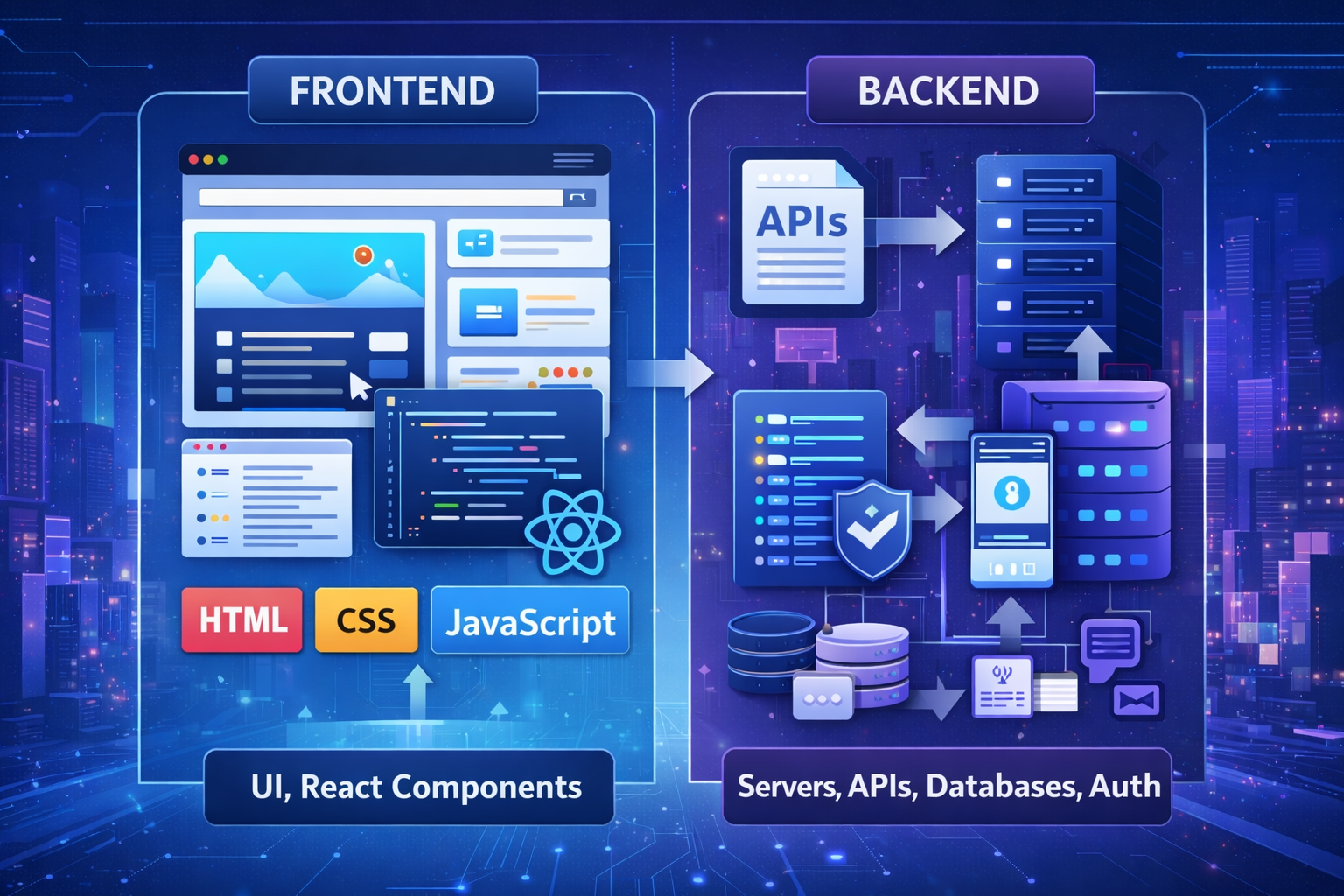
Server-side logic
API creation
Authentication & authorization
Business rule implementation
Database Management
Relational databases (SQL)
NoSQL databases
Query optimization
Data modeling
Cloud & Deployment
Version control
CI/CD basics
Cloud hosting
Production environments
Unlike single-skill developers, professionals following the Full Stack Developer Roadmap in 2026 understand how every layer interacts, making them invaluable to startups and enterprises alike.
Why the Full Stack Developer Roadmap in 2026 Is Still in High Demand
1. Startups Prefer Full Stack Developers
Startups need professionals who can:
Build MVPs quickly
Handle frontend + backend
Reduce hiring costs
One skilled full stack developer can replace multiple specialized roles.
2. Product Companies Need End-to-End Ownership
Product-based companies prefer developers who understand:
UI performance
Backend scalability
Database efficiency
Security and APIs
3. AI Increased Demand for Skilled Developers
AI tools assist coding—but human developers are still required for:
System architecture
Complex logic
Performance tuning
Security decisions
This makes full stack development one of the IT careers that will not be replaced by AI.
Complete Full Stack Developer Roadmap in 2026 (Step-by-Step)
This is the most important section of the Full Stack Developer Roadmap in 2026.
Step 1: Web Fundamentals (Non-Negotiable)
Every successful developer following the Full Stack Developer Roadmap in 2026 starts here.
HTML (Structure)
Semantic tags
Accessibility basics
SEO-friendly markup
CSS (Styling)
Flexbox & Grid
Responsive design
Modern layouts
JavaScript (Core Logic)
Variables, functions, loops
DOM manipulation
Events & async basics
Skipping JavaScript fundamentals is the biggest mistake beginners make in the Full Stack Developer Roadmap in 2026.
Step 2: Frontend Development Skills (2026 Standard)
Frontend defines user experience, and poor frontend kills even the best backend systems.
Must-Learn Frontend Stack:
Component-based architecture
State management basics
Most In-Demand Frontend Framework:
Why React dominates the Full Stack Developer Roadmap in 2026:
Used by startups & enterprises
Huge job market
Strong ecosystem
Backed by Meta
Step 3: Backend Development (Core of Full Stack)
Backend is where real engineering depth begins in the Full Stack Developer Roadmap in 2026.
Popular Backend Technologies:
Backend Concepts You MUST Master:
REST APIs
Authentication & authorization
Business logic
Error handling
Performance optimization
Step 4: Databases & Data Handling
Every application is powered by data.
In the Full Stack Developer Roadmap in 2026, you must understand:
SQL Databases:
MySQL
PostgreSQL
NoSQL Databases:
Key Database Skills:
CRUD operations
Relationships
Query optimization
Why Most People Fail the Full Stack Developer Roadmap in 2026
Common mistakes:
- Jumping directly to frameworks
- Ignoring JavaScript fundamentals
- No real projects
- Copy-paste learning from YouTube
- No deployment experience
Avoiding these alone puts you ahead of 80% of learners.
Step 5: Version Control & Collaboration (Mandatory in the Full Stack Developer Roadmap in 2026)
No matter how good your coding skills are, you are not job-ready in the Full Stack Developer Roadmap in 2026 if you cannot work with version control systems.
Modern software development is collaborative. Teams work across:
Multiple developers
Multiple branches
Multiple environments (dev, test, prod)
Why Version Control Is Critical in 2026
Companies expect developers to:
Track code changes
Collaborate without conflicts
Roll back bugs safely
Review and merge code professionally
This is why Git & GitHub are non-negotiable in the Full Stack Developer Roadmap in 2026.
Git Fundamentals You Must Master
Every developer following the Full Stack Developer Roadmap in 2026 should know:
git initgit clonegit statusgit addgit commitgit pullgit pushBranching & merging
Resolving merge conflicts
GitHub for Developers (Not Just Storage)
In the Full Stack Developer Roadmap in 2026, GitHub acts as:
Your portfolio
Your proof of skills
A resume replacement for many recruiters
Recruiters often:
Check commit history
Review project structure
Look at README explanations
Evaluate consistency
Step 6: Cloud Deployment & DevOps Basics (Huge Career Booster)
One major upgrade in the Full Stack Developer Roadmap in 2026 compared to earlier years is the expectation of deployment knowledge.
Why Deployment Skills Matter in 2026
Companies want developers who can:
Deploy applications independently
Understand environments
Debug production issues
Reduce dependency on DevOps teams
This does not mean you must become a DevOps engineer—but basic cloud literacy is mandatory.
Cloud Platforms Used in the Full Stack Developer Roadmap in 2026
Most common:
For beginners:
AWS (most demand in India)
Simplified deployment platforms
Deployment Skills You Must Learn
In the Full Stack Developer Roadmap in 2026, focus on:
Hosting frontend apps
Hosting backend APIs
Environment variables
Basic CI/CD concepts
Domain & SSL basics
Popular tools:
Step 7: Building Real-World Projects (The Backbone of the Roadmap)
Projects are the single most important factor in the Full Stack Developer Roadmap in 2026.
Degrees, certificates, and courses do not get you hired.
Projects do.
Why Projects Matter More Than Courses
Recruiters evaluate:
How you structure code
How you solve problems
How you explain your approach
How you handle edge cases
How you deploy applications
This is why project quality beats quantity in the Full Stack Developer Roadmap in 2026.
Must-Have Projects for Full Stack Developers (2026)
You should build at least 3–5 strong projects, such as:
1. E-commerce Application
Includes:
User authentication
Product listings
Cart & checkout
Admin dashboard
2. Job Portal / LMS Platform
Includes:
Role-based access
CRUD operations
API integrations
Dashboard analytics
3. Admin Dashboard
Includes:
Data visualization
Secure login
Backend APIs
Database management
Step 8: API Integration & Third-Party Services
In real jobs, developers rarely build everything from scratch.
In the Full Stack Developer Roadmap in 2026, you must know how to:
Consume external APIs
Handle API errors
Secure API keys
Integrate services
Examples:
Payment gateways
Email services
Authentication providers
Step 9: Security Basics
Security awareness separates junior and professional developers in the Full Stack Developer Roadmap in 2026.
You should understand:
Authentication vs authorization
Password hashing
API security basics
Common vulnerabilities (OWASP)
Step 10: System Design Basics (Beginner-Friendly but High Impact)
One major difference between average developers and job-ready developers in the Full Stack Developer Roadmap in 2026 is system thinking.
You are not expected to design Facebook or Amazon as a fresher.
But you are expected to understand how real applications scale.
Why System Design Matters in 2026
Recruiters increasingly ask:
“How would you design this feature?”
“What happens if traffic increases?”
“How would you store this data?”
System design shows:
Depth of understanding
Real-world thinking
Maturity as a developer
That’s why system design is now part of the Full Stack Developer Roadmap in 2026, even for freshers.
Beginner-Level System Design Concepts You Must Know
In the Full Stack Developer Roadmap in 2026, focus on:
Client–server architecture
Monolithic vs microservices
REST API flow
Database read/write patterns
Authentication flow
Basic caching concept
You don’t need advanced math or distributed systems—clarity matters more than complexity.
Example: Designing a Simple Job Portal (Fresher Level)
When asked to design a job portal:
Frontend → React UI
Backend → REST APIs
Database → Users, jobs, applications
Auth → JWT-based login
Deployment → Cloud-hosted
Explaining this clearly already puts you ahead of 70% of candidates following the Full Stack Developer Roadmap in 2026.
Step 11: Interview Preparation Strategy (What Actually Gets You Hired)
Many people follow the Full Stack Developer Roadmap in 2026 but fail interviews—not due to lack of skills, but due to poor preparation strategy.
What Companies Test in Full Stack Interviews
Interviewers evaluate:
JavaScript fundamentals
Framework understanding
Backend logic
Database basics
Project explanations
Problem-solving approach
They rarely expect perfection—but they expect honesty and clarity.
Core Topics to Prepare (Fresher & Junior Level)
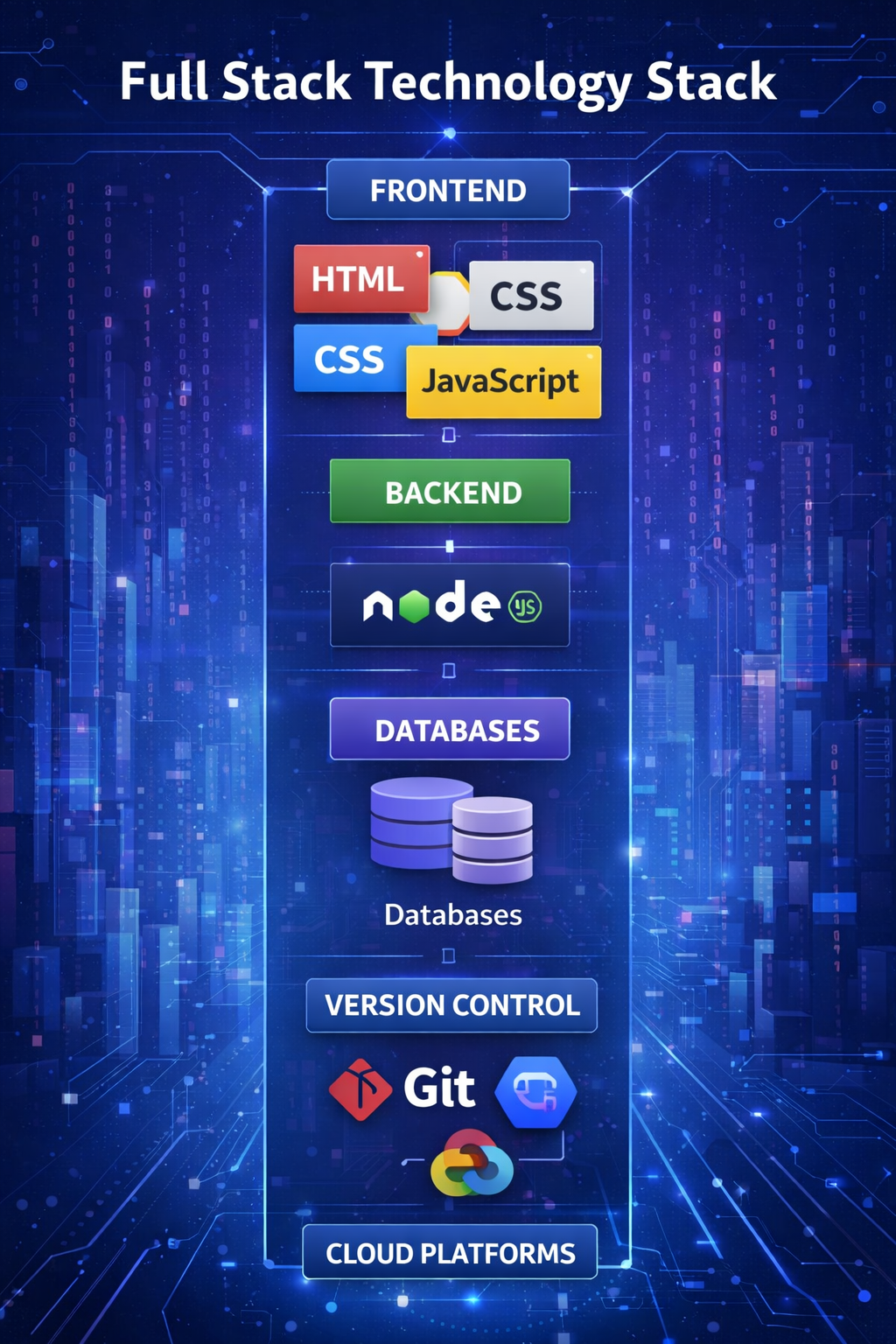
For the Full Stack Developer Roadmap in 2026, prepare:
Frontend:
JavaScript fundamentals
React basics (state, props, hooks)
Component structure
Backend:
REST APIs
Authentication
CRUD logic
Database:
SQL basics
Relationships
Queries
Tools:
Git & GitHub
Deployment basics
Project-Based Interview Questions (Most Important)
Most interviews revolve around your projects.
Expect questions like:
Why did you choose this architecture?
How did you handle authentication?
What problems did you face?
How would you scale this?
This is why projects are the heart of the Full Stack Developer Roadmap in 2026.
Step 12: Resume Strategy for Full Stack Developers (2026 Format)
A bad resume can destroy months of effort.
In the Full Stack Developer Roadmap in 2026, your resume should be:
One page (freshers)
Project-focused
Skill-specific
Keyword-optimized
Resume Sections That Matter Most
Professional Summary
Mention full stack skills
Mention projects
Mention deployment
Technical Skills
Frontend
Backend
Databases
Tools
Projects
Clear description
Technologies used
Live links
GitHub links
Internship / Training
Practical exposure
Real-world tasks
Step 13: LinkedIn & Personal Branding (Often Ignored)
In the Full Stack Developer Roadmap in 2026, LinkedIn acts as:
A networking platform
A visibility engine
A recruiter magnet
How to Optimize LinkedIn as a Full Stack Developer
You should:
Use “Full Stack Developer” in headline
Share project updates
Post learning milestones
Engage with tech content
Consistency matters more than virality.
Step 14: Internship & Placement Strategy (Critical for Freshers)
Getting your first role is the hardest step in the Full Stack Developer Roadmap in 2026.
Best Ways to Get Internships
Training institutes with placement support
Startup internships
Freelance projects
Open-source contributions
Internships provide:
Real-world experience
Resume credibility
Interview confidence
Placement Strategy That Works in 2026
Apply smartly:
Company career pages
LinkedIn jobs
Referral-based applications
Internship-to-job conversions
Avoid:
- Random mass applications
- Fake experience
- Ignoring fundamentals
90–180 Day Fresher Roadmap (Realistic Timeline)
If you follow the Full Stack Developer Roadmap in 2026 seriously:
First 30 Days
HTML, CSS, JavaScript
Git basics
31–90 Days
Frontend framework
Backend basics
Database fundamentals
91–150 Days
Real projects
Deployment
GitHub portfolio
151–180 Days
Interview prep
Internships
Job applications
This timeline is achievable—but only with consistent effort.
Why Many People Quit the Full Stack Developer Roadmap in 2026
Common reasons:
Unrealistic expectations
Skipping fundamentals
Comparing too early
Fear of backend complexity
Persistence is the real differentiator.
How Recruiters Evaluate Full Stack Developers in 2026
Recruiters do not expect perfection.
They look for:
Clean code structure
Logical thinking
Project explanations
Willingness to learn
Deployment experience
Resume filters in the Full Stack Developer Roadmap in 2026 include:
GitHub links
Live project URLs
Tech stack clarity
Internship or hands-on training
Full Stack Developer Salary in India (2026)
One of the biggest reasons students follow the Full Stack Developer Roadmap in 2026 is salary growth.
| Experience | Salary Range |
|---|---|
| Fresher | ₹5 – ₹8 LPA |
| 2–4 Years | ₹10 – ₹18 LPA |
| Senior Level | ₹20+ LPA |
Top hiring cities:
- Bangalore
- Hyderabad
- Chennai
IT Salary Trends in Bangalore, Chennai & Hyderabad
- Glassdoor India
- AmbitionBox
Full Stack Developer vs Data Analyst (Which Is Better?)
Many students compare the Full Stack Developer Roadmap in 2026 with data analytics.
| Factor | Full Stack Developer | Data Analyst |
|---|---|---|
| Coding | High | Low |
| Learning Curve | Steep | Moderate |
| Salary Ceiling | Very High | High |
| Best for | Logical thinkers | Analytical minds |
Data Analytics Career Path in 2026
Is Full Stack Development Good for Freshers in 2026?
Yes—but only if you:
✔ Enjoy coding
✔ Can practice consistently
✔ Build projects seriously
If you want faster entry with less coding, data analytics may be better.
If you want deep technical growth, full stack development is ideal.
Coding vs Non-Coding IT Careers – Salary & Growth
Common Mistakes in the Full Stack Developer Roadmap in 2026
- Jumping directly to frameworks
- Skipping JavaScript basics
- No real projects
- Copy-paste learning
Avoiding these mistakes dramatically improves success.
How Cambridge Infotech Supports the Full Stack Developer Roadmap in 2026
Cambridge Infotech focuses on:
- Job-oriented full stack curriculum
- Real-time projects
- Interview preparation
- Placement assistance
Cambridge Infotech Training Approach & Placement Support
Best IT Courses with Placement Support in Bangalore
Future Scope of the Full Stack Developer Roadmap in 2026
Full stack developers grow into:
- Senior Software Engineer
- Technical Architect
- Product Engineer
- Startup Founder
AI will assist, not replace, skilled developers.
How Cambridge Infotech Supports This Roadmap
Cambridge Infotech focuses on:
Job-oriented full stack curriculum
Real-time industry projects
Interview preparation
Placement assistance
This structured approach helps students move from beginner → job-ready developer.
Want Personalized Career Guidance?
Fill out the form below for a FREE Full Stack Career Counseling Session
Get clarity on:
- Skill roadmap
- Learning timeline
- Salary expectations
Conclusion: Is the Full Stack Developer Roadmap in 2026 Worth It?
The Full Stack Developer Roadmap in 2026 is not just a learning path—it is a long-term career strategy. In a tech landscape shaped by AI, automation, and rapid innovation, companies don’t hire tools; they hire problem solvers who understand systems end-to-end.
Full stack developers remain in high demand because they can:
Build complete applications, not just isolated features
Understand both user experience and backend logic
Adapt quickly to new frameworks and technologies
Work effectively with startups, enterprises, and global teams
AI will continue to accelerate development—but it will not replace developers who can design, think, debug, scale, and secure real-world applications. That is why the Full Stack Developer Roadmap in 2026 is still one of the most future-proof IT careers.
However, success does not come from shortcuts.
If you follow this roadmap seriously—by mastering fundamentals, building real projects, deploying applications, and preparing strategically for interviews—you can move from beginner to job-ready developer within months. Those who skip basics, avoid backend complexity, or rely only on tutorials are the ones who struggle.
For freshers, career switchers, and working professionals, full stack development offers:
Strong salary growth
Global job opportunities
Long-term career progression into senior, architect, or product roles
The roadmap is clear. The demand is real.
The only question is your consistency and commitment.
If you are ready to invest focused effort, the Full Stack Developer Roadmap in 2026 can transform your career—and open doors that remain closed to average, single-skill profiles.
Start now. Build seriously. Think long-term.
Frequently Asked Questions (FAQs)
1. Is the Full Stack Developer Roadmap in 2026 suitable for beginners?
Yes, the Full Stack Developer Roadmap in 2026 is suitable for beginners, provided they start with fundamentals like HTML, CSS, and JavaScript. With consistent practice, real-world projects, and proper guidance, beginners can become job-ready within 4–6 months.
2.How long does it take to become a full stack developer in 2026?
On average, it takes 4 to 6 months to become a job-ready full stack developer in 2026 if you follow a structured roadmap, practice daily, and build real-world projects. The timeline may vary based on prior experience and learning consistency.
3.What skills are mandatory in the Full Stack Developer Roadmap in 2026?
Mandatory skills include:
HTML, CSS, JavaScript
Frontend frameworks like React
Backend development (Node.js / Java / Python)
Databases (SQL & NoSQL)
Git & GitHub
Basic cloud deployment
These skills form the core of the Full Stack Developer Roadmap in 2026.
4. What is the salary of a full stack developer in India in 2026?
In India, a fresher full stack developer can earn ₹5–8 LPA, while professionals with 2–4 years of experience can earn ₹10–18 LPA. Senior full stack developers can earn ₹20+ LPA, depending on skills and company.
5. Will AI replace full stack developers in the future?
No. AI will assist developers but will not replace full stack developers who can design systems, understand business logic, build scalable applications, and solve real-world problems. This makes the Full Stack Developer Roadmap in 2026 a future-proof career choice.