
What is Agentic AI? Definition, Examples & How it Works 2026
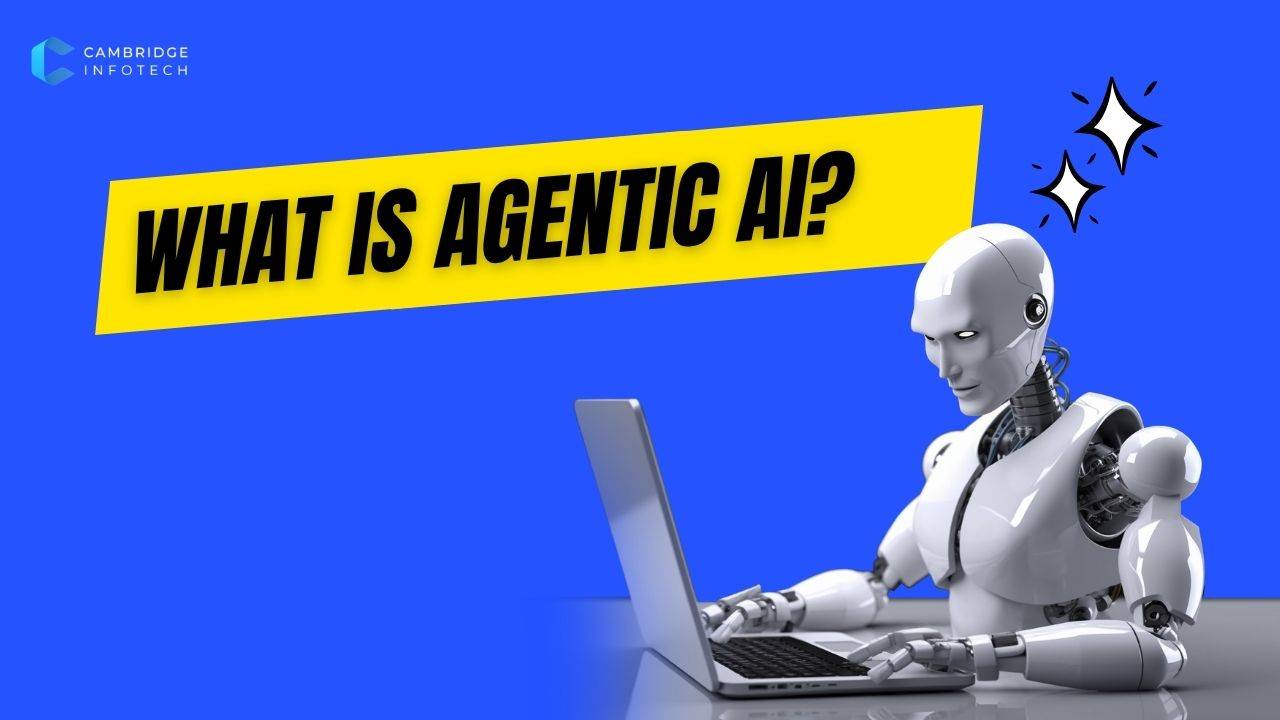
What Is Agentic AI? Definition, How It Works, Real Examples & Career Guide 2026
By Cambridge Infotech | Updated May 2026 | 14 min read
Quick Answer
Agentic AI is an artificial intelligence system that acts autonomously to complete multi-step goals — without needing human instructions at every step. Unlike a chatbot that waits for your next message, an agentic AI system sets its own sub-goals, uses tools (web search, code execution, APIs), tracks its own progress, and self-corrects until the task is done. In 2026, agentic AI is creating an entirely new category of high-paying tech jobs in India, with fresher roles starting at ₹9–15 LPA.
You have probably used ChatGPT to draft an email or summarise a document. You type a prompt, it replies, you type again. That is a conversation loop — useful, but not autonomous.
Agentic AI is something categorically different. Give it a goal like “research the top 5 cloud providers for a fintech startup and send me a comparison report” — and it does exactly that. It searches the web, reads pages, compares data, writes the report, and delivers it. You are not involved in any of those steps.
That shift — from AI-as-responder to AI-as-actor — is why agentic AI is the fastest-growing topic in enterprise technology in 2026, and why Indian IT companies are scrambling to hire professionals who can build these systems. This guide explains exactly what agentic AI is, how it works technically, where it is being used, and what it means for your career.
What Is Agentic AI — The Plain-English Definition
Definition
Agentic AI is an artificial intelligence system that can independently plan, act, and complete multi-step tasks toward a defined goal — using external tools and self-correction — without requiring human input at each step. The word “agentic” comes from agency: the ability to act independently. Agentic AI systems are distinct from standard large language models (LLMs) because they have goals, memory, tool access, and the ability to evaluate and revise their own outputs.
The word agentic comes from agency — the ability to act independently toward a goal. A standard AI model like GPT-4 does not have agency. It responds to your prompt and stops. An agentic AI system has agency: it receives a goal, figures out the steps needed to achieve it, executes those steps using real-world tools, and evaluates whether it succeeded — repeating the cycle until the work is done.
Think of the difference this way. A standard chatbot is like a knowledgeable colleague you can ask questions. An agentic AI system is like a junior employee you can assign work to and trust them to complete it without hand-holding.
The four properties that make an AI system genuinely “agentic”:
- Goal-directedness: it works toward an outcome you define, not just an answer to a single question
- Tool use: it can interact with the outside world — running web searches, executing code, calling APIs, reading files, sending emails
- Memory: it tracks what it has done and what remains, across multiple steps and sometimes across sessions
- Self-correction: it evaluates its own outputs, identifies failures, and tries alternative approaches without being told to
Without all four properties, a system might be AI-powered but it is not truly agentic. A chatbot with web search but no memory or self-correction is not agentic AI — it is a chatbot with a tool.
Agentic AI vs Chatbots vs Generative AI — The Key Differences
The terms agentic AI, generative AI, and AI chatbots are often used interchangeably in the media — incorrectly. Here is the precise difference:
| Property | Standard chatbot (e.g. ChatGPT) | Generative AI model | Agentic AI |
|---|---|---|---|
| How it operates | You ask → it answers | Generates content from prompts | You set a goal → it plans and executes |
| Memory | Limited to conversation window | None between sessions | Tracks full task progress and history |
| Tool access | Limited | None by default | Yes — web, code, APIs, databases, email |
| Multi-step tasks | You guide every step | Single output per prompt | Handles all steps autonomously |
| Self-correction | None | None | Evaluates outputs and retries on failure |
| Example task | “Summarise this article” | “Write a product description” | “Research competitors, compare pricing, and email me a report” |
Generative AI — models like GPT-4, Gemini, and Claude — is the engine inside an agentic AI system. The LLM does the reasoning and language tasks. But the agentic layer is what gives it goals, memory, tools, and the ability to run a multi-step loop. Agentic AI is not a replacement for generative AI; it is what you build when you give a generative AI system agency.
How Agentic AI Works — The 4-Step Loop Explained
Every agentic AI system runs on a continuous reasoning loop. The most widely used framework is called ReAct (Reason + Act), introduced by researchers at Google and Princeton and now the foundation of most production agent frameworks. Understanding this loop makes agentic AI far less mysterious.
Step 1: Perceive (take in the situation)
The agent receives its goal and collects available context — documents, previous outputs, tool results, and any background knowledge it has been given. This is the agent’s situational awareness at the start of each cycle. The richer and more specific the context, the more accurately the agent can plan.
Step 2: Plan (reason about sub-tasks)
Using its underlying LLM as a reasoning engine, the agentic AI breaks the high-level goal into a sequence of concrete sub-tasks. This planning step uses chain-of-thought reasoning — the agent articulates its logic step by step before acting, which significantly improves the quality and reliability of its outputs. For example, for the goal “compare AWS vs Azure costs for our workload”, the plan might be: identify current workload specs → search AWS pricing → search Azure pricing → build comparison → write summary.
Step 3: Act (use tools to execute)
The agent executes the next planned step by calling a tool. Tools can include web search, code execution (Python sandbox), file reading and writing, database queries, API calls, form submission, or even sending emails and Slack messages. The agent selects the most appropriate tool for each step — it is not limited to a fixed set of actions.
Step 4: Reflect (evaluate and correct)
After each action, the agent evaluates the result against the goal: was this step successful? Did the web search return useful information? If the answer is yes, it moves to the next planned step. If the answer is no — the search returned irrelevant results, the code threw an error, the API returned an unexpected format — the agent adjusts its approach and tries again. This self-correction capability is what gives agentic AI its reliability on complex tasks.
The agent cycles through Perceive → Plan → Act → Reflect until either the goal is complete or it determines the goal cannot be achieved with available tools and information.
Memory types in agentic AI systems
Agentic AI systems use multiple types of memory simultaneously:
- Short-term memory: the context window of the current task — what the agent is currently working on
- Long-term memory: stored in a vector database — past interactions, documents, facts the agent should remember across sessions
- Episodic memory: a log of what the agent has done in the current task — prevents it from repeating completed steps or getting stuck in loops
- Semantic memory: the LLM’s built-in knowledge from training — general world knowledge available without searching
Top Agentic AI Frameworks and Tools in 2026
You do not build agentic AI from scratch. In 2026, a mature ecosystem of frameworks handles the architecture, and your job is to use them to solve real business problems.
| Framework | What it’s for | Best used when | India job demand |
|---|---|---|---|
| LangChain | Building single agents with chains, memory, and tool use | Most enterprise use cases; best documentation | Very high |
| CrewAI | Multi-agent systems where different agents have different roles | Complex tasks needing specialist sub-agents | Growing fast |
| Microsoft AutoGen | Multi-agent conversation and collaboration | Microsoft Azure ecosystem and enterprise | High in MNCs |
| Hugging Face Agents | Open-source LLM-based agents | When open-source models are preferred over GPT | Moderate |
| OpenAI Assistants API | Building agents directly on GPT-4 with built-in memory and tools | Simplest path to a working agent using OpenAI | Very high |
For most beginners and junior developers in India, LangChain is the framework to start with — it has the largest community, most tutorials in English, and appears in the highest number of Indian job postings for agentic AI roles in 2026. Learn LangChain first, then add CrewAI for multi-agent projects once you are comfortable.
Real-World Agentic AI Examples by Industry
Agentic AI is no longer confined to research labs. In 2026, it is actively deployed in production systems across every major industry — including right here in India.
Banking and fintech (India)
Indian banks and fintech companies are deploying agentic AI systems for fraud detection workflows where the agent monitors transactions, identifies suspicious patterns, retrieves customer history, cross-references against known fraud vectors, and automatically flags cases for human review — completing in seconds what previously required an analyst and 20 minutes. Razorpay and PhonePe both use ML-driven agent pipelines for transaction monitoring at scale.
IT services and software development
TCS, Infosys, and Wipro have all launched dedicated agentic AI practices. These firms are building agents that autonomously conduct code reviews (checking for security vulnerabilities, code style violations, and logic errors), generate test cases, and produce documentation — tasks that previously required senior developer time. The agents flag issues and suggest fixes; human developers review and approve.
Healthcare
Apollo and Manipal hospital networks are piloting agents for patient intake automation — the agent collects symptoms through a conversation, retrieves relevant medical history from the hospital database, cross-references against diagnostic guidelines, and generates a structured pre-consultation brief for the doctor. This frees 15–20 minutes of preparation time per patient consultation.
Marketing and content operations
Digital marketing agencies across Bangalore are using agentic AI systems to automate content pipelines. A single agent workflow can: research trending topics, generate a content brief, write a blog draft, check it against SEO guidelines, suggest internal links, and flag for human review — all without a human doing anything beyond initiating the workflow and approving the final output. Turnaround time drops from 2 days to 4 hours per article.
Enterprise: Microsoft Copilot
Microsoft’s Copilot suite is the most widely deployed example of agentic AI at enterprise scale. A sales manager can now instruct Copilot to “prepare my quarterly account review for Monday” — and it pulls data from Salesforce, summarises recent email threads, checks calendar context, and generates a complete briefing document. The user never touches any of those source systems.
Limitations and Risks of Agentic AI — What You Need to Know
Responsible deployment of agentic AI requires understanding where it fails — not just where it succeeds. This section is important for both practitioners and decision-makers.
- Hallucination and factual errors. The LLM reasoning engine at the core of an agentic AI system can generate incorrect information confidently. In a multi-step workflow, one hallucination early in the chain can cascade into larger errors downstream. Mitigation: build explicit verification steps into agent workflows; use RAG (Retrieval-Augmented Generation) so the agent cites sources you can verify.
- Runaway loops and infinite retry. If an agent’s self-correction logic is poorly designed, it can enter an infinite loop — repeatedly trying failed approaches without a stopping condition. Well-designed agents include explicit loop limits and graceful failure handling.
- Tool misuse. An agentic AI system with access to send emails, execute code, or delete files can cause real damage if it misinterprets its goal or executes an unintended action. Human-in-the-loop checkpoints for high-stakes actions are an essential safety pattern in 2026.
- Data privacy and compliance. Agents that access customer databases, medical records, or financial data must operate within data governance frameworks (India’s DPDP Act, GDPR for global operations). Prompt injection attacks — where malicious content in the environment manipulates the agent’s behaviour — are an active security concern.
- Cost unpredictability. LLM API calls cost money per token. A complex agent workflow can generate hundreds of API calls per task. Without explicit cost controls, production agent deployments can generate unexpected API bills. Token optimisation and caching are practical skills for production agentic AI developers.
Agentic AI Careers and Salaries in India 2026
Demand for agentic AI skills in India has grown faster than any other technology category in the past 12 months. Job postings for LangChain developers, AI automation engineers, and LLM application developers increased by over 300% on LinkedIn India between 2024 and May 2026. Bangalore alone accounts for over 40% of these openings.
The talent gap is acute: companies need people who can build, deploy, and maintain agentic AI systems, and there are simply not enough trained professionals to fill the roles. This gap is the direct reason starting salaries are significantly higher than for equivalent traditional software engineering roles.
| Role | Fresher (0–1 yr) | Mid (2–4 yrs) | Senior (5+ yrs) |
|---|---|---|---|
| Agentic AI Developer | ₹9–14 LPA | ₹16–26 LPA | ₹26–45 LPA |
| LLM Application Engineer | ₹8–12 LPA | ₹14–22 LPA | ₹22–38 LPA |
| AI Automation Engineer | ₹7–12 LPA | ₹12–20 LPA | ₹20–32 LPA |
| AI Agent Architect | ₹14–20 LPA | ₹22–35 LPA | ₹35–55 LPA |
| Prompt Engineer (agentic systems) | ₹6–10 LPA | ₹10–18 LPA | ₹18–28 LPA |
Source: Naukri Salary Insights, Glassdoor India, AmbitionBox, LinkedIn Salary — May 2026. Ranges vary by company size, city, and specific skill depth.
For a complete roadmap to landing one of these roles — including which certifications to pursue, which companies to target, and how to build a portfolio that gets interviews — read our dedicated guide: Agentic AI Career in India 2026 — Complete Roadmap.
Skills You Need to Build Agentic AI Systems
You do not need a PhD in machine learning to become an agentic AI developer. The practical skill stack is accessible to anyone with motivation and 4–6 months of focused learning. Here is what you actually need:
1. Python programming
Python is the primary language for all major agentic AI frameworks. You need solid fundamentals — functions, classes, error handling, working with JSON and APIs. Most beginners reach a working level within 4–6 weeks. This is the non-negotiable starting point for an agentic AI career.
2. LLM API integration
Understanding how to call OpenAI, Anthropic, or Google Gemini APIs is fundamental. You need to know how to send prompts, handle responses, manage conversation history, and control parameters like temperature and max tokens. This is a few days of practice once Python is solid.
3. LangChain or similar frameworks
LangChain is the most widely used framework for building agentic AI systems. It provides the building blocks for chains (multi-step workflows), agents (goal-directed systems with tool use), and RAG pipelines (connecting AI to your own document sets). Once you know Python and APIs, LangChain takes 2–4 weeks to reach a productive level.
4. Prompt engineering
Writing precise system prompts and task instructions for agentic AI workflows is a genuine skill. A well-constructed system prompt determines whether an agent works reliably across diverse inputs or fails unpredictably. Good prompt engineering significantly reduces hallucination rates and improves task completion accuracy.
5. Vector databases and RAG
Most production agentic AI systems need access to a company’s specific knowledge — documents, product manuals, customer histories. This is done via Retrieval-Augmented Generation (RAG), which requires a vector database like Pinecone, FAISS, or Chroma. You do not need to build these from scratch, but understanding how they store and retrieve information is essential for designing effective agents.
6. Basic cloud deployment
Production agentic AI systems run in the cloud — typically AWS, Azure, or Google Cloud. Knowing enough to deploy a FastAPI application, manage environment variables securely, and monitor costs is sufficient for most junior roles. Docker basics are also expected.
For a structured learning path combining all these skills with real projects and placement support, see our AI course in Bangalore and the dedicated Agentic AI career roadmap. You can also explore our broader Machine Learning course to build the foundational ML knowledge that underlies most agentic systems.
For learning Python — the essential first step — our Python course in Bangalore is structured specifically for learners targeting AI and automation careers.
Ready to Build Agentic AI Systems?
Cambridge Infotech’s Agentic AI course covers Python, LangChain, CrewAI, RAG pipelines, and real deployed projects — with 100% placement support in Bangalore.
New batches start every month · Small batch sizes · Industry trainers · EMI available
Frequently Asked Questions About Agentic AI
1.What is the simple definition of agentic AI?
Agentic AI is an AI system that can independently plan and execute multi-step tasks toward a defined goal, using tools and self-correction — without needing human input at every step. Unlike chatbots that respond to individual prompts, agentic AI systems have four key properties: goal-directedness, tool access, memory, and self-correction.
2.Is agentic AI the same as AGI (Artificial General Intelligence)?
No. AGI refers to a hypothetical AI with broad human-level intelligence across all domains — it does not exist yet. Agentic AI is a real, practical technology available and deployed today. It refers to AI systems that act autonomously within specific, defined domains. AGI remains a theoretical concept; agentic AI is already running inside enterprise software at companies like Microsoft, TCS, and Infosys right now.
3.What are real examples of agentic AI being used in India?
Real examples in India include: TCS,3. Infosys, and Wipro’s automated code review and software testing agents; fintech companies like Razorpay using agentic AI for fraud detection pipelines; healthcare platforms automating patient intake summaries; and digital marketing agencies using agent workflows to automate content research, writing, and SEO optimisation. Bangalore-based startups are building agentic AI tools for healthcare, legal, and HR automation.
4.Can freshers learn agentic AI without a CS degree?
Yes. The core skill stack for agentic AI development — Python, LangChain, API integration, prompt engineering — is learnable by anyone with basic programming motivation and 4–6 months of focused practice. Many professionals entering this field come from non-CS backgrounds including commerce, science, and arts. What matters to employers is a working portfolio of real agent projects, not a formal degree. See our Agentic AI career guide for a complete roadmap.
5.What salary can I expect as an agentic AI developer in India?
Fres.her agentic AI developers in Bangalore currently earn ₹9–14 LPA — significantly above traditional software fresher roles. Mid-level professionals with 2–4 years of agentic AI experience command ₹16–26 LPA. Senior AI Architects specialising in agentic systems earn ₹35–55 LPA at leading companies. These premiums exist because qualified candidates are still scarce relative to demand.
6.How is agentic AI different from RPA (Robotic Process Automation)?
RPA follows rigid, pre-programmed rules and breaks when anything deviates from its script. Agentic AI can reason, adapt, and handle unexpected situations. RPA is deterministic — it does the same thing every time in the same conditions. Agentic AI is adaptive — it adjusts its approach based on what it finds. Many Indian companies are now migrating legacy RPA workflows to agentic AI systems because of this flexibility.
7.What is the best agentic AI course in Bangalore?
Cambridge Infotech at Kalyan Nagar, Bangalore offers a structured agentic AI program covering Python, LangChain, CrewAI, RAG pipelines, vector databases, and real project deployment. The course includes 100% placement support, small batch sizes for individual attention, and trainers who are active agentic AI practitioners. New batches start every month. Call +91 99024 61116 for current batch dates and fees.
Final Thoughts
Agentic AI represents the most significant shift in how software gets built since the move to cloud computing. The change from AI-as-responder to AI-as-actor is not incremental — it opens entirely new categories of automation, entirely new types of products, and an entirely new class of careers.
India is uniquely positioned to benefit from this shift. The country’s large base of software engineers, combined with the current shortage of agentic AI-skilled professionals, creates an unusual window where anyone who builds these skills in 2026 will have a significant and durable advantage over those who wait.
The technology is accessible. The tools are mature. The learning path is clear. The only variable is whether you start now or later.
Explore our Artificial Intelligence course in Bangalore or contact us directly at +91 99024 61116 to find out which course fits your background and goals.
- Agentic AI Career in India 2026 — Salary, Roadmap & How to Get Hired
- Agentic AI vs Generative AI vs Traditional AI — 2026 Comparison Guide
- AI Course in Bangalore — Full Program with Placement Support
- Machine Learning Course in Bangalore
- Generative AI Course in Bangalore 2026
- NLP Course in Bangalore
- AI Careers 2026 India — Top Roles, Salaries & Complete Guide