
Currently Empty: ₹0.00
SQL for Beginners in 2025 A Complete Guide to Mastering Data Skills
February 28, 2024

SQL for Beginners
Your Ultimate Guide to Mastering Structured Query Language
In today’s data-driven digital economy, SQL for Beginners is one of the most essential skills for anyone who wants to build a successful career in technology, data analytics, or software development. Whether you are a student, a working professional, or planning a career transition, learning SQL gives you a strong foundation in handling real-world data.
SQL is the universal language of databases. From startups to global enterprises like Google, Amazon, and Microsoft, SQL is used to store, manage, and analyze data efficiently. Mastering SQL as a beginner opens doors to countless career opportunities in high-demand domains.
Why Learn SQL as a Beginner?
1. SQL is the Backbone of Data Management
SQL is the standard language used to interact with relational databases. Almost every application today relies on databases, making SQL a core skill for beginners.
2. High Demand in the Job Market
SQL is a must-have skill for roles such as:
Data Analyst
Business Analyst
Data Scientist
Backend Developer
Database Administrator
Business Intelligence Professional
Companies actively seek professionals who can extract insights from data using SQL.
3. Future-Proof Your Career
With the rise of AI, Machine Learning, Big Data, and Cloud Computing, SQL remains a foundational technology. It works alongside advanced tools, making it one of the most future-proof skills you can learn.
What is SQL?
SQL, or Structured Query Language, is a domain-specific language used to communicate with databases. For beginners, it’s important to understand that SQL allows you to:
- Create and modify database structures.
- Insert, update, and delete data.
- Query and analyze data to extract meaningful insights.
SQL works with relational database management systems (RDBMS) like MySQL, PostgreSQL, Oracle, and Microsoft SQL Server.
Getting Started with SQL as a Beginner
Understand the Basics
For SQL beginners, start by familiarizing yourself with foundational concepts:
- Tables: Data is stored in tables, which consist of rows and columns.
- Queries: Commands like
SELECT,INSERT,UPDATE, andDELETEare used to interact with data. - Clauses:
WHERE,GROUP BY,ORDER BY, andHAVINGhelp refine your queries.
Set Up Your Environment
To practice SQL as a beginner, you’ll need a database environment. Here are some beginner-friendly options:
- MySQL: A popular open-source RDBMS.
- SQLite: Lightweight and easy to set up.
- Online Platforms: Websites like SQLFiddle or DB Fiddle allow you to practice SQL without installing anything.
Learn Through Hands-On Practice
The best way to learn SQL for beginners is by doing. Start with simple queries and gradually move to more complex ones. Here’s an example:
sql
-- Select all records from a table
SELECT * FROM employees;
-- Filter records using WHERE
SELECT * FROM employees WHERE department = 'Sales';
-- Aggregate data using GROUP BY
SELECT department, COUNT(*) as employee_count
FROM employees
GROUP BY department;
Explore Advanced Topics
Once you’re comfortable with the basics, dive into advanced topics like:
- Joins: Combine data from multiple tables.
- Subqueries: Nest queries within queries.
- Indexing: Optimize database performance.
- Stored Procedures: Write reusable SQL code.
SQL Trends for Beginners to Watch
SQL and AI Integration
As AI and machine learning continue to evolve, SQL for beginners will include integration with tools like TensorFlow and PyTorch to enable seamless data analysis and model training.
Cloud-Based SQL Databases
Cloud platforms like AWS, Google Cloud, and Microsoft Azure are offering managed SQL services, making it easier for beginners to work with databases without worrying about infrastructure.
SQL for Big Data
With the rise of big data technologies like Hadoop and Spark, SQL for beginners is being adapted to handle large-scale data processing. Tools like Apache Hive and Presto allow you to run SQL queries on massive datasets.
Tips for Learning SQL as a Beginner
Start Small: Focus on mastering the basics before tackling advanced concepts.
Practice Regularly: Consistency is key to retaining what you learn.
Work on Real-World Projects: Apply your skills to real datasets to gain practical experience.
Join a Community: Engage with forums like Stack Overflow or Reddit’s r/SQL to ask questions and learn from others.
Take a Course: Enroll in a structured course like those offered by Cambridge Infotech to get expert guidance and hands-on training.
Why Choose Cambridge Infotech for SQL Training?
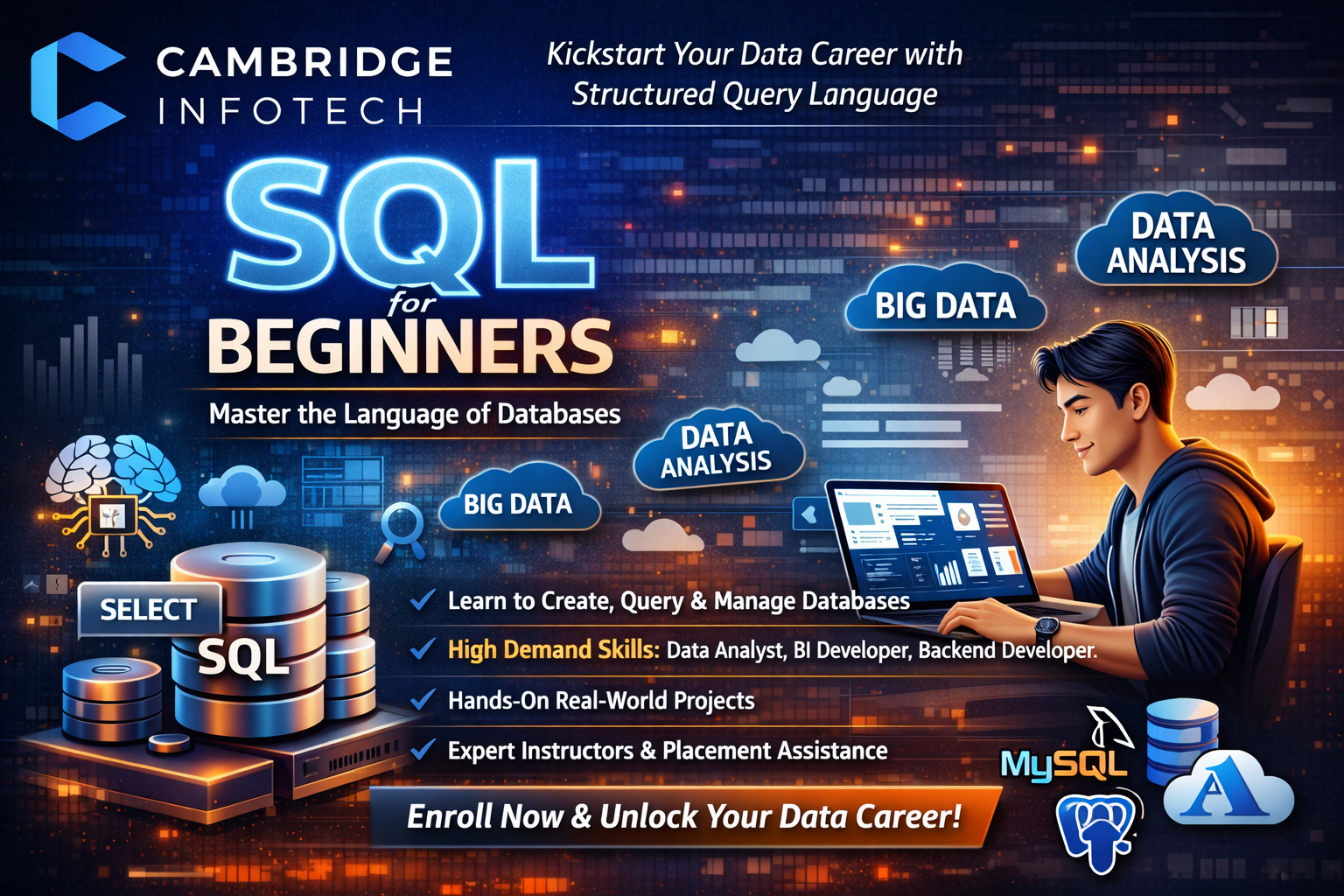
At Cambridge Infotech, we offer comprehensive SQL for beginners courses designed for learners of all levels. Our SQL for Beginners program covers:
- Fundamentals of SQL
- Database Design and Management
- Advanced Querying Techniques
- Real-World Applications and Case Studies
With hands-on projects, expert instructors, and a focus on industry-relevant skills, we ensure you’re job-ready by the time you complete the course.
FAQs
About SQL for Beginners
Is SQL hard to learn?
Not at all! SQL for beginners is one of the easiest programming languages to learn, thanks to its simple syntax and logical structure.
How long does it take to learn SQL?
With consistent practice, beginners can learn the basics of SQL in a few weeks. Mastering advanced concepts may take a few months.
Do I need prior programming experience to learn SQL?
No, SQL for beginners is beginner-friendly and doesn’t require any prior programming knowledge.
What are the career opportunities after learning SQL?
SQL for beginners opens doors to roles like Data Analyst, Database Administrator, Business Analyst, and Software Developer.
Conclusion
Learning SQL for beginners is a smart investment in your future. Whether you’re looking to start a career in tech, upskill, or simply understand how data works, SQL is a versatile and powerful tool that will serve you well.
Ready to take the first step? Enroll in Cambridge Infotech’s SQL for Beginners course today and unlock the power of data!
Learn more about
The article from Cambridge Infotech discusses the latest trends in AI and web development, highlighting how AI is transforming the web development landscape. It emphasizes the growing use of AI-driven tools for automating tasks, enhancing user experiences, and improving website performance. Key trends include the integration of AI-powered chatbots, personalized content delivery, and advanced data analytics to create more dynamic and user-centric websites. The article also explores how AI is enabling developers to build smarter, more efficient applications, paving the way for innovative solutions in the digital space. For more details, visit the link provided.
Cambridge Infotech serves as a comprehensive guide for aspiring Python full-stack developers. It outlines the essential skills, tools, and frameworks required to excel in full-stack development using Python. Key topics include front-end technologies like HTML, CSS, and JavaScript, back-end frameworks such as Django and Flask, and database management systems. The guide also emphasizes the importance of understanding REST APIs, version control systems like Git, and deployment strategies. By mastering these components, developers can build robust, scalable, and efficient web applications. For a detailed breakdown, visit the provided link.
Cambridge Infotech explores the role of data analytics companies in today’s data-driven world. It highlights how these companies leverage advanced technologies, such as AI, machine learning, and big data tools, to extract actionable insights from vast amounts of data. The piece emphasizes their contribution to improving decision-making, optimizing business processes, and driving innovation across industries like healthcare, finance, and retail. Additionally, it discusses the importance of data security, scalability, and real-time analytics in delivering value to clients. For a deeper understanding of how data analytics companies are shaping the future, visit the provided link.
Cambridge Infotech provides an insightful overview of cybersecurity salaries in India, reflecting the growing demand for skilled professionals in this field. It highlights how factors like experience, certifications, and specialized skills (such as ethical hacking, cloud security, and risk management) significantly influence salary ranges. Entry-level professionals can expect competitive starting salaries, while experienced experts and those in leadership roles command higher compensation due to the critical nature of their work. The article also underscores the increasing importance of cybersecurity in safeguarding digital assets, making it a lucrative and rewarding career path in India. For detailed salary trends and insights, visit the provided link.
Cambridge Infotech highlights the best AI courses available in Bangalore, a hub for technology and innovation. It emphasizes the growing demand for AI skills and how these courses cater to both beginners and experienced professionals. Key features of top AI courses include comprehensive curricula covering machine learning, deep learning, natural language processing, and computer vision, along with hands-on projects and industry-relevant training. The article also discusses the importance of choosing courses offered by reputed institutes or platforms with experienced instructors and strong placement support. For those looking to build a career in AI, Bangalore offers some of the most advanced and practical learning opportunities. For more details, visit the provided link.
CATEGORIES
Programming Languages
Database
App Development
Web Development
Full Stack Developer
Project Management
Data Science & Analytics
Cloud Computing
Cybersecurity Program
Operating Systems
Devops and Automation
Artificial Intelligence
Software Testing & QA
Six Sigma Leadership Program
Graphic Design
Microsoft Office
Tally Accounting
SAP Course
CompTIA
Spoken English Course