
Currently Empty: ₹0.00
Artificial Intelligence and Machine Learning, Data Science & Data Analytic, Digital Marketing, Digital Marketing Education/Training, Learning and course related, Web Development
Top AI Skills in 2026: How Indian Students Can Prepare for the Future
November 14, 2025
Introduction: Why AI Skills Matter in 2026
The world is evolving faster than ever, and by 2026, Artificial Intelligence will dominate every industry—from IT to healthcare, finance, manufacturing, retail, education, cybersecurity, and even entertainment. This is why the term Top AI Skills in 2026 has become one of the most searched topics among students and working professionals in India.
AI is not just another technology trend; it’s a new industrial revolution. Companies like Google, Microsoft, Amazon, Meta, OpenAI, TCS, Infosys, and Wipro are rapidly expanding their AI workforce. Indian students who want high-paying jobs, international opportunities, and long-term career stability must build the Top AI Skills in 2026 before competition increases.
By the end of this blog, you will understand:
What the Top AI Skills in 2026 are
How to learn them
Career opportunities
Salary expectations
Tools to master
How Cambridge Infotech can support your journey
Let’s begin.
Understanding the AI Revolution in 2026
AI in 2026 will not be the same as today. With exponential growth in generative AI, automation, autonomous systems, personalized computing, AI-driven data insights, and robotics, thousands of job roles will be reshaped.
The reason companies focus on the Top AI Skills in 2026 is simple: AI reduces cost, improves productivity, speeds development, enhances decision-making, and unlocks innovation. Organizations that do not adopt AI skills will fall behind permanently.
Key transformations in 2026:
70% of IT jobs will require at least basic AI knowledge.
90% of software development will involve AI assistance.
60% of companies will use generative AI for automation.
AI will create more jobs than it replaces.
This makes the Top AI Skills in 2026 not only important—but necessary.
Why “Top AI Skills in 2026” Matter for Indian Students
India is on track to become the world’s largest AI workforce hub. Companies prefer Indian professionals because of:
Strong analytical skills
Ability to quickly learn new technologies
Large talent pool
Cost advantage for global organizations
Students who master the Top AI Skills in 2026 will have unmatched advantages: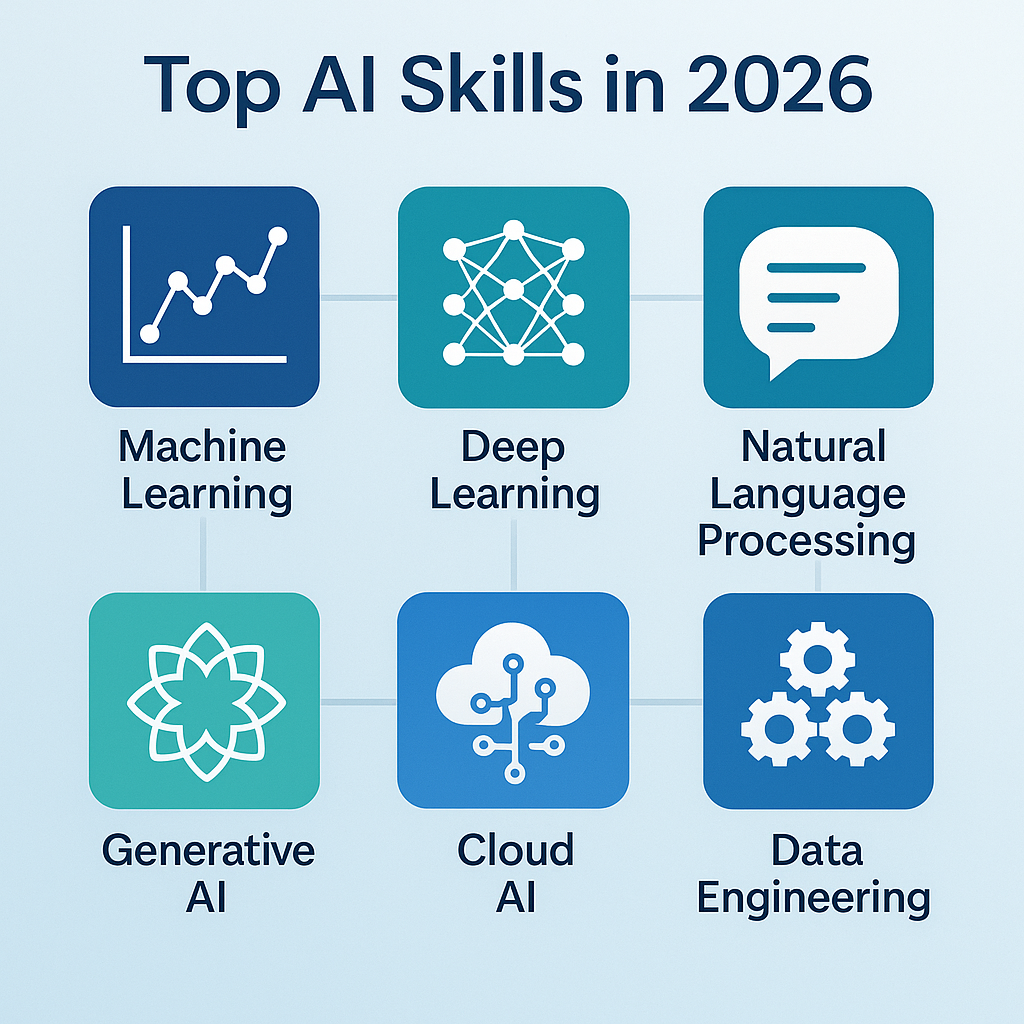
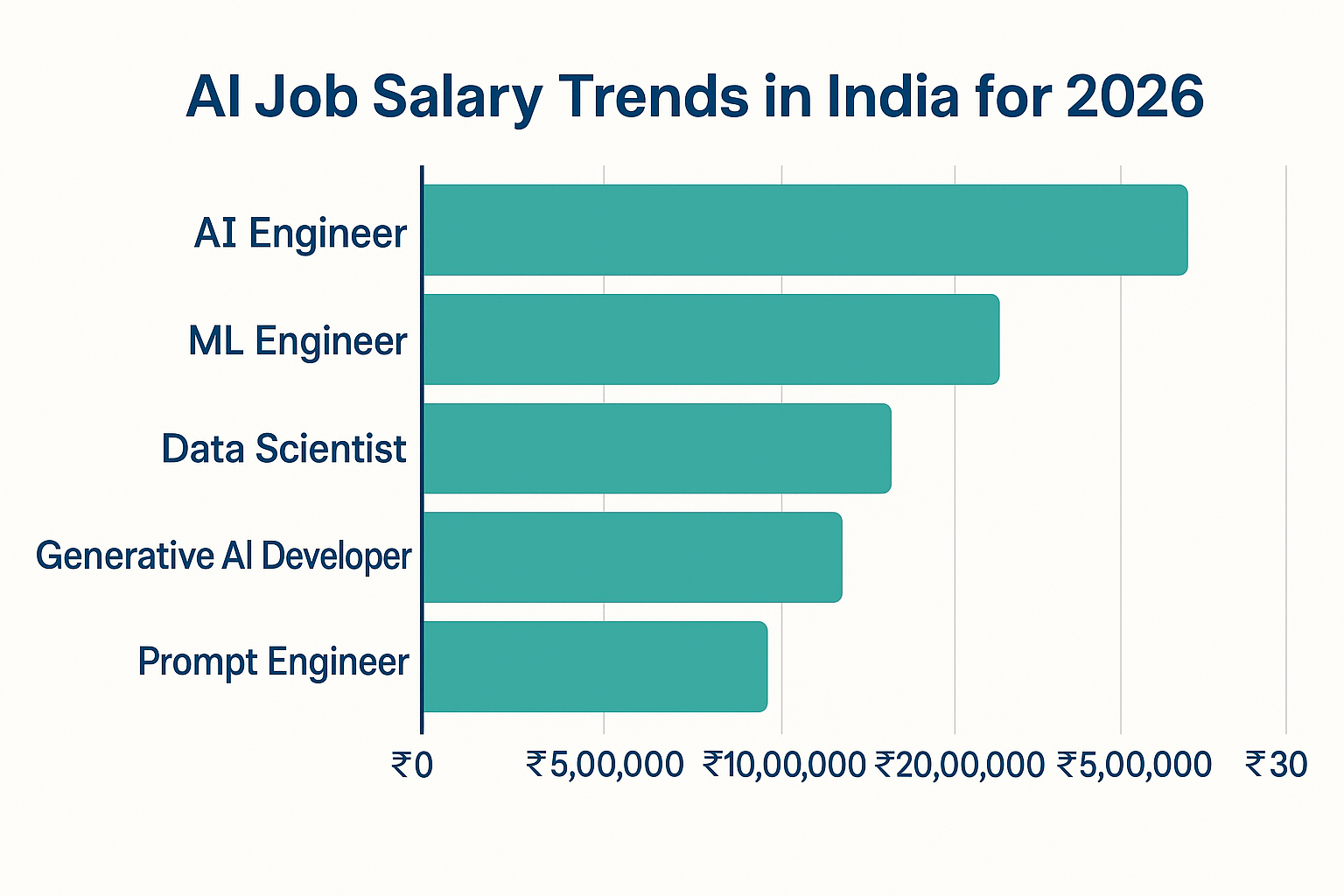
High-paying jobs (₹10L–₹60L CTC)
AI engineers are among the highest-paid professionals.
Remote & work-from-home opportunities
Global companies hire Indian AI talent remotely.
Freelancing opportunities
AI skills such as prompt engineering and model fine-tuning generate excellent part-time income.
International job migration
Countries like Canada, UK, Germany, and Australia prefer AI-skilled professionals.
Startup opportunities
AI is creating thousands of new business ideas.
This is why mastering the Top AI Skills in 2026 can completely transform your career.
The 12 Most Important AI Skills You Must Learn
Below are the top skills included in the core definition of Top AI Skills in 2026.
1. Machine Learning
Machine Learning is the backbone of AI. It includes supervised learning, unsupervised learning, algorithms like decision trees, SVM, and random forests. ML engineers are in massive demand and this forms the base of the Top AI Skills in 2026.
2.Deep Learning
Deep learning powers neural networks, LSTMs, CNNs, GANs, and Transformers. It is required for building advanced models, self-driving mechanisms, speech recognition, and generative AI.
3. Natural Language Processing (NLP)
NLP allows machines to understand human language. Every chatbot, AI assistant, translation system, and content generation tool relies on NLP.
4. Generative AI
This is the hottest skill in India. Generative AI skills include:
Fine-tuning models
Text generation
Image generation
Voice synthesis
Video generation
It is one of the strongest components of the Top AI Skills in 2026.
5. AI Prompt Engineering
Companies now hire Prompt Engineers with salaries up to ₹40 lakhs. This includes:
Writing prompts
Model instructions
System optimization
AI workflow creation
6. Data Engineering
AI needs clean, structured data. Data engineering includes:
ETL pipelines
Data modeling
Snowflake
BigQuery
Hadoop
Spark
7. Computer Vision
Used for:
Face recognition
Satellite image processing
Medical imaging
Smart surveillance
It is critical for the Top AI Skills in 2026 grouping.
8. MLOps & AI Deployment
Building an AI model is easy. Deploying, monitoring, scaling—and maintaining it—is challenging. MLOps is now demanded in most AI job descriptions.
9. Reinforcement Learning
Used for robotics, gaming, autonomous vehicles, manufacturing automation.
10. Edge AI
AI processed on devices like mobile phones, IoT devices, and embedded systems.
11. AI Ethics, Safety & Governance
Companies want responsible AI. Professionals who understand this domain stand out.
12. Cloud AI Tools
Every company uses:
AWS AI
Google Cloud AI
Azure AI
HuggingFace
OpenAI APIs
These tools dominate hiring trends related to Top AI Skills in 2026.
Learning Roadmap for Indian Students
If you want to master the Top AI Skills in 2026, follow this roadmap:
Step 1: Learn Python
Essential libraries: NumPy, Pandas, Matplotlib.
Step 2: Master Machine Learning
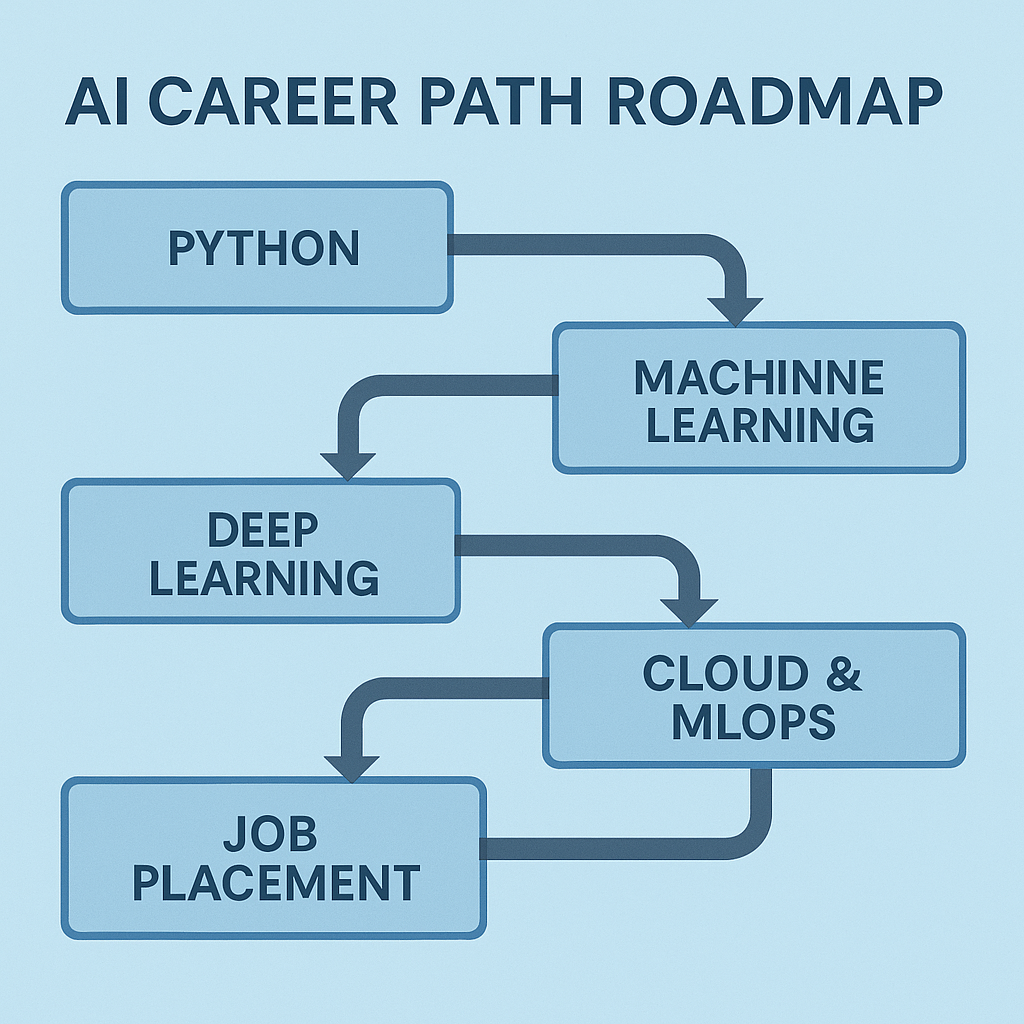
Start with ML fundamentals and implement models.
Step 3: Move into Deep Learning
Learn CNNs, RNNs, Transformers, and modern architectures.
Step 4: Start with NLP & Generative AI
Work with LLMs, embeddings, tokenizers, and prompt engineering.
Step 5: Build Real Projects
Nothing increases your job chances more.
Step 6: Learn Cloud Deployment
Use AWS, Azure, or GCP to deploy AI models.
Step 7: Build a Portfolio
GitHub, Kaggle, LinkedIn.
Step 8: Apply for Internships
Cambridge Infotech can help with guidance, mentoring, and training.
Best Courses & Certifications
To master the Top AI Skills in 2026, students must pursue globally recognized certifications that prove industry readiness. Below is the expanded list with descriptions, internal links, and external links.
1. Google Professional Machine Learning Engineer
Why it’s valuable:
Google’s ML Engineer certification validates your ability to design, build, and deploy ML models using Google Cloud. It is one of the highest-demand certifications for AI jobs worldwide.
Skills you learn:
Machine learning pipeline design
Data engineering
MLOps
TensorFlow & cloud-based ML workflows
2. AWS Certified Machine Learning – Specialty
Why it matters:
AWS is used by 60%+ of AI-driven companies. This certification helps you prove your expertise in ML deployment, automation, and cloud scaling — critical Top AI Skills in 2026.
Skills you learn:
Building ML models
AWS Sagemaker
Model optimization
Automation tools
3. Microsoft Azure AI Engineer Associate
Why students choose it:
Azure is widely used in Indian enterprises (TCS, Infosys, Wipro). This certification focuses on AI solutions, computer vision, NLP, and cloud deployment.
Skills you learn:
Cognitive Services
Text & speech recognition
AI model deployment on Azure
API-driven AI integration
4. Coursera – AI Specialization
Why it’s famous:
Created by Andrew Ng, the global leader in AI. This specialization is the foundation for ML, DL, AI math, and advanced neural networks — perfect for beginners.
Skills you learn:
Linear regression
Deep learning
Optimizers
Neural networks
5. Stanford CS229 – Machine Learning
Why it’s legendary:
Stanford’s CS229 course is considered the world’s most complete university-level course for ML. Even top AI researchers studied it.
Skills you learn:
ML mathematics
Optimisation
Model selection
Real-world ML research
6. DeepLearning.AI Certifications
Why choose it:
DeepLearning.AI provides job-ready courses in LLMs, GenAI, Prompt Engineering, NLP, Transformers, and AI deployment.
Skills you learn:
Generative AI
LangChain
ChatGPT development
LLM fine-tuning
AI integration workflows
7. IIT Madras / IISc Bangalore AI Courses
Why they are popular:
India’s top institutions offer certified online and offline courses in AI, ML, and data science — highly valuable for resumes.
Skills you learn:
Core ML
Deep Learning
Robotics
Mathematics for AI
Research foundations
8. Cambridge Infotech Internal AI Courses
Why add this:
You can use this as an internal backlink to boost SEO.
This link should point to your AI course landing page.
What your institute can offer:
Python for AI
Machine Learning
Deep Learning
Data Science
Generative AI
Cloud AI
Interview preparation
Placement support
How Cambridge Infotech Helps Students
Cambridge Infotech plays a crucial role in preparing students for real-world AI careers. Instead of just teaching theory, the institute focuses on practical, hands-on, and industry-ready training aligned with the Top AI Skills in 2026. With experienced trainers, modern labs, real projects, and dedicated placement mentoring, students gain the confidence and skillset required to enter the fast-growing AI and IT job market.
Below is the fully expanded version along with internal link placements you can include on your website.
Industry-Oriented Training Programs
Cambridge Infotech offers modern, job-focused training programs that cover the complete AI ecosystem — from basics to advanced specializations.
These programs include:
Fundamentals of AI & Python
Data preprocessing and feature engineering
Machine Learning algorithms
Deep Learning using TensorFlow & PyTorch
NLP & Generative AI
Cloud AI tools (AWS, Azure, GCP)
This comprehensive curriculum ensures students learn the exact skills companies expect in 2026 and beyond.
Machine Learning & AI Specializations
Students can enroll in specialized ML/AI courses designed to match the Top AI Skills in 2026 requirements.
Here, students learn:
Supervised & unsupervised learning
Neural networks
Transformers
Model deployment
Real-world ML pipelines
Python Programming for AI
Python is the foundation of AI. Cambridge Infotech provides complete Python training with hands-on coding sessions.
Students practice with:
NumPy
Pandas
Matplotlib
Scikit-Learn
API development
Data processing workflows
This ensures they gain strong programming foundations needed for AI projects.
Cloud Computing for AI Students
AI systems today run on cloud platforms. Cambridge Infotech teaches students how to build, deploy, and maintain AI apps on cloud services.
Coverage includes:
AWS AI tools
Azure Cognitive Services
Google Cloud AI Platform
Serverless ML deployment
Generative AI & Prompt Engineering
The institute offers special training on Generative AI — one of the fastest-growing tech fields.
Students learn:
LLMs (Large Language Models)
Prompt engineering
Model fine-tuning
Chatbot creation
AI workflow automation
Data Analytics With Real Business Insights
AI without data is impossible. That’s why Cambridge Infotech provides complete data analytics training.
Training includes:
Power BI
Excel
SQL
Basic ML
Dashboard creation
Cybersecurity Training for AI Students
AI professionals must understand cybersecurity. Cambridge Infotech provides essential security skills for safe AI deployment.
Students learn:
Network security
Ethical hacking basics
AI threat detection
Secure coding practices
Real-Time Hands-On Projects
Students build industry-level AI and ML projects, showcasing real problem-solving ability.
Example projects:
Chatbots
Face recognition
Sales forecasting
Resume screening AI
NLP sentiment analysis
Recommendation systems
These projects help students build a strong portfolio for job interviews.
Mentorship From Industry Experts
Students get direct guidance from working professionals in the IT and AI field.
Mentors help with:
Portfolio creation
Resume building
Interview preparation
Career path recommendations
Placement Support & Career Assistance
Cambridge Infotech provides full placement support to help students enter the job market confidently.
Placement support includes:
Resume optimization
Mock interviews
HR screening
Referral support
Internship opportunities
This ensures students completing the Top AI Skills in 2026 training are job-ready.
Salary Trends in 2026
Mastering the Top AI Skills in 2026 offers incredible earning potential:
AI Projects That Will Make You Job-Ready
To demonstrate the Top AI Skills in 2026, build:
AI chatbot
Face recognition system
E-commerce recommendation engine
Stock prediction model
Sentiment analysis tool
AI automated resume screener
Image classification
Video analytics
Tools & Technologies
Essential tools for mastering the Top AI Skills in 2026:
How Beginners Can Start Without Coding
Many students believe that AI requires advanced coding from day one — but that’s not true. In 2026, several no-code and low-code tools allow beginners to start their AI journey even without programming knowledge. These platforms help you understand AI concepts, build simple models, experiment with data, and create basic automation. This is a perfect entry point before learning Python and machine learning in-depth.
Below is the expanded explanation of each tool:
ChatGPT (Beginner-Friendly AI Learning & Practice)
ChatGPT is one of the most powerful tools to begin your AI learning journey. Even without coding skills, beginners can:
Ask AI-related questions
Understand ML concepts
Practice prompt engineering
Generate datasets
Create simple AI workflows
Build chat-based automation
It teaches you how AI models work, how they understand prompts, and how they generate responses — an essential part of the Top AI Skills in 2026.
Google Gemini (Multimodal AI for Learning & Projects)
Google Gemini allows beginners to explore AI through text, image, and even video interactions. Without writing code, students can:
Create summaries
Analyze images
Draft study materials
Generate notes
Work on school/college projects using AI
Explore multimodal capabilities
It’s a great tool if you want to understand how large language models process multiple types of data.
Perplexity AI (AI Search Engine for Learning Faster)
Perplexity AI works like ChatGPT, but it focuses on research and verified information. This helps beginners:
Learn AI topics quickly
Get accurate references
Study AI trends
Explore how algorithms and models work
Read simplified answers to complex topics
It’s one of the best tools to understand AI theory, real-world applications, and learning pathways.
No-Code Machine Learning Tools (Build Models Without Coding)
No-code ML tools let you create AI models visually using drag-and-drop interfaces. Examples include:
Teachable Machine
Lobe AI
Make.com
Bubble.io integrations
With these tools, beginners can:
Train ML models using images or sound
Create simple classifiers
Build prototypes
Understand ML workflows
Deploy mini AI apps
This gives you hands-on experience without needing Python or algorithms initially.
AutoML Platforms (AI That Builds Models For You)
AutoML tools are designed for non-programmers. They automatically:
Train ML models
Select algorithms
Optimize performance
Handle data preprocessing
Generate reports
Popular AutoML tools include:
Google AutoML
AWS AutoML
DataRobot
Azure AutoML
Beginners can upload datasets and watch the tool generate an ML model automatically — a great way to understand how machine learning behaves with different data types.
Why You Should Still Learn Coding Later
Although no-code tools are a great starting point, coding becomes essential when you want to move from basic AI to professional-level AI development. To truly master the Top AI Skills in 2026, you must eventually learn:
Python
NumPy & Pandas
ML algorithms
Neural networks
Deep learning frameworks
Model deployment
Coding unlocks high-paying roles like AI Engineer, ML Engineer, NLP Engineer, and Data Scientist.
Conclusion: Preparing for the Future of AI
AI is the future, and mastering the Top AI Skills in 2026 will ensure that you stay relevant, competitive, and employable in a world transformed by automation and innovation. Indian students who start today will have a massive advantage in the global tech ecosystem.
Cambridge Infotech can guide you with:
Practical training
Real projects
Placement support
Industry courses
Your AI career starts now.
FAQ
1. What are the Top AI Skills in 2026 for beginners?
Beginners can start with Python basics, Machine Learning fundamentals, Generative AI, Prompt Engineering, and simple no-code AI tools. These form the foundation of the Top AI Skills in 2026 and require no advanced math or coding at the start.
2. Can I learn the Top AI Skills in 2026 without a technical background?
Yes. Anyone from arts, commerce, or non-IT backgrounds can learn AI using beginner-friendly tools like ChatGPT, Gemini, and AutoML platforms. With consistent practice, you can progress to coding and advanced skills.
3. How long does it take to master the Top AI Skills in 2026?
Most students take 4–8 months to learn essential AI skills, depending on their background and practice levels. Advanced skills like deep learning or MLOps may require 6–12 months of structured learning and hands-on projects.
4. What jobs can I get after learning the Top AI Skills in 2026?
You can apply for roles such as AI Engineer, ML Engineer, Data Analyst, NLP Engineer, Prompt Engineer, Generative AI Developer, Cloud AI Specialist, and MLOps Engineer. These jobs are among the highest-paying in the tech industry.
5. Do I need to know coding to learn the Top AI Skills in 2026?
Not initially. You can start with no-code AI tools and gradually move into Python programming. However, for long-term growth in AI careers, learning Python and ML algorithms becomes essential.