

Currently Empty: ₹0.00

C vs C++ 2026: A Complete Guide to Choosing the Right Programming Language for Your Career
In 2026, C and C++ continue to power the backbone of modern technology. From operating systems and embedded devices to game engines and high-performance applications, these two languages remain indispensable. While many new languages have emerged, C and C++ are still unmatched when performance, control, and system-level programming matter most.
If you’re planning your programming journey and confused about C vs C++, this updated guide will help you choose the right language based on today’s industry needs, career trends, and learning paths.
What is C?
C is a procedural programming language developed by Dennis Ritchie in 1972. It is known for:
Low-level memory access

High performance
Hardware-level control
Simplicity and portability

Even in 2026, C is widely used in:
Operating systems (Linux kernel, embedded OS)
Embedded systems & IoT
Firmware and device drivers
Real-time systems
Microcontroller programming
C teaches you how computers really work. It is the foundation language for serious system programmers. Learn more about the history of C from GeeksforGeeks.
What is C++?
C++ is a multi-paradigm language that supports:
Procedural programming
Object-Oriented Programming (OOP)
Generic programming
Modern paradigms like functional features
Developed by Bjarne Stroustrup, C++ extends C with powerful abstractions. Modern C++ (C++20 / C++23 standards) makes it safer, faster, and more expressive than ever.
In 2026, C++ is heavily used in:
Game development (Unreal Engine, AAA titles)
AI and ML frameworks
High-frequency trading systems
Robotics & simulations
Browsers (Chrome, Firefox engines)
Desktop applications and real-time software
For a deeper dive into C++, check out this C++ tutorial by W3Schools.
C vs C++: Key Differences 2026
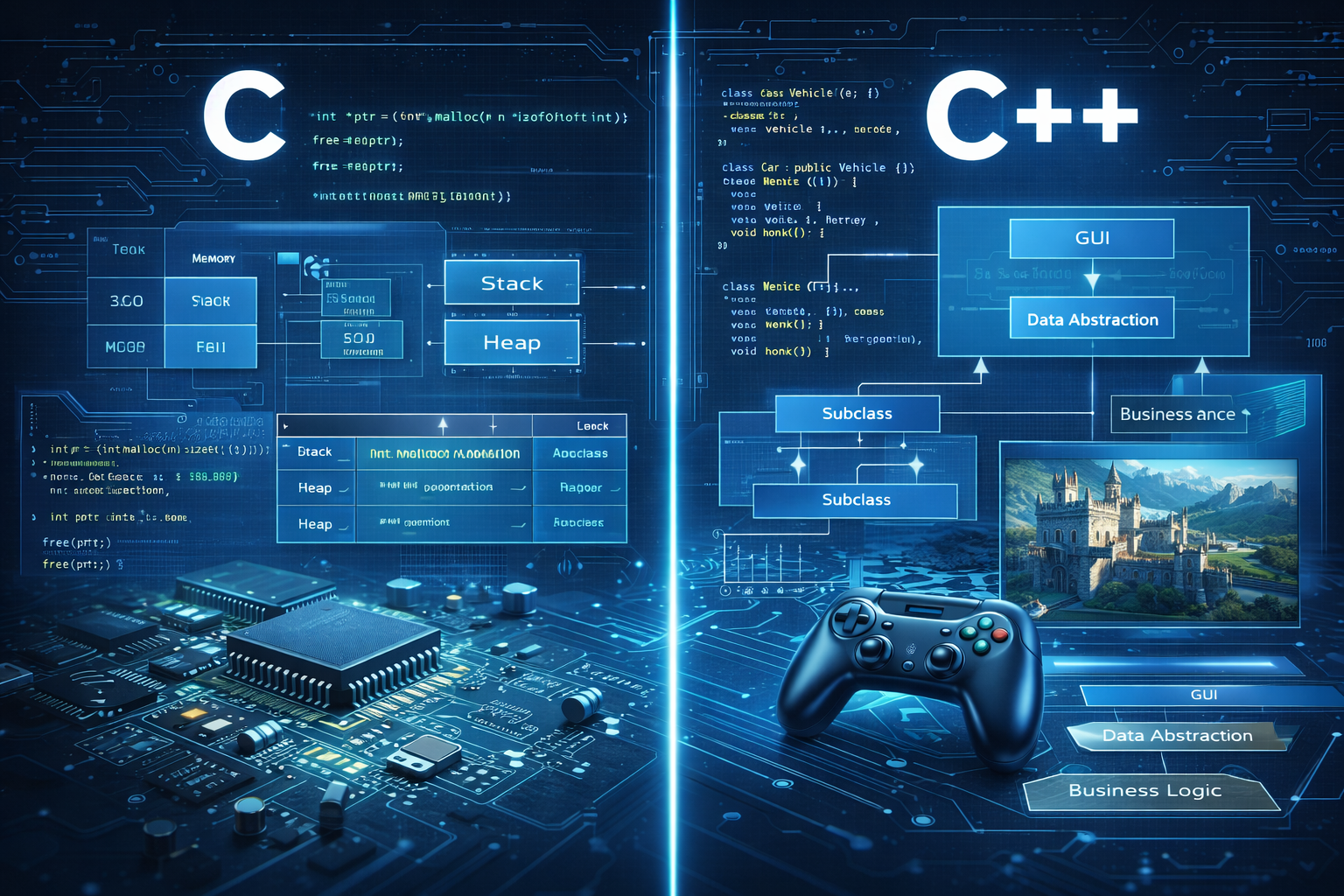
| Feature | C | C++ |
|---|---|---|
| Programming Style | Procedural | Multi-paradigm (OOP, procedural, generic) |
| Complexity | Simple and lightweight | More powerful but complex |
| Memory Management | Manual (malloc/free) | Manual + RAII, smart pointers |
| Abstraction | Very low-level | High-level abstractions |
| Standard Library | Limited | Very rich (STL, algorithms, containers) |
| Security | More error-prone | Safer when using modern C++ practices |
| Performance | Extremely fast | Matches C when optimized |
| Scalability | Harder for large systems | Ideal for large-scale projects |
| Industry Usage | Embedded, OS, IoT | Games, AI, finance, software engineering |
When Should You Choose C?
Choose C if you want:
A strong foundation in low-level programming
To work in embedded systems, IoT, firmware, or OS development
Maximum hardware control
Minimal abstraction
To understand memory, pointers, and system architecture deeply
C is perfect for students who want to master the core of computing.
When Should You Choose C++?
Choose C++ if you want:
To build large, scalable, and high-performance applications
A career in game development, robotics, AI systems, fintech
Object-oriented design skills
Access to the STL and modern libraries
Professional-grade software engineering capabilities
C++ dominates performance-critical software in 2026.
You want to leverage the Standard Template Library (STL) for efficient data structures and algorithms. Learn more about the STL from cppreference.com.
Performance: C vs C++ in 2026
Both languages remain blazing fast:
C is slightly faster in minimal system-level tasks.
C++ matches or exceeds C when using:
Move semantics
Inline functions
Efficient STL containers
Smart memory handling
With modern compilers, performance differences are negligible in real-world projects. Check out this Stack Overflow discussion.
Learning Curve Comparison
| Aspect | C | C++ |
|---|---|---|
| Difficulty | Easy to start | Steeper learning curve |
| Concepts | Functions, pointers, memory | OOP, templates, STL, memory models |
| Best for Beginners | Yes | Better after C basics |
Recommended Path in 2026:
Start with C → Move to C++ → Specialize in modern software engineering.
Career Opportunities in 2026
Careers with C
Embedded Systems Engineer
Firmware Developer
IoT Engineer
OS Developer
Robotics Controller Programmer
Careers with C++
Game Developer
AI Systems Engineer
Quantitative Developer
Software Architect
Robotics Simulation Engineer
High-Performance Computing Engineer
Both languages offer high-paying, future-proof careers.
Advantages of C vs C++
Advantages of C
- Efficiency: C is fast and lightweight, making it ideal for low-level programming.
- Portability: C code can run on almost any platform with minimal changes.
- Simplicity: Its syntax is straightforward, making it easier to learn and debug.

Advantages of C++:
- OOP Features: Encapsulation, inheritance, and polymorphism make code more organized and reusable.
- Rich Library Support: The STL provides pre-built functions and data structures.
- Scalability: C++ is better suited for large, complex projects.
Disadvantages of C and C++
Disadvantages of C:
- Lack of OOP: C does not support object-oriented programming, which can make large projects harder to manage.
- Manual Memory Management: This can lead to memory leaks and segmentation faults if not handled properly. Learn more about memory management in C from TutorialsPoint.
- Limited Standard Library: C lacks the extensive libraries found in modern languages.
Disadvantages of C++:
- Complexity: The added features of C++ make it harder to learn and master.
- Slower Compilation: C++ programs can take longer to compile compared to C.
- Memory Management: Like C, C++ requires manual memory management, which can be error-prone.
C vs C++: Performance Comparison
Both C and C++ are known for their high performance, but there are subtle differences:
- C is slightly faster in some cases because it lacks the overhead of OOP features.
- C++ can match C’s performance when used correctly, especially with features like inline functions and efficient use of the STL. For a detailed performance comparison,
Learning Curve: Which is Easier?
- C is easier to learn for beginners due to its simplicity and smaller feature set.
- C++ has a steeper learning curve because of its advanced features like OOP, templates, and exception handling.
However, learning C first can provide a solid foundation for understanding C++. If you’re looking for beginner-friendly resources, try this C programming tutorial by Programiz.
Career OpportunitiesC vs C++
Both languages offer excellent career opportunities, but the choice depends on your interests:
- C is highly valued in industries like embedded systems, operating systems, and IoT.
- C++ is in demand for roles in game development, software engineering, and application development. Explore job opportunities for C++ developers on Indeed.
Which Should You Learn First: C or C++?
If you’re a beginner, starting with C is often recommended. It helps you understand the basics of programming, memory management, and how computers work at a low level. Once you’re comfortable with C, transitioning to C++ will be easier, and you’ll appreciate the added features it offers. For a step-by-step guide, check out this C++ for C programmers tutorial.
Conclusion: C vs C++ – Which is Better?
The answer to “C vs C++” depends on your goals:
- Choose C if you want to work on system-level programming or prefer a simpler language.
- Choose C++ if you need the power of object-oriented programming for large-scale applications.
Both languages have their strengths and are highly relevant in today’s tech industry. At Cambridge Infotech, we offer comprehensive courses in both C and C++ to help you master these languages and advance your programming career.
FAQs
About C vs C++
1.Is C++ harder than C?
Yes, C++ is generally considered more challenging than C. While C focuses on procedural programming and core concepts, C++ introduces advanced features such as object-oriented programming (OOP), templates, STL, and memory management techniques like smart pointers. These powerful tools make C++ more versatile but also increase its learning complexity.
2.Can I learn C++ without learning C?
Yes, you can learn C++ directly without first learning C. Many modern courses teach C++ from scratch. However, having knowledge of C can give you a deeper understanding of memory management, pointers, and low-level programming, which makes learning C++ smoother and more intuitive.
3.Which language is faster: C or C++?
C can be slightly faster in minimal, low-level tasks because it has fewer abstractions. However, modern C++ is highly optimized and can match or even outperform C when written correctly. With features like inline functions, move semantics, and efficient STL usage, C++ delivers performance that is virtually equal to C in real-world applications.
4.What are the real-world applications of C vs C++?
C is widely used in:
Operating systems (Linux kernel, embedded OS)
Embedded systems and IoT devices
Firmware development
Device drivers
Real-time systems
C++ is widely used in:
Game development (Unreal Engine, AAA games)
GUI and desktop applications
Web browsers and rendering engines
AI and machine learning infrastructure
High-performance financial systems
Robotics and simulation software
Start Your Programming Journey with Cambridge Infotech
Whether you’re a beginner or an experienced programmer, Cambridge Infotech offers tailored courses in C vs C++ to help you achieve your goals. Our expert instructors and hands-on projects ensure you gain the skills needed to excel in the tech industry.
Learn more about
Cambridge InfoTech offers comprehensive Azure training designed to equip professionals with the skills needed to excel in cloud computing. Their courses cover a wide range of Azure services, including virtual machines, storage solutions, and AI integration, tailored for both beginners and advanced users. With hands-on labs and expert instructors, learners gain practical experience to deploy, manage, and optimize Azure solutions effectively. Whether you’re looking to earn Azure certifications or enhance your cloud expertise, Cambridge InfoTech provides the resources and guidance to help you succeed in the rapidly evolving tech landscape.
Cambridge InfoTech explores the latest trends in Artificial Intelligence (AI), highlighting advancements in machine learning, natural language processing, and AI-driven automation. Their insights delve into how AI is transforming industries like healthcare, finance, and retail, enabling smarter decision-making and operational efficiency. The article also discusses the growing importance of ethical AI and the need for robust frameworks to ensure transparency and fairness. By staying updated on these trends, Cambridge InfoTech empowers businesses and professionals to leverage AI technologies effectively, driving innovation and competitive advantage in an increasingly AI-driven world.
Cambridge InfoTech offers Certified Ethical Hacking (CEH) training, designed to equip professionals with the skills to identify and address cybersecurity vulnerabilities. This comprehensive program covers key areas such as penetration testing, network security, and threat analysis, providing hands-on experience in ethical hacking techniques. With expert instructors and real-world scenarios, learners gain the knowledge to protect systems from malicious attacks and ensure robust security frameworks. Ideal for IT professionals aiming to enhance their cybersecurity expertise, Cambridge InfoTech’s CEH training prepares individuals to tackle modern cyber threats and advance their careers in this critical field.
CATEGORIES
Programming Languages
Database
App Development
Web Development
Full Stack Developer
Project Management
Data Science & Analytics
Cloud Computing
Cybersecurity Program
Operating Systems
Devops and Automation
Artificial Intelligence
Software Testing & QA
Six Sigma Leadership Program
Graphic Design
Microsoft Office
Tally Accounting
SAP Course
CompTIA
Spoken English Course