
How to Become a Data Analyst in India in 2026 — Complete Guide

How to Become a Data Analyst in India in 2026 — Complete Beginner’s Guide
Data analyst is one of the most searched job titles in India in 2026 — and for good reason.
Every company in every industry is sitting on more data than it knows what to do with. The professionals who can make sense of that data, turn it into insights, and communicate those insights to decision-makers are among the most consistently in-demand people in the Indian job market right now.
But if you search “how to become a data analyst in India”, you get a flood of contradictory advice. Some guides tell you to learn Python and machine learning for 2 years. Others say you only need Excel. Some push expensive bootcamps. Others say certifications are useless.
This guide cuts through all of it. It is written specifically for the Indian job market in 2026 — based on what employers in Bangalore, Mumbai, and Hyderabad are actually hiring for, what salaries are actually being paid, and the fastest realistic path from where you are now to your first data analyst job.
What does a data analyst actually do?
Before planning your path to becoming a data analyst in India, it helps to understand what the job actually involves day to day — because there is a significant gap between the theoretical description and the reality.
A data analyst in India in 2026 typically spends their time doing some combination of:
Collecting and cleaning data — pulling data from databases, spreadsheets, CRM systems, or APIs, and transforming messy raw data into a usable format. In practice, this takes up 40–60% of a data analyst’s time. Tools used: SQL, Excel, Power Query, Python (Pandas).
Analysing data — running calculations, building pivot tables, creating summary statistics, identifying trends and anomalies, and answering specific business questions. Tools used: Excel, Python, SQL, Power BI, Tableau.
Visualising and reporting — turning analysis into charts, dashboards, and reports that non-technical stakeholders can understand and act on. Tools used: Power BI, Tableau, Excel dashboards, Google Data Studio.
Communicating insights — presenting findings to managers, teams, or leadership. Writing clear summaries. Making recommendations. This is the part most aspiring data analysts underestimate — being able to explain what the data means in plain language is as important as the technical analysis itself.
Answering ad-hoc questions — “Why did sales drop in Q3?”, “Which customer segment has the highest churn rate?”, “How are we performing against last month?” — data analysts are expected to respond to these questions quickly and accurately.
Data analyst vs data scientist — what is the difference?
This is the most common point of confusion for people trying to become a data analyst in India. The two roles are related but meaningfully different.
| Data Analyst | Data Scientist | |
|---|---|---|
| Primary focus | Answering business questions with existing data | Building predictive models and algorithms |
| Main tools | Excel, SQL, Power BI, Python basics | Python (advanced), machine learning, TensorFlow |
| Maths required | Basic statistics | Statistics + linear algebra + calculus |
| Programming depth | Light to moderate Python / SQL | Advanced Python + ML libraries |
| Time to job-ready | 3–6 months | 8–18 months |
| Fresher salary Bangalore | ₹4–8 LPA | ₹6–12 LPA |
| Job openings in India | Very high | High |
For most people asking how to become a data analyst in India, the data analyst path is the right starting point. It is faster, more accessible, and has a larger job market than data science — especially for freshers and career switchers.
You can always transition from data analyst to data scientist once you have industry experience and decide to specialise further.
Data analyst salary in India 2026 — what to realistically expect
One of the first questions anyone researching how to become a data analyst in India asks is: what will I earn?
Here is the honest picture based on current data from LinkedIn India Salary, Naukri.com, and Glassdoor India:
Fresher data analyst (0–1 years, Bangalore):
- With basic skills (Excel, basic SQL): ₹3–5 LPA
- With intermediate skills (SQL, Python basics, Power BI): ₹4–7 LPA
- With strong project portfolio + certification: ₹5–9 LPA
Junior data analyst (1–3 years):
- ₹7–14 LPA depending on company, sector, and skill depth
Senior data analyst (3–6 years):
- ₹12–22 LPA
Lead / Manager (6+ years):
- ₹20–35 LPA
Which sectors pay data analysts the most in India:
- BFSI (Banking, Financial Services, Insurance) — highest average salaries
- E-commerce and technology companies — high salaries + equity
- Consulting firms — structured career paths
- Healthcare and pharma — growing demand, competitive packages
- FMCG and retail — widespread demand, slightly lower than tech sector
The fastest path to higher fresher salaries is combining SQL + Python + Power BI with a strong project portfolio — that combination puts you in the ₹6–9 LPA range even as a fresher.
The data analyst skill stack for India in 2026 — what you actually need
The tools and skills required to become a data analyst in India have evolved significantly. Here is the honest 2026 picture — not what was true in 2020.
Tier 1 — Essential (non-negotiable for any data analyst role)
Excel (advanced): Despite the rise of Python and Power BI, Excel remains the most universally required skill across all data analyst roles in India. You need to be comfortable with XLOOKUP, pivot tables, dynamic arrays, Power Query, and dashboard design. In 2026, you also need to know how to use Microsoft Copilot in Excel — it is already being referenced in job descriptions at large Indian corporates.
SQL: SQL is the language of data. Whether your company stores data in MySQL, PostgreSQL, Microsoft SQL Server, or a cloud data warehouse, you will write SQL queries every single day as a data analyst. Focus on: SELECT statements, JOINs, GROUP BY, subqueries, window functions, and CTEs (Common Table Expressions). According to Stack Overflow’s 2025 Developer Survey, SQL is the most widely used data tool by professionals globally.
Power BI: Power BI is the dominant business intelligence tool in Indian enterprises. Almost every MNC, bank, FMCG, and large IT company in India uses Power BI for dashboard reporting. Learning Power BI Desktop — building data models, writing DAX measures, and creating interactive dashboards — is one of the highest-ROI skills for aspiring data analysts in India.
Tier 2 — Strong differentiator (significantly improves salary and job options)
Python (data analysis level): You do not need to learn Python like a software developer. As a data analyst, you need Python for: data cleaning with Pandas, data visualisation with Matplotlib and Seaborn, statistical analysis with NumPy and SciPy, and basic automation of repetitive tasks. Python.org’s official tutorial covers the foundations, and the Pandas documentation covers data analysis specifically.
Statistics fundamentals: Mean, median, mode, standard deviation, correlation, regression, hypothesis testing, and probability. You do not need a statistics degree — but you need to understand these concepts well enough to apply them correctly and explain your findings to stakeholders. Khan Academy’s statistics course covers everything you need for free.
Data visualisation principles: Knowing which chart type to use for which data, how to design dashboards that are readable rather than cluttered, and how to tell a clear story with data is a skill most data analysts underestimate. The book Storytelling with Data by Cole Nussbaumer Knaflic is the best resource on this topic.
Tier 3 — Valuable additions (for roles at tech companies and startups)
Tableau: While Power BI dominates Indian enterprises, Tableau is widely used at global tech companies with India offices. If you are targeting MNC product companies or consulting firms, Tableau knowledge adds significant value.
Google Analytics 4 (GA4): For data analyst roles in e-commerce, digital marketing, and product companies, GA4 proficiency is frequently required. Google’s own Skillshop offers free GA4 certification.
AI-powered analytics tools: In 2026, data analysts at leading companies are using AI tools to accelerate their work. Microsoft Copilot for data analysis, ChatGPT for writing SQL queries and Python code, and AI-powered BI tools are all becoming part of the standard data analyst workflow.
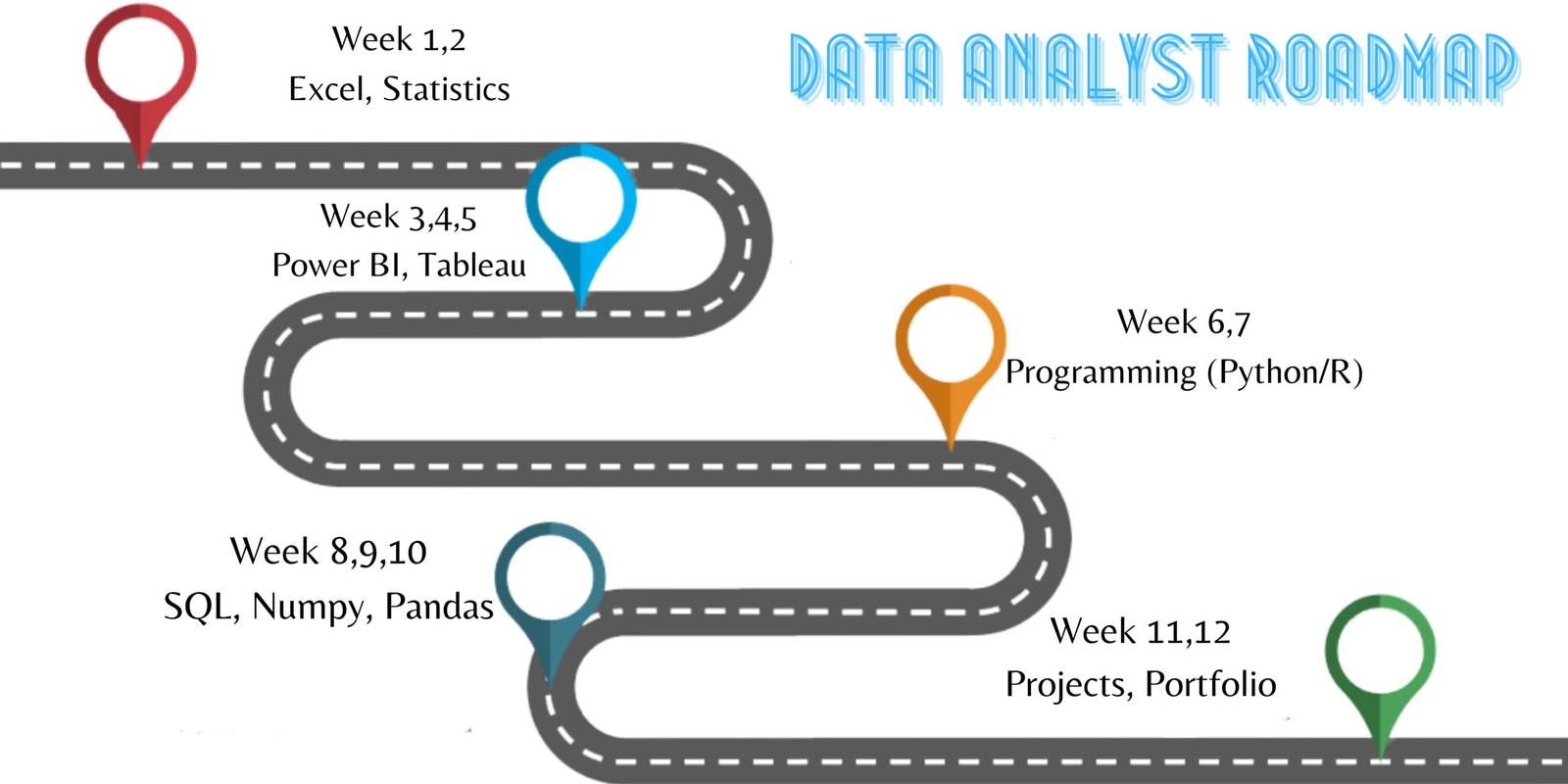
Step-by-step roadmap — how to become a data analyst in India in 2026
Here is the most direct path from wherever you are starting to your first data analyst job in India.
Phase 1 — Build foundations (Months 1–2)
Month 1: Excel + SQL
Start with Excel. Even if you already know basic Excel, spend 2 weeks upgrading to advanced Excel — XLOOKUP, Power Query, pivot tables with slicers, and basic dashboard design. Then spend 2 weeks on SQL fundamentals: SELECT, WHERE, GROUP BY, ORDER BY, and basic JOINs.
Free resources:
- Microsoft Learn Excel training — free, official, structured
- SQLZoo — the best interactive SQL practice site, completely free
- Mode Analytics SQL Tutorial — real-world SQL scenarios
Month 2: Python basics + statistics
Learn Python at the data analysis level. Focus exclusively on Pandas and Matplotlib — you do not need web development, algorithms, or object-oriented programming. Simultaneously, work through basic statistics: mean, median, standard deviation, correlation, and what each measure tells you about your data.
Free resources:
- Kaggle’s free Python course — specifically designed for data work, takes 5 hours
- Kaggle’s Pandas course — the fastest practical Pandas tutorial available free
- Khan Academy Statistics — free, clear explanations
Phase 2 — Build tools proficiency (Months 2–3)
Power BI: Work through Microsoft’s free Power BI learning path. Focus on: connecting to data sources, building data models, writing basic DAX measures, and creating interactive dashboards with filters and drill-through.
Practice by building a dashboard using a free dataset — the Indian Census data or the SEBI market data from data.gov.in are excellent Indian datasets that make your portfolio feel locally relevant.
Advanced SQL: Move beyond basics to: multi-table JOINs, subqueries, window functions (RANK, ROW_NUMBER, LAG, LEAD), and CTEs. LeetCode’s database section is the best practice resource — many Indian companies use LeetCode-style SQL questions in data analyst interviews.
Phase 3 — Build your portfolio (Months 3–4)
This is the phase most people skip, and it is the reason most people struggle to get interviews despite having the skills. To become a data analyst in India and actually land a job, you need proof of what you can do.
Project 1: Sales analysis dashboard
Download a retail sales dataset (search Kaggle datasets for “India sales data”). Use Excel or Power BI to build a complete dashboard showing: monthly revenue trend, top products by category, regional performance, and year-over-year comparison. Write a 200-word summary of your top 3 findings as if presenting to a business manager.
Project 2: SQL data investigation
Choose a publicly available database (the IMDB dataset or a sports dataset from Kaggle work well). Write 10–15 SQL queries answering progressively complex business questions. Document each query with: the question you were answering, the SQL you wrote, and what the answer revealed.
Project 3: Python EDA (Exploratory Data Analysis)
Take a messy Indian dataset — Zomato restaurant data, Indian startup funding data, or a real dataset from data.gov.in — and perform a full exploratory analysis using Python (Pandas + Matplotlib). Find 5 interesting patterns, visualize them clearly, and write interpretations of what each finding means.
Where to publish your portfolio:
- GitHub — for SQL scripts and Python notebooks
- Kaggle — for notebooks (Kaggle notebooks are publicly visible and respected by employers)
- Tableau Public — for dashboards (free, publicly viewable)
Phase 4 — Get certified (Month 4)
Certifications signal commitment and provide a standardized credential that HR teams can screen for. For data analysts in India, these certifications carry the most weight:
Microsoft PL-300 (Power BI Data Analyst Associate): The most respected data analyst certification for Indian corporates. Microsoft’s exam page covers all preparation materials. This certification alone increases interview callback rates significantly.
Google Data Analytics Certificate: Available on Coursera, this 6-month certificate is well-recognized, especially at companies using Google tools. Covers data cleaning, SQL, R basics, and Tableau.
IBM Data Analyst Professional Certificate: Also on Coursera, covers Python, SQL, Excel, and Power BI. More technical than the Google certificate.
A structured data analytics course from a certified training institute combines all of these components — tools training, projects, and certification preparation — in a single programme, which is faster and more efficient than piecing them together from free resources.
Phase 5 — Apply strategically (Month 4–5)
Where to find data analyst jobs in India:
- LinkedIn Jobs India — filter by “Entry Level” and post date (last 7 days)
- Naukri.com — the highest volume of data analyst postings for Indian companies
- Instahyre — particularly good for Bangalore startup roles
- AngelList / Wellfound — best for data analyst roles at funded Indian startups
Search terms that work:
- “data analyst fresher Bangalore”
- “junior data analyst SQL Power BI”
- “business analyst Excel SQL”
- “MIS analyst Bangalore”
- “reporting analyst Excel”
How to write a data analyst CV that gets shortlisted: Lead with your tools — put “Excel (Advanced), SQL, Python (Pandas), Power BI” prominently in the first section. Add your 3 portfolio projects with one-line descriptions and links to GitHub/Kaggle. Include any certifications. Keep the CV to 1 page for freshers, 2 pages maximum for experienced professionals.
Interview preparation for data analyst roles in India:
SQL is almost universally tested. Practice on LeetCode database problems (easy and medium level) and HackerRank SQL challenges. Be ready to:
- Write a query joining 3 tables and filtering by date range
- Explain what a window function does and give an example
- Write a subquery that finds the top N results per category
Excel is tested at many Indian companies through practical tasks — building a pivot table from raw data, using XLOOKUP to find values across sheets, writing a SUMIFS formula.
Case study questions are common at consulting firms and product companies — “How would you analyze a 20% drop in app registrations?” Practice structuring your answers using data: what data would you look at, what hypothesis would you test, how would you visualize the findings.
Top companies hiring data analysts in India in 2026
IT services companies (highest volume of openings):
- TCS — Business Intelligence and Analytics CoE
- Infosys — BPM analytics roles
- Wipro — data analytics services
- HCLTech — enterprise data and analytics
- Capgemini India — data and analytics practice
BFSI (highest salaries):
- HDFC Bank, ICICI Bank, Axis Bank — retail analytics, credit risk
- Bajaj Finserv — consumer finance analytics
- Paytm, PhonePe — payments data analytics
E-commerce and technology:
- Amazon India — business intelligence analyst roles
- Flipkart — supply chain and consumer analytics
- Swiggy, Zomato — operations and growth analytics
- Meesho — e-commerce analytics
FMCG and Retail:
- HUL (Hindustan Unilever) — sales and marketing analytics
- ITC — supply chain analytics
- Tata Consumer Products — market and consumer analytics
Consulting:
- Deloitte India — analytics advisory
- KPMG India — data analytics practice
- McKinsey & Company India — analytics roles for experienced professionals
- EY India — data and analytics service line
Do you need a degree to become a data analyst in India?
This is one of the most searched questions by people researching how to become a data analyst in India. The honest answer: a degree helps but is not a strict requirement — especially in 2026.
What actually matters to hiring managers:
- Portfolio projects — three well-documented projects demonstrating Excel, SQL, Python, and Power BI skills will get you more interviews than a degree with no practical work
- Certifications — Microsoft PL-300, Google Data Analytics Certificate, or an IBM Data Analyst Certificate signal structured learning to HR teams
- Communication skills — the ability to explain what your data shows in plain language. This is frequently what separates candidates at the interview stage
- Problem-solving in interviews — your ability to approach a business problem systematically using data
Companies like TCS, Infosys, and HCL formally require a degree for their structured campus hiring. Startups, consulting firms, and product companies are significantly more flexible — particularly for candidates with strong portfolios.
How long does it take to become a data analyst in India?
Realistically, from zero experience to first job:
- With structured training + 6 hours/day dedication: 4–5 months
- With structured training + 2–3 hours/day alongside work: 6–8 months
- Self-study only + no structure: 9–14 months (high variability)
The biggest variable is how structured your learning path is. People who follow a proven curriculum with instructor support, project feedback, and placement assistance consistently get placed faster than those who self-study from a mix of free resources.
FAQs — how to become a data analyst in India
1.Is data analyst a good career in India in 2026?
Yes — data analyst is consistently one of the top 10 most in-demand job roles in India. According to LinkedIn India’s Jobs on the Rise report, data-related roles have appeared every year in the top 15 fastest-growing jobs since 2021 and show no signs of slowing. The combination of widespread demand, accessible skill requirements, and strong salary growth makes it one of the best career choices for Indian graduates in 2026.
2.Which is better — data analyst or data scientist?
For most freshers, start as a data analyst. The path is faster, the job market is larger, and the salary is very competitive. Data scientist roles require stronger mathematics and programming skills — but the data analyst path is a natural stepping stone. Many successful data scientists started as data analysts and transitioned once they had 2–3 years of industry experience.
3.Can an arts or commerce graduate become a data analyst in India?
Absolutely. Arts and commerce graduates regularly become data analysts in India. The key skills — Excel, SQL, Power BI — are learnable by anyone. Programming (Python) has a steeper learning curve but is manageable with structured training. The domain knowledge that arts and commerce graduates bring — business processes, finance, operations — is genuinely valuable in data analyst roles. Many employers prefer candidates who understand the business context of the data they analyze.
4.Do I need Python to become a data analyst in India?
For entry-level data analyst roles at traditional Indian companies — not always. Many MIS analyst and junior data analyst roles at BFSI, FMCG, and manufacturing companies primarily use Excel and SQL. However, Python knowledge significantly increases your salary potential and opens doors at tech companies, startups, and product-focused analytics roles. If you have the time, learning Python at the Pandas level (not full software development) is worth the investment.
5.What is the fastest way to get a data analyst job as a fresher in India?
The fastest path is: (1) complete a structured data analytics course with placement support, (2) build 3 portfolio projects using real data, (3) get your Microsoft PL-300 or Google Data Analytics certificate, (4) apply to MIS analyst and junior data analyst roles at BFSI and IT services companies (highest volume of fresher openings), and (5) practice SQL and Excel for technical interview rounds. Candidates who follow this approach are typically placed within 2–4 months of completing their training.
Start your data analyst career in Bangalore
Cambridge Infotech’s Data Analytics course in Bangalore is designed for exactly the journey described in this guide — from zero to job-ready data analyst in 3–4 months.
The course covers every tool and skill in this guide: Advanced Excel with Microsoft Copilot, SQL from basics to advanced, Python with Pandas, Power BI dashboards, statistics, and real project work using Indian business datasets. Placement assistance is included until you are placed.
The course includes:
- Advanced Excel, Microsoft Copilot in Excel, XLOOKUP, Power Query, and dynamic arrays
- SQL from fundamentals to window functions and CTEs
- Python with Pandas, NumPy, and Matplotlib for data analysis
- Power BI — data modelling, DAX, and interactive dashboards
- Statistics for data analysts — applied, not theoretical
- 3 real-world capstone projects with instructor feedback
- Microsoft PL-300 Power BI exam preparation
- Resume building, LinkedIn optimisation, and mock interviews
- Dedicated placement coordinator until you are placed
Contact us for a free course counselling call:
- Phone: +91 9902461116
- Email: enquiry@cambridgeinfotech.io
- Address: 3rd Floor, 137, Valmiki Main Rd, Kalyan Nagar, Bangalore 560043
View Data Analytics course syllabus, fees and upcoming batch dates →