
How Generative AI is Transforming Businesses in 2026: Key Use Cases, Tools & Strategies
Introduction: Why Generative AI for Business Is No Longer Optional
Generative AI for Business is no longer a future concept. It is a present-day competitive weapon. By 2026, Generative AI in 2026 will become as essential to companies as websites and mobile apps are today. Organizations that adopt a strong GenAI business strategy now will dominate their industries, while those who delay will struggle to survive.
Generative AI for Business enables companies to:
Cut content creation time by up to 70%
Reduce customer service costs by 40%
Accelerate product development 3x faster
Deliver hyper-personalization using AI
This is why AI transformation for companies is happening at an unprecedented speed. Generative AI use cases are expanding across marketing, healthcare, finance, education, cybersecurity, software development, and cloud computing.
When we talk about Generative AI in 2026, we are not talking about tools alone. We are talking about:
Business automation with AI
Enterprise AI transformation
AI-powered innovation
AI operational efficiency
Generative AI for Business is the foundation of the future economy.
The $1.3 Trillion Opportunity: Generative AI in 2026
According to McKinsey, Generative AI in 2026 will contribute over $1.3 trillion in global business value. Gartner reports that over 60% of enterprises are already piloting GenAI solutions, and this number is growing rapidly. IDC predicts that the AI tools market will grow by more than 250% by 2026.
These numbers clearly show one thing:
Generative AI for Business is not an experiment anymore. It is a business necessity.
Companies using Generative AI for Business are already experiencing:
30–50% improvements in AI operational efficiency
Faster AI-driven product development
Smarter AI customer service automation
Higher engagement through AI-powered content creation
Generative AI in 2026 will redefine how businesses compete. It will determine:
Who leads markets
Who attracts customers
Who controls innovation
This is the era of enterprise AI transformation.
Why Generative AI Matters for Every Industry
Generative AI for Business is industry-agnostic. It is powerful because it adapts to every sector:
| Industry | Impact of Generative AI |
|---|---|
| Marketing | AI-powered content creation, hyper-personalization using AI |
| IT & Software | AI-driven product development, automated coding |
| Cloud Computing | Intelligent infrastructure optimization |
| Cybersecurity | Threat detection, AI-based risk modeling |
| Data Science | Faster insights, predictive modeling |
| Education | Personalized learning experiences |
| Customer Support | AI customer service automation |
At Cambridge Infotech, this is why your career paths like:
Cloud Computing
Cybersecurity
Full Stack Development
Data Science & Analytics
Digital Marketing
are perfectly aligned with the rise of Generative AI for Business.
Every one of these domains will be powered by Generative AI in 2026.
What Is Generative AI? (Simple Business Explanation)
Generative AI for Business refers to AI systems that can create new content instead of just analyzing existing data.
Traditional AI answers questions.
Generative AI creates solutions.
Generative AI use cases include:
Writing marketing copy
Designing product prototypes
Generating code
Creating videos and images
Drafting legal documents
Automating customer responses
Generative AI in 2026 will be the backbone of:
AI-powered innovation
AI transformation for companies
Business automation with AI
Unlike older automation tools, Generative AI understands context, creativity, and human intent.
Traditional AI vs Generative AI for Business
| Feature | Traditional AI | Generative AI for Business |
|---|---|---|
| Purpose | Analyze data | Create new content |
| Intelligence | Reactive | Proactive |
| Output | Predictions | Original generation |
| Business Value | Optimization | Transformation |
Traditional AI helped businesses optimize.
Generative AI for Business transforms how businesses operate.
That is the difference between survival and leadership in Generative AI in 2026.
How Generative AI in 2026 Is Redefining Competitive Advantage
Companies that master Generative AI for Business will:
Innovate faster
Spend less
Serve customers better
Build stronger brands
Their GenAI business strategy will revolve around:
AI automation for business
AI-powered content creation
AI-driven product development
AI operational efficiency
This is what AI transformation for companies looks like in the real world.
Generative AI in 2026 will create two types of businesses:
AI-first companies
Obsolete companies
There will be no middle ground.
How Generative AI for Business Actually Works (In Simple Terms)
To understand why Generative AI for Business is so powerful, you must understand its two main phases. Every successful GenAI business strategy is built on these.
Phase 1: Massive Learning Phase
Generative AI systems are trained on:
Billions of text documents
Millions of images
Code repositories
Research papers
Business data
This allows Generative AI in 2026 to:
Understand human language
Identify business patterns
Learn creativity and structure
Predict outcomes with intelligence
This is the foundation of AI transformation for companies.
Phase 2: Creative Generation Phase
When you give a prompt like:
“Create a high-converting sales email for a SaaS product”
Generative AI for Business:
Understands your intent
Analyzes best business patterns
Predicts optimal output
Generates original content
That is how AI-powered innovation is born.
This is why:
AI automation for business is accelerating
AI-powered content creation is becoming standard
AI-driven product development is faster than ever
Generative AI in 2026 is not copying.
It is creating.
Generative AI Use Cases That Are Transforming Business
Every industry is now reshaped by Generative AI for Business. Let’s explore real Generative AI use cases that define enterprise AI transformation.
1. Marketing: AI-Powered Content Creation
Marketing is where Generative AI for Business shows immediate ROI.
Businesses now use:
AI-powered content creation for blogs
AI-generated social media posts
AI ad copy generation
AI-based email campaigns
Benefits:
70% faster content production
Lower marketing costs
Higher personalization
Consistent brand voice
This is why AI transformation for companies always begins with marketing.
Generative AI in 2026 will replace traditional content teams with AI-powered content ecosystems.
2. Customer Support: AI Customer Service Automation
Customer service is one of the strongest Generative AI use cases.
AI customer service automation can:
Handle 80% of customer queries
Operate 24/7
Reduce support costs by 40%
Improve customer satisfaction
Generative AI for Business enables:
Smart chatbots
Voice AI support
Automated ticket resolution
This is business automation with AI at its best.
3. Sales: AI-Powered Sales Enablement
Sales teams using Generative AI for Business achieve:
Higher conversions
Faster lead qualification
Automated proposal writing
AI-driven follow-ups
GenAI business strategy in sales focuses on:
Predicting customer intent
Personalizing communication
Closing deals faster
This is AI-powered innovation in revenue generation.
4 Product Development: AI-Driven Product Development
One of the biggest impacts of Generative AI in 2026 is on product innovation.
Generative AI use cases include:
Auto-generating product designs
Writing code
Simulating product performance
Rapid prototyping
AI-driven product development reduces:
Development cycles by 3x
R&D costs
Time-to-market
This is core to AI transformation for companies.
5. HR & Recruitment: AI Automation for Business Operations
Generative AI for Business helps HR teams:
Generate job descriptions
Screen resumes
Conduct interview analysis
Create training material
This increases:
Hiring speed
Talent quality
Employee engagement
AI operational efficiency improves dramatically.
6. Education & Training: Personalized Learning
Institutes and businesses use Generative AI in 2026 to:
Create custom learning paths
Generate study material
Provide AI mentors
Automate assessments
This is transforming corporate learning and IT education.
7. Cybersecurity: Smarter Threat Detection
Generative AI for Business plays a key role in:
Threat prediction
Attack simulations
Incident response automation
This is vital for enterprise AI transformation in security.
8. Cloud Computing: Intelligent Infrastructure
Generative AI in 2026 enhances:
Resource optimization
Cost prediction
Auto-scaling systems
Infrastructure design
This connects AI transformation for companies with cloud engineering.
How GenAI Creates Hyper-Personalization Using AI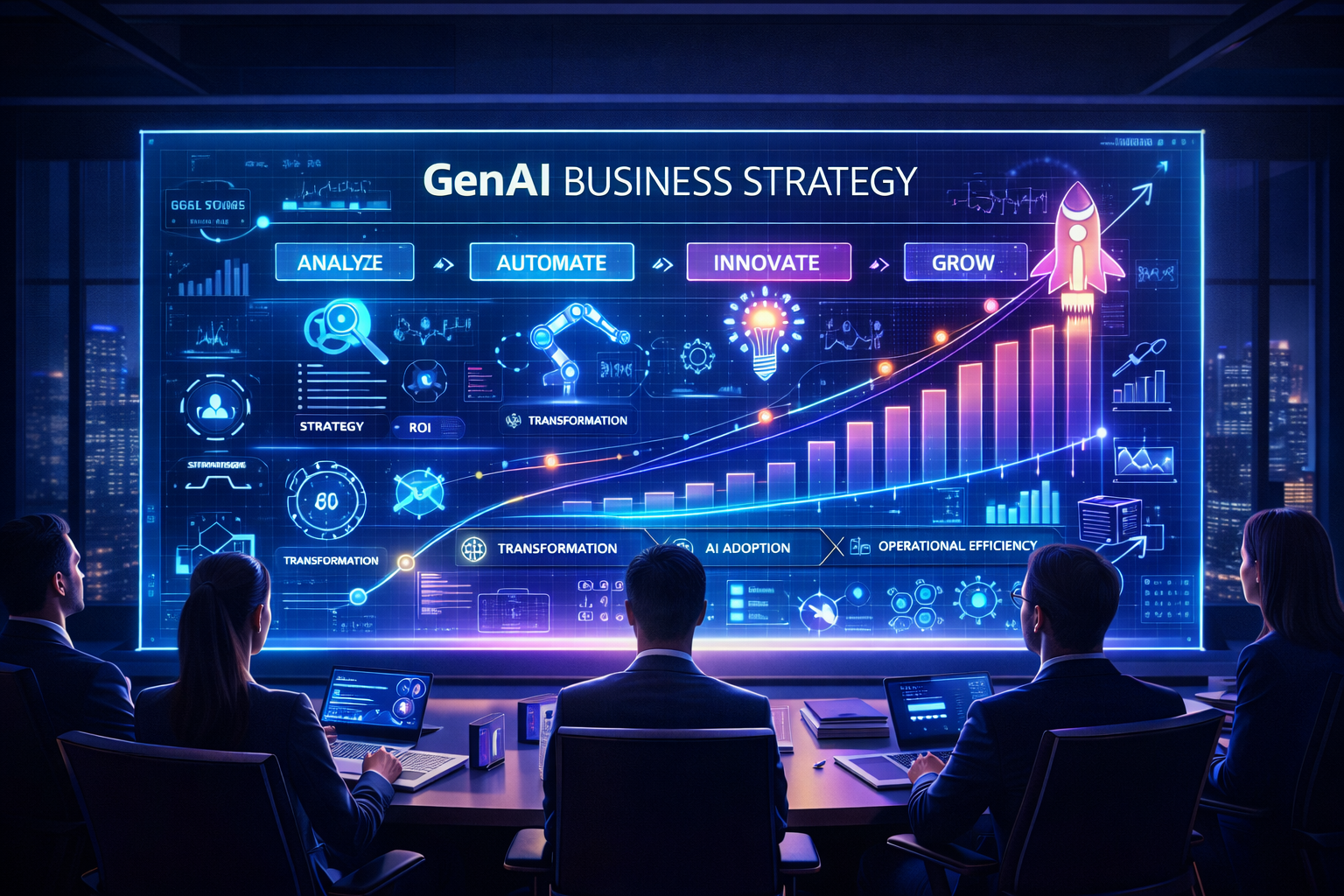
Modern customers expect:
Personalized emails
Personalized product recommendations
Personalized learning
Personalized marketing
Generative AI for Business enables hyper-personalization using AI by:
Understanding user behavior
Predicting preferences
Generating tailored experiences
This boosts:
Engagement
Brand loyalty
Conversion rates
Hyper-personalization using AI is the future of customer experience.
Why AI Operational Efficiency Is the New KPI
Generative AI in 2026 is shifting business KPIs from:
Cost-cutting → Value creation
Speed → Intelligence
Scale → Personalization
Companies measure:
AI operational efficiency
AI-powered innovation output
Business automation with AI
This becomes the heart of GenAI business strategy.
Generative AI Tools 2026: The New Digital Workforce
By 2026, Generative AI tools will act like:
Virtual marketers
Virtual developers
Virtual customer agents
Virtual product designers
Generative AI for Business is not a tool.
It is a digital workforce.
This is why AI transformation for companies is unstoppable.
Why Every Business Needs a GenAI Business Strategy
Without a GenAI business strategy:
Businesses will lose competitiveness
Operational costs will rise
Innovation will slow
Customer loyalty will drop
With Generative AI for Business:
Automation becomes intelligence
Creativity becomes scalable
Innovation becomes affordable
This is enterprise AI transformation.
Generative AI Tools 2026: The Digital Workforce for Every Company
In 2026, Generative AI for Business will not be limited to a single platform. Businesses will build an ecosystem of GenAI tools that function like a digital workforce. These tools will work alongside humans, automate decisions, and create content at machine speed.
The most powerful categories of Generative AI tools 2026 include: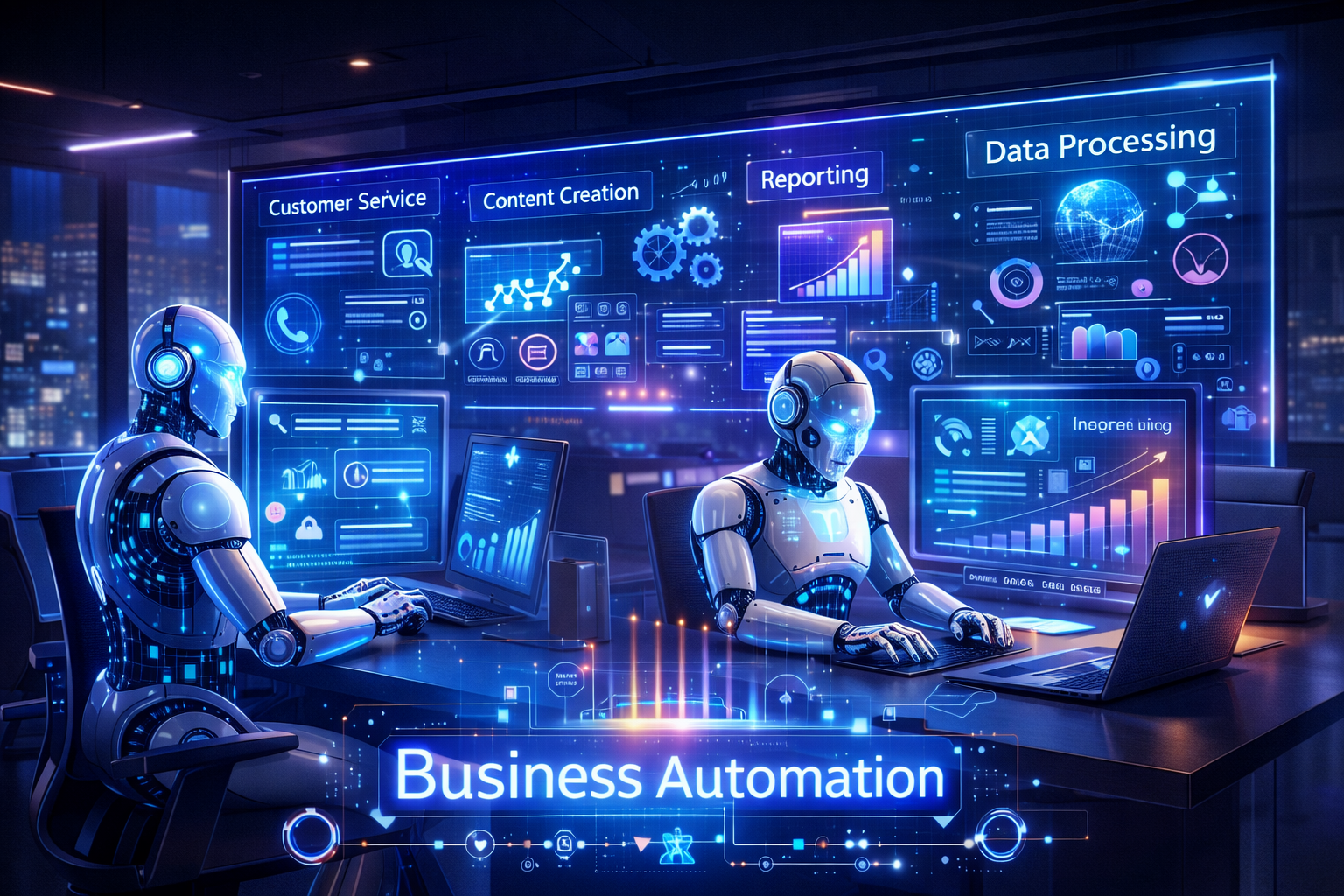
1. AI-Powered Content Creation Tools
Used for:
Blogs, ads, social media
Website copy
Email marketing
Video scripts
These tools drive:
AI-powered innovation
AI operational efficiency
Business automation with AI
They are the backbone of Generative AI for Business in marketing.
2. AI Customer Service Automation Tools
Used for:
Chatbots
Voice assistants
Automated ticket resolution
Customer sentiment analysis
Benefits:
40–60% cost reduction
24/7 customer support
Faster issue resolution
AI customer service automation is one of the fastest ROI areas in AI transformation for companies.
3. AI-Driven Product Development Platforms
Used for:
Code generation
UI/UX design
Product testing
Simulation models
This enables:
Faster launches
Smarter designs
Lower R&D costs
AI-driven product development defines the future of innovation.
4. AI Automation for Business Operations
Used for:
HR automation
Finance reporting
Legal documentation
Workflow optimization
This strengthens:
AI operational efficiency
Enterprise AI transformation
Business automation with AI
5. Cloud-Based GenAI Infrastructure
Generative AI for Business depends heavily on:
Cloud computing
GPU processing
Scalable data storage
This is why cloud professionals are in massive demand in Generative AI in 2026.
(At Cambridge Infotech, this directly aligns with your Cloud Computing, Cybersecurity, Full Stack Development, Data Science, and Digital Marketing learning paths.)
ROI of Generative AI: Why Businesses Are Investing Aggressively
Return on Investment (ROI) is the strongest reason behind AI transformation for companies.
Companies using Generative AI for Business report:
| Area | ROI Impact |
|---|---|
| Content Creation | 70% faster production |
| Customer Support | 40–60% cost reduction |
| Product Development | 3x faster delivery |
| Sales & Marketing | 20–40% higher conversions |
| Operations | 30–50% AI operational efficiency |
This proves one thing:
The ROI of Generative AI is measurable, fast, and scalable.
Generative AI in 2026 is not a cost.
It is a profit engine.
AI Adoption Roadmap: How to Implement Generative AI for Business
Every successful GenAI business strategy follows a structured roadmap:
Step 1: Identify High-Impact Areas
Start with:
AI-powered content creation
AI customer service automation
AI automation for business workflows
These give immediate ROI.
Step 2: Choose the Right Tools
Select tools that:
Integrate with your systems
Ensure data security
Scale with growth
This is critical for enterprise AI transformation.
Step 3: Train Your Workforce
Generative AI for Business is useless without skilled people.
Train teams in:
Prompt engineering
AI ethics
Data handling
AI operations
This is where Cambridge Infotech’s programs become essential.
Step 4: Build AI Governance
Define:
AI usage policies
Data privacy rules
Bias prevention strategies
Human oversight
This protects your business.
Step 5: Measure AI Operational Efficiency
Track:
Cost reduction
Productivity gains
Customer satisfaction
Revenue growth
This ensures your AI transformation for companies is sustainable.
Risks & Challenges of Generative AI for Business
Every powerful technology has risks. Generative AI in 2026 must be implemented responsibly.
1. Data Security Risks
Sensitive data exposure
Compliance issues
Cyber threats
This increases demand for Cybersecurity professionals.
2. Bias & Ethical Concerns
AI can inherit bias
Wrong decisions can harm brands
Ethical AI governance is mandatory.
3. Over-Automation
Losing human creativity
Reduced emotional intelligence
The solution is human + AI collaboration.
4. Skill Gap
Lack of trained professionals is the biggest bottleneck in enterprise AI transformation.
This is where IT education becomes critical.
Why Generative AI Skills Will Define Careers in 2026
Generative AI for Business is creating new job roles:
GenAI Engineer
AI Product Manager
AI Prompt Engineer
AI Marketing Specialist
AI Cloud Architect
AI Cybersecurity Analyst
These roles combine:
AI + Cloud
AI + Cybersecurity
AI + Full Stack
AI + Data Science
AI + Digital Marketing
Which perfectly aligns with Cambridge Infotech’s career ecosystem.
The Competitive Advantage of Early AI Adoption
Companies that adopt Generative AI for Business early will:
Dominate markets
Innovate faster
Build stronger brands
Attract better talent
Late adopters will:
Lose efficiency
Lose customers
Lose relevance
This is why Generative AI in 2026 is not optional.
How Generative AI for Business Is Creating the Future Workforce
Generative AI for Business is not only transforming companies, it is transforming careers. By 2026, every high-paying IT role will be connected to Generative AI in 2026 in some way.
The most in-demand AI-powered roles include:
AI Cloud Engineer
GenAI Developer
AI Cybersecurity Analyst
AI Data Scientist
AI Digital Marketing Specialist
AI Product Designer
AI Automation Engineer
This is why AI transformation for companies directly impacts education and training institutes.
At Cambridge Infotech, your learning ecosystem already matches the future of Generative AI for Business.
How Your Course Categories Align with Generative AI in 2026
Let’s connect Generative AI for Business with your core programs using internal links:
Cloud Computing + Generative AI
Generative AI in 2026 depends heavily on cloud platforms. All GenAI models require:
Scalable cloud infrastructure
GPU processing
AI deployment pipelines
Your Cloud Computing courses prepare students to become:
AI Cloud Engineers
GenAI Infrastructure Architects
Cybersecurity + Generative AI
With AI adoption rising, data security risks also rise. Generative AI for Business needs:
Secure AI systems
Ethical AI governance
Data protection strategies
Cybersecurity professionals will be responsible for protecting AI systems.
Full Stack Development + Generative AI
Generative AI in 2026 will power:
AI-driven applications
Smart web platforms
AI chatbots
SaaS automation tools
Your Full Stack Development program prepares developers to:
Integrate AI models
Build GenAI-powered apps
Data Science & Analytics + Generative AI
Data is the fuel of Generative AI for Business.
Without data scientists, AI transformation for companies is impossible.
Data scientists:
Train AI models
Optimize AI performance
Analyze AI-generated insights
Digital Marketing + Generative AI
Marketing is where Generative AI for Business shows the fastest ROI.
AI-powered marketing includes:
AI-powered content creation
Hyper-personalization using AI
AI-based ad optimization
AI Trends & Knowledge Hub
Your blog section is the perfect place to publish AI thought leadership content.
This will boost your authority in:
Generative AI for Business
GenAI business strategy
Enterprise AI transformation
Student Roadmap: How to Build a Career in Generative AI
If a student wants to build a future-proof career in Generative AI for Business, the roadmap looks like this:
Start with a strong foundation
Cloud Computing
Data Science
Full Stack Development
Add AI specialization
Generative AI tools
Prompt engineering
Model deployment
Add domain expertise
Digital Marketing (AI marketing)
Cybersecurity (AI protection)
Build projects
AI-powered chatbot
AI content generator
AI automation system
Become job-ready
GenAI Engineer
AI Product Specialist
AI Automation Architect
This is the real GenAI business strategy for individuals.
Why Cambridge Infotech Is Perfectly Positioned for the GenAI Era
Cambridge Infotech is not just an IT training institute.
It is becoming a future AI talent factory.
Your ecosystem covers:
AI + Cloud
AI + Cybersecurity
AI + Development
AI + Data Science
AI + Marketing
This makes you a complete partner in AI transformation for companies.
Main website:
https://cambridgeinfotech.io/
this blog will reference:
- McKinsey – Generative AI impact
- Gartner – AI adoption reports
- Salesforce – AI personalization trends
- IDC – AI market growth
- OpenAI – GenAI foundation
Conclusion: Generative AI for Business Is the New Standard
Generative AI for Business is no longer a choice.
It is the foundation of survival in the digital economy.
Generative AI in 2026 will define:
How companies operate
How products are built
How customers are served
How careers are shaped
Companies that adopt GenAI business strategy today will:
Lead markets
Build stronger brands
Achieve massive ROI
Attract top talent
Those who ignore it will disappear.
This is the age of:
AI transformation for companies
AI-powered innovation
AI automation for business
Enterprise AI transformation
And Cambridge Infotech stands at the center of this revolution.
Start your future today with Cambridge Infotech:
Learn Cloud Computing for AI
Master Data Science & AI
Build GenAI-powered applications
Secure AI systems with Cybersecurity
Dominate AI-powered Digital Marketing