

Currently Empty: ₹0.00
Master Data Science with Our Expert-Led Course in Bangalore
Data Science Course in Bangalore | Job Placement | Cambridge Infotech
Enroll in our comprehensive Data Science Course in Bangalore. Gain hands-on experience in Python, Machine Learning, & Data Visualization. 100% Job Placement Assistance. Start your Data Science career today!

Talk to Learning Advisor
Edit Content
Edit Content
Click on the Edit Content button to edit/add the content.
Edit Content
Click on the Edit Content button to edit/add the content.
Edit Content
Click on the Edit Content button to edit/add the content.
Edit Content
Click on the Edit Content button to edit/add the content.
Upcoming Batch
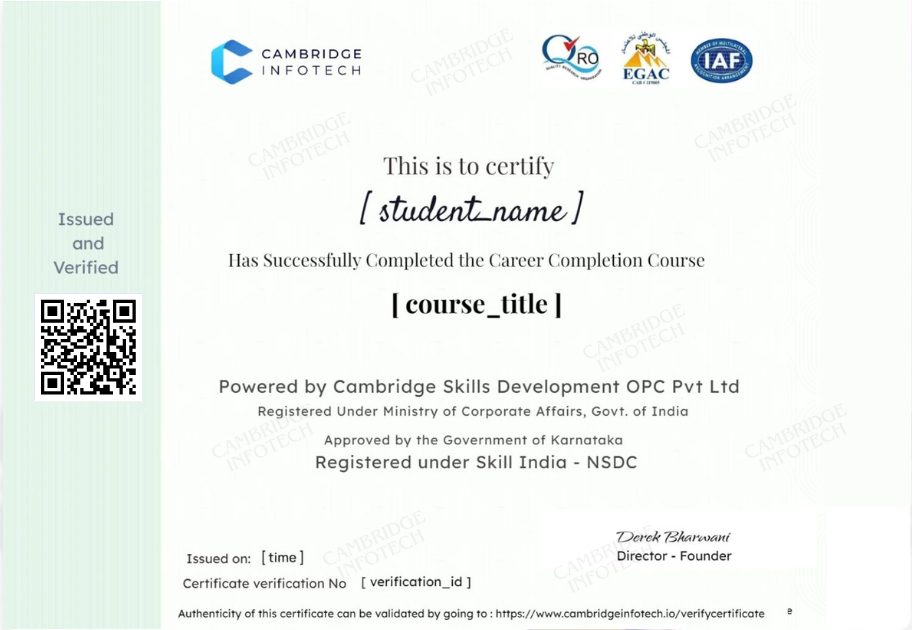
Data Science Course Completion Certificate
The Data Science Course Completion Certificate from Cambridge Infotech is more than just a piece of paper; it’s a testament to your dedication and mastery of critical Data Science skills. This certificate validates your proficiency in Python programming, machine learning, data visualization, and data mining, demonstrating to potential employers that you possess the practical abilities needed to succeed in today’s data-driven world.
Here are a few reasons why our Data Science Course in Bangalore stands out:
- Practical, Hands-On Learning: Our curriculum emphasizes real-world application, ensuring you gain practical skills through hands-on projects and case studies.
- Globally Recognized Certification: Earn a certification that validates your skills and opens doors to international career opportunities.
- Dedicated Job Placement Assistance: Receive comprehensive career support, including resume building, interview preparation, and job placement assistance.
Choosing your Data Science training in Bangalore is crucial. Our institute offers comprehensive courses to sharpen your analytical skills and boost your career. We provide hands-on learning and industry-relevant curriculum, ensuring you’re ready for the tech-driven market.”
1. What are Data Structures?
Definition and Importance
Types of Data Structures: Primitive and Non-Primitive
Basic Terminology: Data, Data Type, Abstract Data Type (ADT)
2. Algorithms and Problem-Solving
Introduction to Algorithms
Characteristics of a Good Algorithm
Problem-Solving Techniques
3. Complexity Analysis
Time and Space Complexity
Big-O, Big-Theta, and Big-Omega Notations
Best, Worst, and Average Case Analysis
- Arrays
Introduction to Arrays
One-Dimensional and Multi-Dimensional Arrays
Operations: Insertion, Deletion, Traversal, Searching, Sorting
Applications of Arrays
2. Linked Lists
Introduction to Linked Lists
Types: Singly, Doubly, and Circular Linked Lists
Operations: Insertion, Deletion, Traversal, Searching
Applications of Linked Lists
3. Stacks
Introduction to Stacks
Stack Operations: Push, Pop, Peek
Implementation using Arrays and Linked Lists
Applications: Expression Evaluation, Parsing, Backtracking
4. Queues
Introduction to Queues
Types: Linear, Circular, Priority, and Double-Ended Queues
Operations: Enqueue, Dequeue, Peek
Implementation using Arrays and Linked Lists
Applications: Scheduling, Buffering
- Trees
Introduction to Trees
Binary Trees: Properties, Types, and Traversal (Inorder, Preorder, Postorder, Level Order)
Binary Search Trees (BST): Insertion, Deletion, Searching
Balanced Trees: AVL Trees, Red-Black Trees
Applications: File Systems, Hierarchical Data
2. Graphs
Introduction to Graphs
Types: Directed, Undirected, Weighted, Unweighted
Representation: Adjacency Matrix, Adjacency List
Traversal Algorithms: Depth-First Search (DFS), Breadth-First Search (BFS)
Applications: Social Networks, Maps, Recommendation Systems
3. Hashing
Introduction to Hashing
Hash Functions and Collision Resolution Techniques
Hash Tables: Insertion, Deletion, Searching
Applications: Databases, Caching, Cryptography
- Heaps
Introduction to Heaps
Types: Min-Heap, Max-Heap
Operations: Insertion, Deletion, Heapify
Applications: Priority Queues, Heap Sort
2. Advanced Trees
B-Trees and B+ Trees: Properties and Applications in Databases
Trie (Prefix Tree): Insertion, Deletion, Searching
Applications: Autocomplete, Spell Checking
3. Advanced Graphs
Shortest Path Algorithms: Dijkstra’s Algorithm, Bellman-Ford Algorithm, Floyd-Warshall Algorithm
Minimum Spanning Tree (MST): Kruskal’s Algorithm, Prim’s Algorithm
Topological Sorting
Applications: Network Routing, Project Scheduling
- Sorting Algorithms
Bubble Sort, Selection Sort, Insertion Sort
Merge Sort, Quick Sort, Heap Sort
Radix Sort, Counting Sort, Bucket Sort
2. Searching Algorithms
Linear Search, Binary Search
Interpolation Search, Exponential Search
3. Dynamic Programming
Introduction to Dynamic Programming
Problems: Fibonacci Series, Knapsack Problem, Longest Common Subsequence (LCS)
4. Greedy Algorithms
Introduction to Greedy Algorithms
Problems: Fractional Knapsack, Activity Selection, Huffman Coding
5. Divide and Conquer
Introduction to Divide and Conquer
Problems: Merge Sort, Quick Sort, Closest Pair of Points
- Applications of Data Structures
Databases: Indexing, Query Optimization
Operating Systems: File Systems, Memory Management
Artificial Intelligence: Search Algorithms, Decision Trees
Networking: Routing Algorithms, Packet Filtering
2. Hands-On Projects
Building a File System using Trees
Implementing a Social Network Graph using Graphs
Designing a Search Engine using Hashing and Sorting
- Programming Languages
Python, Java, C++
2. Development Tools
IDEs, Debuggers, Version Control Systems (Git)
3. Visualization Tools
Graphviz, Matplotlib
- Coding Challenges
Practice solving coding problems commonly asked in technical interviews.
2. Interview Strategies
Learn strategies to approach and solve complex problems efficiently.
3. Competitive Programming
Gain confidence in tackling competitive programming challenges.
Networking and Security Fundamentals Course
- 20 Lessons
- 60 Hours
- Intermediate
Networking and Security Fundamentals Course
- 20 Lessons
- 60 Hours
- Intermediate
Networking and Security Fundamentals Course
- 20 Lessons
- 60 Hours
- Intermediate
Networking and Security Fundamentals Course
- 20 Lessons
- 60 Hours
- Intermediate

Companies
our students are placed in
The companies our students are placed in are a testament to the excellence of our program. Our education equips students with the skills and knowledge necessary to succeed in these top-notch organizations. Take a look at where our graduates have landed: