

Currently Empty: ₹0.00
Blog, Cybersecurity, Data Science & Data Analytic, Full Stack Developer, generative ai, High School, Industry specific and business blogs, Programming Language, Python Full Stack, Python Full Stack
The AI Stack of 2026: Python, Data Science, ML, DL, NLP & Agentic AI
January 31, 2026
Introduction: Why the AI Stack of 2026 Matters
Artificial Intelligence is no longer a futuristic concept—it is the backbone of modern digital transformation. In 2026, Artificial Intelligence systems are not just predictive or reactive; they are generative, autonomous, and agentic. Organizations across industries are actively investing in Python for AI, Data Science, Machine Learning, Deep Learning, NLP, Generative AI, and Agentic AI to stay competitive.
The AI Stack of 2026 represents a layered ecosystem of technologies, tools, frameworks, and methodologies that together power intelligent systems. From raw data ingestion to autonomous AI agents capable of decision-making, the modern AI stack has evolved rapidly.
This blog provides a deep, end-to-end guide to the AI Stack of 2026, explaining how Python, Data Science, Machine Learning, Deep Learning, Natural Language Processing, Generative AI, and Agentic AI fit together to create powerful real-world AI solutions.
If you are new to AI, start with our internal guide.
Understanding the Modern AI Stack
The AI stack is best understood as a multi-layered architecture:
- Programming & Core Tools (Python)
- Data Layer (Data Science)
- Intelligence Layer (Machine Learning)
- Representation Layer (Deep Learning)
- Language Layer (NLP)
- Creativity Layer (Generative AI)
- Autonomy Layer (Agentic AI)
Each layer builds on the previous one, making Python for AI the foundation of everything.
Python: The Foundation of the AI Stack
Python continues to dominate the AI ecosystem in 2026. Over 80% of AI and Data Science projects rely on Python due to its simplicity, scalability, and vast ecosystem.
Why Python Is Essential for Artificial Intelligence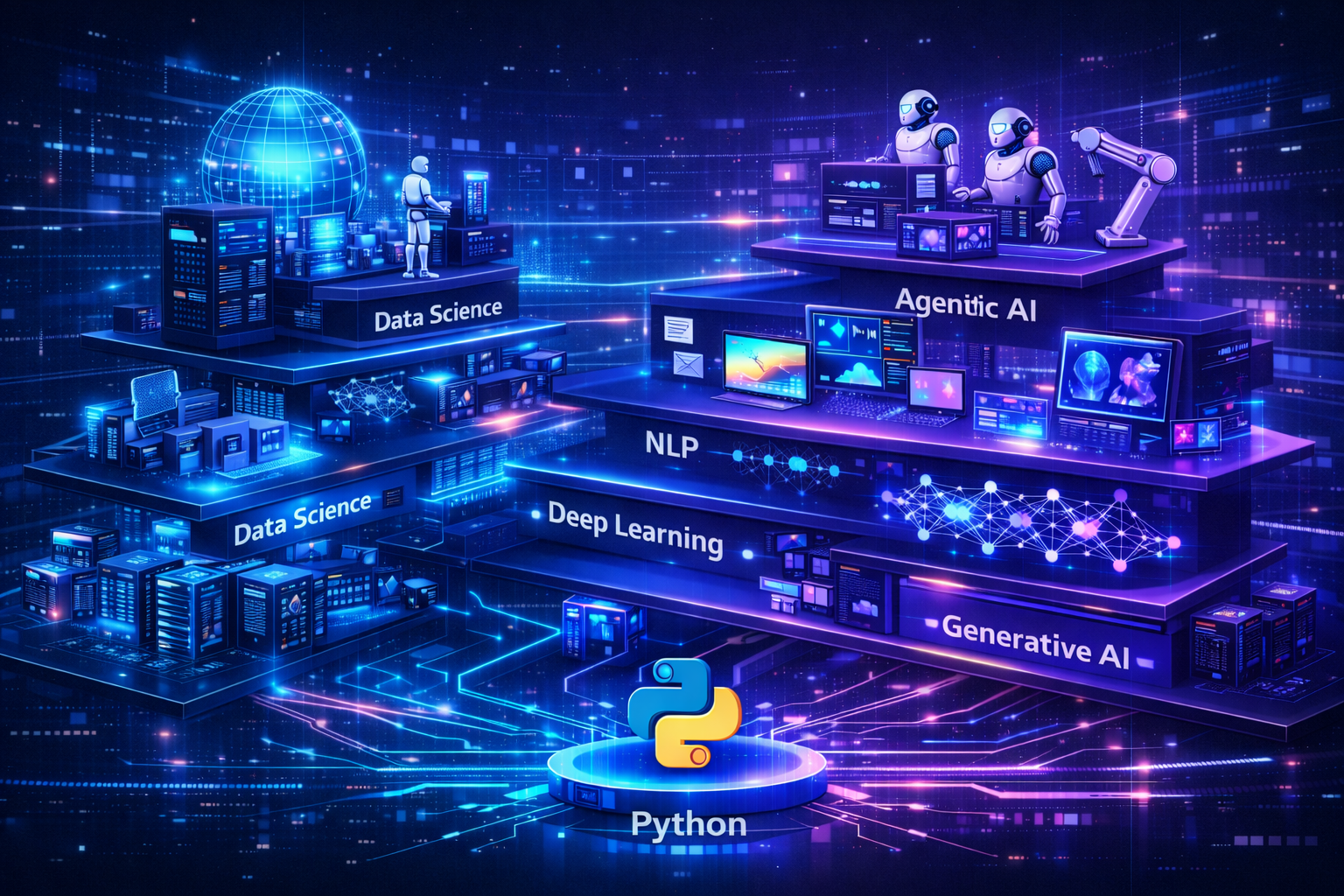
- Easy syntax and rapid development
- Massive AI and Data Science libraries
- Strong community support
- Seamless integration with cloud platforms
Core Python Libraries for AI
- NumPy & Pandas for data handling
- Matplotlib & Seaborn for visualization
- Scikit-learn for Machine Learning
- TensorFlow & PyTorch for Deep Learning
- Hugging Face for NLP & Generative AI
Python is the common language that connects Data Science, Machine Learning, Deep Learning, NLP, Generative AI, and Agentic AI.
Data Science: The Backbone of Intelligent Systems
Without Data Science, Artificial Intelligence cannot exist. Data Science transforms raw data into meaningful insights that fuel Machine Learning and Deep Learning models.
Core Components of Data Science
- Data collection from multiple sources
- Data cleaning and preprocessing
- Exploratory Data Analysis (EDA)
- Feature engineering
- Data visualization and storytelling
In 2026, Data Science is tightly integrated with cloud platforms and real-time data pipelines.
Tools Used in Data Science
- Python & SQL
- Pandas, NumPy
- Power BI & Tableau
- Cloud data warehouses
Read more on Data Science fundamentals:
Machine Learning: Teaching Systems to Learn
Machine Learning (ML) enables systems to learn patterns from data and make predictions without being explicitly programmed.
Types of Machine Learning
- Supervised Learning
- Unsupervised Learning
- Semi-Supervised Learning
- Reinforcement Learning
Machine Learning is widely used in fraud detection, recommendation systems, demand forecasting, and predictive analytics.
Popular ML Algorithms
- Linear & Logistic Regression
- Decision Trees & Random Forest
- Support Vector Machines
- K-Means & Hierarchical Clustering
Machine Learning acts as the bridge between Data Science and Deep Learning.
Deep Learning: Powering Advanced AI
Deep Learning (DL) is a subset of Machine Learning that uses neural networks to model complex patterns in data.
Key Deep Learning Architectures
- Artificial Neural Networks (ANN)
- Convolutional Neural Networks (CNN)
- Recurrent Neural Networks (RNN)
- Transformers
Deep Learning enables breakthroughs in image recognition, speech recognition, and autonomous systems.
Frameworks for Deep Learning
- TensorFlow
- PyTorch
- Keras
Deep Learning models form the core of NLP and Generative AI systems.
Natural Language Processing (NLP): Teaching Machines Language
Natural Language Processing (NLP) allows machines to understand, interpret, and generate human language.
NLP Tasks in 2026
- Text classification
- Sentiment analysis
- Named Entity Recognition
- Machine translation
- Text summarization
NLP Evolution
- Rule-based NLP
- Statistical NLP
- Neural NLP
- Transformer-based NLP
NLP is foundational to chatbots, voice assistants, and Generative AI models.
Generative AI: Creating Content with AI
Generative AI is transforming how content is created. From text and images to code and videos, Generative AI models are everywhere.
What Makes Generative AI Different?
- Produces new content, not just predictions
- Uses Large Language Models (LLMs)
- Powered by Deep Learning & NLP
Generative AI Applications
- AI chatbots
- Content generation
- Image and video creation
- Code generation
- Personalized marketing
Popular Generative AI Technologies
- GPT-based models
- Diffusion models
- Multimodal AI systems
Agentic AI: The Next Evolution of Artificial Intelligence
Agentic AI represents the most advanced layer of the AI Stack of 2026. Unlike traditional AI, Agentic AI systems can:
- Plan
- Reason
- Use tools
- Take autonomous actions
Key Features of Agentic AI
- Goal-driven behavior
- Multi-agent collaboration
- Memory and context awareness
- Human-in-the-loop control
Real-World Agentic AI Use Cases
- Autonomous customer support agents
- AI research assistants
- Workflow automation
- Enterprise decision systems
Agentic AI combines Python, Data Science, Machine Learning, Deep Learning, NLP, and Generative AI into a single intelligent system.
AI Deployment, MLOps & LLMOps
Building AI is only half the journey. Deploying and maintaining AI systems requires MLOps and LLMOps.
Key MLOps Practices
- Model versioning
- CI/CD pipelines
- Monitoring and drift detection
- Scalability and optimization
Cloud platforms play a crucial role in AI deployment.
Ethics, Security & Responsible AI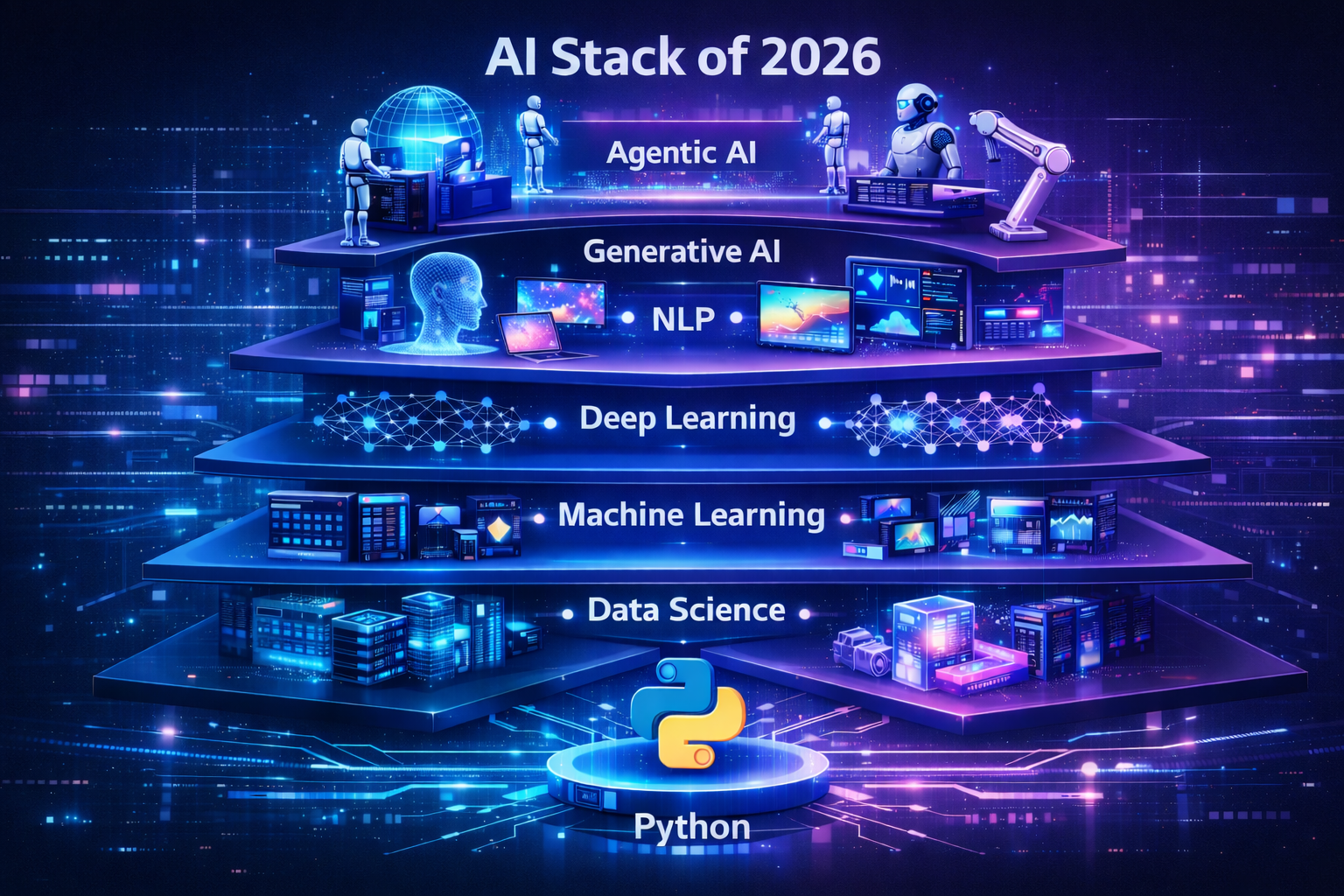
As Artificial Intelligence grows, ethical concerns become critical.
Responsible AI Principles
- Fairness and bias mitigation
- Explainability
- Privacy and data security
- Regulatory compliance
Agentic AI systems must follow strict governance frameworks to ensure safe deployment.
AI Career Roadmap for 2026
To master the AI Stack of 2026, professionals should follow this path:
- Python for AI
- Data Science fundamentals
- Machine Learning algorithms
- Deep Learning architectures
- NLP and Transformers
- Generative AI applications
- Agentic AI systems
FAQs: AI Stack of 2026
1: What is the AI Stack of 2026?
The AI Stack of 2026 refers to the complete technology ecosystem used to build modern Artificial Intelligence systems. It includes Python, Data Science, Machine Learning, Deep Learning, NLP (Natural Language Processing), Generative AI, and Agentic AI. This stack enables intelligent, autonomous, and scalable AI solutions across industries.
2: Why is Python essential in the AI Stack of 2026?
Python is the backbone of the AI Stack of 2026 because of its simplicity, flexibility, and powerful ecosystem. Most Data Science, Machine Learning, Deep Learning, NLP, Generative AI, and Agentic AI frameworks are built using Python, making it the most preferred programming language for Artificial Intelligence.
3: How is Generative AI different from traditional Machine Learning?
Traditional Machine Learning focuses on prediction and classification, while Generative AI creates new content such as text, images, code, and audio. Generative AI relies heavily on Deep Learning and NLP, using large models like LLMs to generate human-like outputs, making it a core part of the AI Stack of 2026.
4: What is Agentic AI and why is it important in 2026?
Agentic AI is an advanced form of Artificial Intelligence where AI systems can plan, reason, use tools, and take autonomous actions toward achieving goals. In 2026, Agentic AI is crucial for building autonomous assistants, AI agents, enterprise automation systems, and decision-making platforms.
5: What skills are required to master the AI Stack of 2026?
To master the AI Stack of 2026, you need skills in:
Python programming
Data Science & data analysis
Machine Learning algorithms
Deep Learning & neural networks
NLP & transformer models
Generative AI tools
Agentic AI frameworks
These skills together enable you to build complete end-to-end Artificial Intelligence solutions.
Conclusion: Mastering the AI Stack of 2026
The AI Stack of 2026 is more powerful, autonomous, and transformative than ever before. By mastering Python, Data Science, Machine Learning, Deep Learning, NLP, Generative AI, and Agentic AI, professionals and organizations can build future-ready AI solutions.
Artificial Intelligence is no longer optional—it is the foundation of digital innovation.