

In 2026, cloud computing is no longer an optional skill; it is a core requirement for anyone who wants to build a successful career in IT, software development, data science, cybersecurity, or even business and management roles. Among all cloud platforms, Amazon Web Services (AWS) continues to dominate the global market. This is why the AWS Certified Cloud Practitioner Certification has become one of the most valuable entry-level credentials for beginners.
The AWS Certified Cloud Practitioner Certification is designed for individuals who want to understand the fundamentals of cloud computing and AWS without needing deep technical experience. It serves as a perfect starting point for students, fresh graduates, career switchers, and professionals who want to validate their cloud knowledge. Whether you come from a technical background or a non-technical one, this certification builds a strong foundation that prepares you for more advanced AWS certifications and real-world cloud projects.
In 2026, organizations are aggressively migrating their infrastructure, applications, and data to the cloud. As a result, professionals with cloud literacy are in high demand. The AWS Certified Cloud Practitioner Certification proves that you understand cloud concepts, AWS services, pricing, security, and the shared responsibility model. It acts as a gateway to cloud careers and opens opportunities in roles such as Cloud Support Associate, Junior Cloud Engineer, IT Support Executive, Cloud Sales Consultant, and AWS Solutions Architect (Associate-level pathway).
What makes this certification especially powerful is its beginner-friendly nature. You don’t need to be a programmer or a system administrator to start. The AWS Certified Cloud Practitioner Certification focuses on clarity, concepts, and real-world awareness of cloud services rather than deep technical configurations. This makes it ideal for 2026 learners who want fast, reliable entry into the cloud ecosystem.
This blog is a complete beginner’s guide to help you understand everything you need to know about the AWS Certified Cloud Practitioner Certification. We will cover cloud fundamentals, AWS basics, core services, security, pricing, and the exam preparation strategy step by step. By the end of this guide, you will have a clear roadmap to start your AWS journey with confidence.
Introduction to AWS Certified Cloud Practitioner
The AWS Certified Cloud Practitioner Certification is the foundational-level certification offered by Amazon Web Services. It validates your overall understanding of the AWS Cloud, independent of any specific technical role. Instead of testing how well you can configure servers or write code, this certification tests your knowledge of cloud concepts, AWS services, security best practices, billing models, and AWS global infrastructure.
This certification is often considered the first milestone in the AWS certification path. It is designed to help candidates:
- Understand what cloud computing is
- Learn how AWS delivers cloud services
- Recognize core AWS services and their use cases
- Understand AWS pricing and billing models
- Gain awareness of AWS security and compliance
The AWS Certified Cloud Practitioner Certification is especially popular among:
- Students and fresh graduates
- Non-technical professionals (sales, marketing, management, HR)
- Beginners in IT
- Career switchers entering cloud computing
- Professionals who want AWS fundamentals before moving to technical certifications
Unlike associate-level or professional-level AWS certifications, this one does not demand hands-on technical expertise. However, it strongly builds conceptual clarity, which is crucial before moving forward in your cloud journey.
In 2026, when cloud adoption is touching almost every industry—healthcare, finance, education, e-commerce, AI, and IoT—the AWS Certified Cloud Practitioner Certification acts as a universal badge of cloud awareness. Employers see it as proof that you understand how cloud platforms work and how AWS fits into modern IT infrastructure.
1. What is AWS Certification?
AWS Certification is a globally recognized credentialing program offered by Amazon to validate expertise in cloud technologies. AWS certifications are divided into four levels:
- Foundational
- Associate
- Professional
- Specialty
The AWS Certified Cloud Practitioner Certification belongs to the Foundational level. It is the first step in the AWS learning path and prepares candidates for associate-level certifications like:
- AWS Certified Solutions Architect – Associate
- AWS Certified Developer – Associate
- AWS Certified SysOps Administrator – Associate
By starting with the AWS Certified Cloud Practitioner Certification, learners develop confidence and clarity, making advanced certifications easier to achieve.
2. Who Should Take the Cloud Practitioner Exam?
The AWS Certified Cloud Practitioner Certification is suitable for anyone who wants to learn cloud computing from scratch. You should consider this certification if you are:
- A student exploring cloud technology
- A beginner in IT looking for direction
- A professional in non-technical roles working with cloud teams
- A business owner using AWS services
- A trainer, instructor, or consultant
- Someone preparing for associate-level AWS certifications
In 2026, even project managers, product owners, and digital marketers benefit from having the AWS Certified Cloud Practitioner Certification, because it allows them to communicate better with technical teams and understand cloud-based project structures.
3. Benefits of AWS Certification in 2026
The demand for cloud professionals is growing every year. In 2026, cloud computing skills are no longer niche; they are essential. Here are the key benefits of earning the AWS Certified Cloud Practitioner Certification:
- Career Advancement: It opens doors to cloud-based job roles.
- Industry Recognition: AWS certifications are respected worldwide.
- Strong Foundation: It builds your base for advanced AWS learning.
- Better Salary Potential: Certified professionals often earn more.
- Confidence Boost: You gain clarity in cloud concepts and AWS services.
- Global Validity: Recognized across countries and industries.
Having the AWS Certified Cloud Practitioner Certification on your resume instantly increases your credibility, especially if you are new to cloud computing.
4. Career Opportunities After Certification
After completing the AWS Certified Cloud Practitioner Certification, you can target roles such as:
- Cloud Support Associate
- AWS Trainee Engineer
- IT Support Executive
- Cloud Sales Consultant
- Junior Cloud Engineer
- Technical Support Analyst
This certification also sets the stage for advanced AWS certifications and specialized cloud roles in the future.
Cloud Computing Fundamentals
Before understanding AWS, it is essential to understand what cloud computing actually means. Cloud computing is the delivery of computing services such as servers, storage, databases, networking, software, and analytics over the internet. Instead of owning physical hardware, organizations rent resources on demand from cloud providers like AWS.
The AWS Certified Cloud Practitioner Certification focuses heavily on cloud fundamentals because without understanding cloud concepts, you cannot truly understand AWS services.
Cloud computing provides:
- On-demand access to resources
- Scalability
- High availability
- Cost efficiency
- Global reach
In 2026, almost every modern application you use—banking apps, e-commerce platforms, streaming services, AI tools—is powered by cloud infrastructure.
1. What is Cloud Computing?
Cloud computing means using computing resources over the internet instead of local servers or personal computers. AWS owns massive data centers around the world and allows users to rent resources as needed.
With the AWS Certified Cloud Practitioner Certification, you learn how organizations:
- Avoid buying expensive hardware
- Reduce operational costs
- Scale instantly
- Improve system reliability
Cloud computing follows a “pay-as-you-go” model, which means you only pay for what you use.
2.Types of Cloud Models
The AWS Certified Cloud Practitioner Certification covers three main cloud deployment models:
- Public Cloud:
Services are provided over the internet by third-party providers like AWS. Most AWS services fall under this category.
- Private Cloud:
Dedicated infrastructure used by a single organization. - Hybrid Cloud:
A combination of public and private clouds, allowing data and applications to move between them.
3. Cloud Service Models
There are three major cloud service models you must understand for the AWS Certified Cloud Practitioner Certification:
- IaaS (Infrastructure as a Service):
You manage servers, storage, and networking (Example: Amazon EC2). - PaaS (Platform as a Service):
AWS manages infrastructure, and you focus on applications. - SaaS (Software as a Service):
Complete software delivered over the internet (Example: Gmail, Salesforce).
4. Advantages of Cloud Computing
The AWS Certified Cloud Practitioner Certification emphasizes these benefits:
- Cost efficiency
- Global scalability
- High reliability
- Security
- Performance optimization
- Innovation enablement
These advantages explain why AWS is the leading cloud provider worldwide.
Introduction to Amazon Web Services (AWS)
Amazon Web Services (AWS) is the world’s leading cloud platform, offering more than 200 fully featured services from data centers around the globe. When you prepare for the AWS Certified Cloud Practitioner Certification, understanding AWS as a platform is just as important as understanding cloud computing itself. AWS provides computing power, storage, databases, networking, analytics, machine learning, IoT, and security services on a pay-as-you-go basis.
The AWS Certified Cloud Practitioner Certification ensures that you know what AWS is, how it operates, and why it is preferred by millions of businesses worldwide. AWS is trusted by startups, large enterprises, government organizations, and educational institutions because of its reliability, security, and scalability.
AWS allows organizations to:
- Launch applications globally in minutes
- Scale infrastructure automatically
- Reduce capital expenses
- Innovate faster
- Improve security and compliance
In 2026, AWS continues to lead the cloud market because of its wide service portfolio, global reach, and continuous innovation. Learning AWS through the AWS Certified Cloud Practitioner Certification gives beginners a strong industry-aligned foundation.
1. Overview of AWS Global Infrastructure
AWS has one of the largest and most advanced global infrastructures in the world. For the AWS Certified Cloud Practitioner Certification, you must understand the key building blocks of this infrastructure:
- Regions:
A region is a physical geographic location that contains multiple data centers. Examples include Asia Pacific (Mumbai), US East (N. Virginia), Europe (Frankfurt), etc. - Availability Zones (AZs):
Each region has multiple Availability Zones. An AZ is a separate data center with its own power, networking, and connectivity. AZs are isolated from each other to ensure fault tolerance. - Edge Locations:
These are used by AWS services like CloudFront to deliver content to users with low latency.
This infrastructure design allows AWS to provide:
- High availability
- Fault tolerance
- Low latency
- Disaster recovery solutions
The AWS Certified Cloud Practitioner Certification tests your understanding of how Regions and Availability Zones improve reliability and performance.
2. Regions, Availability Zones, and Edge Locations
To pass the AWS Certified Cloud Practitioner Certification, you must clearly differentiate between these three:
| Component | Purpose |
|---|---|
| Region | Geographic area containing multiple AZs |
| Availability Zone | One or more discrete data centers within a region |
| Edge Location | Used for content delivery and caching |
By distributing applications across multiple Availability Zones, companies ensure business continuity even if one data center fails. This concept is a core part of AWS architecture and a frequent topic in the AWS Certified Cloud Practitioner Certification exam.
3. AWS Management Console, CLI, and SDK
AWS provides multiple ways to interact with its services:
- AWS Management Console:
A web-based interface that allows users to manage AWS services visually. Beginners use this the most. - AWS Command Line Interface (CLI):
Allows you to manage AWS services using commands from a terminal. - AWS Software Development Kits (SDKs):
Enable developers to access AWS services using programming languages like Python, Java, and JavaScript.
For the AWS Certified Cloud Practitioner Certification, you are not required to master the CLI or SDKs, but you should understand their purpose and usage.
4. AWS Shared Responsibility Model
One of the most important concepts in the AWS Certified Cloud Practitioner Certification is the Shared Responsibility Model. It explains how security and compliance responsibilities are divided between AWS and the customer.
AWS is responsible for:
- Security of the cloud
- Physical data centers
- Hardware
- Networking infrastructure
- Virtualization layer
Customers are responsible for:
- Security in the cloud
- Data protection
- IAM configuration
- Operating systems
- Application security
This model ensures clarity and accountability, making cloud environments secure and manageable.
Core AWS Services Overview
The AWS Certified Cloud Practitioner Certification expects you to understand the most important AWS services and their use cases. You are not required to configure them, but you must know what they do and when they are used.
AWS services are grouped into major categories:
- Compute
- Storage
- Databases
- Networking
1. Compute Services
Compute services provide processing power.
Key services:
- Amazon EC2 (Elastic Compute Cloud):
Virtual servers in the cloud. You can choose CPU, memory, storage, and operating system. - AWS Lambda:
Serverless computing service where you run code without managing servers. - Amazon ECS & EKS:
Container management services.
For the AWS Certified Cloud Practitioner Certification, you should know:
- EC2 = virtual servers
- Lambda = event-driven serverless computing
2. Storage Services
Storage services allow you to store data securely and cost-effectively.
Important services:
- Amazon S3 (Simple Storage Service):
Object storage for files, backups, media, and big data. - Amazon EBS (Elastic Block Store):
Block storage for EC2 instances. - Amazon EFS (Elastic File System):
File storage for shared file systems. - Amazon Glacier:
Low-cost archival storage.
S3 is one of the most tested services in the AWS Certified Cloud Practitioner Certification exam.
3. Database Services
AWS offers managed database solutions.
Common ones:
- Amazon RDS:
Managed relational databases (MySQL, PostgreSQL, SQL Server). - Amazon DynamoDB:
Fully managed NoSQL database. - Amazon Aurora:
High-performance relational database built for AWS.
The AWS Certified Cloud Practitioner Certification focuses on understanding use cases rather than database administration.
4. Networking Services
Networking enables communication between services and users.
Key services:
- Amazon VPC:
Virtual network where AWS resources are launched. - Amazon Route 53:
Scalable DNS service. - Amazon CloudFront:
Content Delivery Network (CDN).
These services ensure performance, security, and global accessibility.
AWS Security and Compliance
Security is a major domain in the AWS Certified Cloud Practitioner Certification. AWS is built with security at every layer, making it one of the most secure cloud platforms.
AWS provides:
- Data encryption
- Identity and access control
- Compliance with global standards
- Continuous monitoring
1. AWS Security Principles
Key security principles you must know:
- Least privilege access
- Strong identity management
- Encryption of data
- Monitoring and logging
These principles are core to the AWS Certified Cloud Practitioner Certification exam.
2. Identity and Access Management (IAM)
IAM controls who can access AWS resources.
With IAM, you manage:
- Users
- Groups
- Roles
- Policies
IAM is one of the most critical topics in the AWS Certified Cloud Practitioner Certification.
3. Data Encryption and Key Management
AWS provides:
- Encryption at rest
- Encryption in transit
- AWS Key Management Service (KMS)
This ensures sensitive data is protected.
4. AWS Compliance Programs
AWS complies with global standards like:
- ISO
- SOC
- GDPR
- HIPAA
These certifications make AWS suitable for regulated industries such as healthcare and finance, which is why the AWS Certified Cloud Practitioner Certification emphasizes compliance knowledge.
AWS Cloud Architecture Basics
When preparing for the AWS Certified Cloud Practitioner Certification, understanding basic cloud architecture principles is extremely important. AWS architecture is designed to make applications highly available, scalable, fault-tolerant, and cost-effective. These principles guide how organizations design their cloud environments.
The AWS Certified Cloud Practitioner Certification does not expect you to design complex architectures, but it does expect you to understand the concepts behind reliable and efficient cloud systems.
AWS architecture focuses on:
- High availability
- Scalability
- Fault tolerance
- Performance efficiency
- Cost optimization
These are also the pillars of the AWS Well-Architected Framework, which is a core concept tested in the AWS Certified Cloud Practitioner Certification.
1. High Availability and Fault Tolerance
High availability means systems remain operational even when failures occur. Fault tolerance means systems continue functioning without interruption.
AWS achieves this by:
- Using multiple Availability Zones
- Replicating data across locations
- Designing redundant systems
For example, running applications across two or more Availability Zones ensures that even if one data center fails, the application keeps running. This concept is central to the AWS Certified Cloud Practitioner Certification because it explains why AWS infrastructure is so reliable.
2. Scalability and Elasticity
Scalability is the ability to increase or decrease resources based on demand. Elasticity is the automatic scaling of resources.
AWS allows:
- Vertical scaling (increase server size)
- Horizontal scaling (add more servers)
Services like Auto Scaling and Elastic Load Balancing support these features. The AWS Certified Cloud Practitioner Certification highlights that AWS helps businesses handle unpredictable workloads efficiently.
3. Reliability and Performance Efficiency
Reliability ensures that applications consistently work as expected. Performance efficiency ensures that systems use resources efficiently.
AWS improves performance by:
- Using global infrastructure
- Offering high-performance storage and networking
- Providing optimized services like CloudFront
These principles appear frequently in AWS Certified Cloud Practitioner Certification exam questions.
4. AWS Well-Architected Framework Overview
The AWS Well-Architected Framework provides best practices for building secure and efficient systems. It is built on six pillars:
- Operational Excellence
- Security
- Reliability
- Performance Efficiency
- Cost Optimization
- Sustainability
Understanding these pillars is essential for the AWS Certified Cloud Practitioner Certification, as they summarize AWS’s design philosophy.
AWS Pricing and Billing
Pricing is one of the most important domains in the AWS Certified Cloud Practitioner Certification. AWS follows a flexible pricing model that allows users to pay only for what they use.
AWS pricing is based on:
- Compute usage
- Storage consumed
- Data transfer
- Service-specific pricing
The AWS Certified Cloud Practitioner Certification ensures you understand how AWS helps organizations reduce infrastructure costs.
1. AWS Pricing Models
- On-Demand:
Pay per hour or second with no long-term commitment. - Reserved Instances:
Commit for 1 or 3 years to get significant discounts. - Spot Instances:
Use unused AWS capacity at lower prices.
These pricing options are a core part of the AWS Certified Cloud Practitioner Certification syllabus.
2. AWS Free Tier Explained
AWS Free Tier allows beginners to practice without cost. It includes:
- 12 months of free services
- Always-free services
- Short-term free trials
For learners preparing for the AWS Certified Cloud Practitioner Certification, the Free Tier is extremely valuable.
3. AWS Cost Management Tools
AWS provides tools to control and track spending:
- AWS Cost Explorer
- AWS Budgets
- Billing Dashboard
- AWS Pricing Calculator
These tools help organizations optimize costs and avoid unexpected bills. Understanding them is crucial for the AWS Certified Cloud Practitioner Certification.
4. Billing Dashboard and Reports
The Billing Dashboard provides:
- Monthly cost summaries
- Detailed service usage
- Payment history
This section helps candidates understand real-world AWS billing.
AWS Support Plans
AWS offers multiple support plans for different business needs. The AWS Certified Cloud Practitioner Certification requires you to know the differences between them.
Support Plans include:
- Basic:
Free, includes documentation and community support. - Developer:
Business-hour technical support. - Business:
24/7 technical support and faster response times. - Enterprise:
Mission-critical support with dedicated account managers.
Understanding these plans is part of the AWS Certified Cloud Practitioner Certification exam.
Monitoring and Management Tools
AWS provides several tools to monitor resources and maintain security and compliance. These tools help maintain system health and performance.
1. Amazon CloudWatch
CloudWatch monitors:
- CPU usage
- Memory usage
- Network activity
- Application logs
It helps in performance tuning and troubleshooting, a core concept in the AWS Certified Cloud Practitioner Certification.
2. AWS CloudTrail
CloudTrail tracks:
- User activity
- API calls
- Security changes
It is used for auditing and compliance.
3. AWS Trusted Advisor
Trusted Advisor provides recommendations on:
- Cost optimization
- Security
- Performance
- Fault tolerance
It helps organizations follow AWS best practices.
4. AWS Config
AWS Config tracks:
- Resource changes
- Configuration history
- Compliance status
It is essential for governance and compliance.
Migration and Innovation with AWS
One of the major reasons companies adopt AWS is to migrate their existing infrastructure to the cloud and innovate faster. The AWS Certified Cloud Practitioner Certification introduces you to the basic concepts of cloud migration and how AWS supports digital transformation.
Cloud migration means moving applications, data, and workloads from on-premises servers to the AWS cloud. Organizations migrate to AWS to:
- Reduce infrastructure cost
- Improve performance and reliability
- Increase scalability
- Enhance security
- Enable faster innovation
AWS provides a wide range of tools and services that simplify migration, making it easier even for beginners to understand through the AWS Certified Cloud Practitioner Certification.
1. AWS Migration Strategies
AWS defines common migration strategies known as the 6 Rs:
- Rehost – Move applications without changes (Lift and Shift)
- Replatform – Make minor changes to optimize for the cloud
- Refactor – Redesign applications using cloud-native services
- Repurchase – Switch to SaaS solutions
- Retire – Remove unnecessary applications
- Retain – Keep some workloads on-premises
These strategies are part of the conceptual understanding required for the AWS Certified Cloud Practitioner Certification.
2. AWS Snow Family
The AWS Snow Family helps move large volumes of data into AWS when internet transfer is slow or expensive.
It includes:
- AWS Snowcone
- AWS Snowball
- AWS Snowmobile
This topic is often tested in the AWS Certified Cloud Practitioner Certification exam to check your understanding of large-scale data transfer.
3. AI, ML, and Analytics on AWS
AWS is not just about infrastructure; it is also about innovation. AWS offers:
- Amazon SageMaker for Machine Learning
- Amazon Rekognition for image analysis
- Amazon Comprehend for NLP
- Amazon Redshift for data warehousing
- Amazon QuickSight for BI analytics
The AWS Certified Cloud Practitioner Certification ensures you are aware of these services and how AWS enables innovation.
Exam Structure and Format
Understanding the exam pattern is crucial when preparing for the AWS Certified Cloud Practitioner Certification.
Exam details:
- Format: Multiple-choice and multiple-response
- Duration: 90 minutes
- Number of Questions: ~65
- Passing Score: 700 out of 1000
- Cost: USD 100
- Delivery: Online or at testing centers
1. Exam Domains and Weightage
The exam is divided into four domains:
- Cloud Concepts – 26%
- Security and Compliance – 25%
- Cloud Technology and Services – 33%
- Billing, Pricing, and Support – 16%
These domains reflect what you must master for the AWS Certified Cloud Practitioner Certification.
2. Question Types
Questions focus on:
- AWS service use cases
- Basic architectural principles
- Security responsibility
- Pricing models
- Support plans
The AWS Certified Cloud Practitioner Certification exam tests understanding, not deep technical implementation.
3. Scoring and Passing Criteria
AWS uses a scaled scoring system. You need conceptual clarity to pass, not memorization. This is why the AWS Certified Cloud Practitioner Certification is ideal for beginners.
Exam Preparation Strategy
Preparing for the AWS Certified Cloud Practitioner Certification requires structured learning and consistent practice.
1. Study Plan for Beginners
A 4-week plan:
- Week 1: Cloud fundamentals + AWS basics
- Week 2: Core services + security
- Week 3: Pricing + architecture
- Week 4: Revision + mock tests
2. Recommended Learning Resources
- AWS Skill Builder
- Official AWS documentation
- Practice exams
- Instructor-led training
These resources strengthen preparation for the AWS Certified Cloud Practitioner Certification.
3. Practice Tests and Mock Exams
Practice exams help:
- Identify weak areas
- Improve time management
- Build exam confidence
4. Common Mistakes to Avoid
- Ignoring billing concepts
- Memorizing without understanding
- Skipping practice tests
- Not revising regularly
Hands-on Practice and Labs
Although the AWS Certified Cloud Practitioner Certification is conceptual, hands-on practice improves understanding.
1. Setting Up an AWS Free Tier Account
AWS Free Tier allows safe practice without cost. Beginners can:
- Launch EC2
- Upload data to S3
- Explore IAM
2. Simple Labs with Core Services
Recommended labs:
- Create S3 bucket
- Launch EC2 instance
- Configure IAM user
- Monitor resources with CloudWatch
3. Cost Control Best Practices
- Enable budgets
- Delete unused resources
- Monitor usage daily
Real-World Use Cases
The AWS Certified Cloud Practitioner Certification connects theory to real-world applications.
1. AWS for Startups
Startups use AWS for:
- Low-cost infrastructure
- Rapid scalability
- Innovation support
2. AWS for Enterprises
Enterprises use AWS for:
- Disaster recovery
- Big data analytics
- Hybrid cloud
3. AWS in Education and Healthcare
AWS powers:
- Online learning platforms
- Telemedicine systems
- Secure patient data storage
Career Path After Cloud Practitioner
The AWS Certified Cloud Practitioner Certification is the starting point of your cloud career.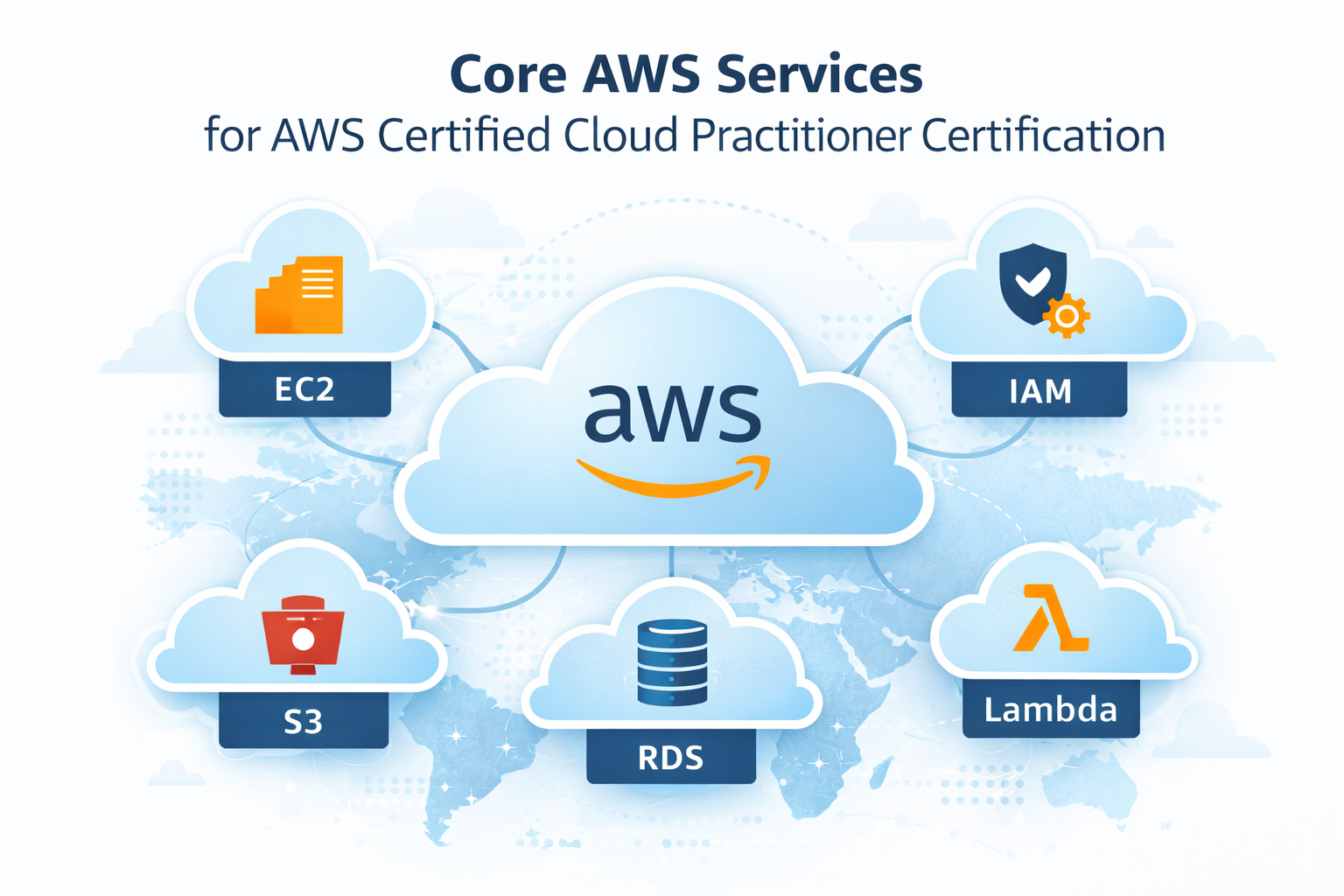
Next certifications:
- AWS Solutions Architect – Associate
- AWS Developer – Associate
- AWS SysOps Administrator – Associate
Job roles:
- Cloud Support Associate
- AWS Engineer
- Cloud Administrator
- Junior Solutions Architect
In 2026, cloud professionals are among the highest in demand.
Final Revision and Quick Notes
1. Key Concepts Summary
- Cloud computing basics
- AWS global infrastructure
- Shared Responsibility Model
- Core AWS services
- Security and compliance
- Pricing and billing
These concepts define success in the AWS Certified Cloud Practitioner Certification.
2. AWS Services Cheat Sheet
| Category | Services |
|---|---|
| Compute | EC2, Lambda |
| Storage | S3, EBS |
| Database | RDS, DynamoDB |
| Networking | VPC, CloudFront |
| Security | IAM, KMS |
3. Last-Minute Exam Tips
- Revise IAM and pricing
- Take mock tests
- Sleep well before exam
- Read questions carefully
Frequently Asked Questions (FAQ)
1. What is the AWS Certified Cloud Practitioner Certification?
The AWS Certified Cloud Practitioner Certification is a foundational-level AWS certification that validates your understanding of cloud concepts, AWS services, security, pricing, and the shared responsibility model. It is ideal for beginners and non-technical professionals.
: https://aws.amazon.com/certification/certified-cloud-practitioner/
2. Who should take the AWS Certified Cloud Practitioner Certification?
This certification is perfect for students, fresh graduates, IT beginners, business professionals, sales/marketing professionals working with cloud teams, and anyone who wants to start a career in cloud computing.
3. Is the AWS Certified Cloud Practitioner Certification good for beginners?
Yes, it is specially designed for beginners. You don’t need programming or system administration experience. The focus is on understanding concepts rather than deep technical implementation.
4. What is the exam format for the AWS Certified Cloud Practitioner Certification?
The exam contains around 65 multiple-choice and multiple-response questions, lasts 90 minutes, and the passing score is 700 out of 1000.
5. How much does the AWS Certified Cloud Practitioner Certification exam cost?
The exam costs USD 100. AWS also offers discounts for students and learners who complete AWS training programs.
6. How long does it take to prepare for the AWS Certified Cloud Practitioner Certification?
Most beginners can prepare in 3–4 weeks with consistent study and practice.
7. Do I need coding knowledge for the AWS Certified Cloud Practitioner Certification?
No, coding knowledge is not required. The certification focuses on cloud concepts, AWS services, billing, and security awareness.
8. What jobs can I get after AWS Certified Cloud Practitioner Certification?
You can apply for roles such as Cloud Support Associate, Junior Cloud Engineer, AWS Trainee, IT Support Executive, and Cloud Sales Consultant.
9. What is the AWS Free Tier and how does it help?
AWS Free Tier allows you to use many AWS services free for 12 months, helping beginners practice without spending money.
10. What is the AWS Shared Responsibility Model?
It explains that AWS is responsible for security of the cloud, while customers are responsible for security in the cloud.
Conclusion
The AWS Certified Cloud Practitioner Certification is the perfect entry point into the world of cloud computing in 2026. It builds a strong foundation in cloud concepts, AWS services, security, pricing, and architecture. Whether you are a student, beginner, professional, or career switcher, the AWS Certified Cloud Practitioner Certification opens the door to countless opportunities in the cloud industry.
By completing this certification, you prove that you understand how the modern cloud works and how AWS powers the digital world. It is more than just a certificate—it is your gateway to a future-proof IT career.
If you are serious about building a successful cloud career, start today with the AWS Certified Cloud Practitioner Certification.