
Artificial Intelligence in Education: The Future of Learning
Introduction
In the last decade, the education sector has undergone a digital revolution. From smart classrooms to adaptive online platforms, every aspect of learning has been reimagined through technology. Among all the innovations shaping this transformation, Artificial Intelligence in Education stands out as the most powerful and promising.
 Today, the idea of “AI learning technologies” is no longer futuristic—it’s practical, measurable, and already integrated into daily academic life. Whether it’s personalized study recommendations, AI-powered learning platforms, or intelligent tutoring systems, Artificial Intelligence in Education is redefining how students learn and how educators teach.
Institutions like Cambridge Infotech are at the forefront of this transformation, helping students and professionals understand how AI tools for students and teachers can be used not only for smarter learning but also for better career readiness.
The role of artificial intelligence in education extends beyond automation. It brings empathy, personalization, and precision into teaching—areas that were once impossible to scale. By analyzing student data, predicting learning patterns, and tailoring educational content to each learner’s strengths, AI in education makes learning more efficient and engaging.
Moreover, with the rise of AI-powered learning platforms, teachers are now supported by intelligent assistants capable of grading assignments, tracking progress, and suggesting customized improvement plans. Students, on the other hand, can use AI-driven personalized education tools that adapt in real time to their pace, strengths, and interests.
The benefits of AI in education are visible across all levels—from primary schools to higher-education institutions and professional training centers. For instance, when AI identifies struggling learners early, educators can intervene with specific strategies to ensure every student succeeds. Similarly, adaptive learning with AI ensures that no learner is left behind, no matter their learning style or background.
As we move further into 2025 and beyond, the future of AI in learning will continue to expand through innovations such as virtual classrooms, immersive AR/VR simulations, and data-driven teaching methods. These advancements not only make education accessible but also relevant to the dynamic demands of modern industries.
For institutes, embracing Artificial Intelligence in Education is no longer optional—it’s a necessity to stay competitive. AI tools are streamlining administrative workflows, improving student satisfaction, and offering data-driven decision-making that enhances institutional performance.
The emergence of AI-based micro-learning, automated assessments, and skill-tracking systems demonstrates that education is evolving from one-size-fits-all to a fully individualized experience. AI learning technologies bridge the gap between traditional teaching and the expectations of digital-first learners.
At Cambridge Infotech, this transformation is not just about technology; it’s about people. The institute’s AI-driven teaching ecosystem ensures every learner receives the support and insights they need to succeed—whether they are beginners exploring AI fundamentals or professionals mastering advanced machine-learning techniques.
As we dive deeper into this article, we’ll explore the role of Artificial Intelligence in Education, the benefits of AI in learning technologies, and how institutes like Cambridge Infotech are leveraging these innovations to shape a smarter, more inclusive, and career-ready generation.
 The Role of Artificial Intelligence in Education
The modern classroom looks nothing like it did a decade ago. Chalkboards have been replaced by smart displays, textbooks have gone digital, and lessons have become interactive and personalized. But the most significant catalyst behind this evolution is Artificial Intelligence in Education. AI is not just another trend—it’s the backbone of a more intelligent, adaptive, and inclusive learning system.
How Artificial Intelligence in Education Works
At its core, AI learning technologies analyze massive amounts of data to deliver tailored educational experiences. Every student learns at a different pace, and AI identifies these differences through continuous data collection—exam results, participation levels, assignment patterns, and even behavioral cues.
This data is then processed by algorithms that power AI-powered learning platforms, which adjust content difficulty, suggest extra resources, or even modify teaching methods in real time. For instance, if a student struggles with algebra, the system can instantly recommend simpler practice sets or trigger a video tutorial. This kind of AI-driven personalized education was unimaginable in traditional classrooms.
Instructors benefit too. The role of artificial intelligence in education extends to helping teachers plan lessons more effectively. AI automates grading, tracks progress, and provides insights into each student’s performance. Instead of spending hours marking papers, educators can focus on human-centered teaching—mentoring, motivating, and guiding students.
Bridging the Gap Between Teachers and Technology
Some fear that AI may replace teachers, but in reality, it does the opposite—it empowers them. With AI tools for students and teachers, technology becomes a partner in the learning process. Teachers can identify knowledge gaps early and personalize lessons for each learner. AI chatbots can answer routine queries about homework or exams, freeing educators for deeper interactions.
Institutes like Cambridge Infotech have already implemented hybrid learning systems that use AI in education to track learner progress and provide real-time feedback. This combination of human expertise and artificial intelligence creates a classroom where no student is overlooked.
Moreover, adaptive learning with AI ensures that lessons dynamically evolve with the learner’s abilities. If a student demonstrates strong conceptual understanding, the system can introduce advanced topics. Conversely, if the learner struggles, the AI platform can revisit earlier concepts, making sure the student fully grasps each step before moving forward.
AI in Education Beyond the Classroom
The impact of Artificial Intelligence in Education extends well beyond classrooms. AI supports administrative operations, campus management, and even admissions. Predictive analytics help institutions forecast enrollment trends, optimize resources, and design better programs.
For example, AI-driven analytics can identify which courses are in high demand and help institutes like Cambridge Infotech align their training programs accordingly. Similarly, AI chatbots assist students 24/7—answering queries about class schedules, assignments, and deadlines—creating smoother, more efficient student experiences.
In higher education and professional training, AI learning technologies are transforming research and upskilling initiatives. Machine learning algorithms can scan vast academic databases to suggest relevant study materials or identify emerging trends. In fields like data science, cybersecurity, or cloud computing, AI-driven personalized education platforms make learning faster and more practical.
The Human Side of AI in Education
It’s easy to associate artificial intelligence with cold algorithms and automation, but when designed ethically, AI in education enhances the human connection. Personalized learning recommendations make students feel seen and supported. Educators can focus on emotional intelligence, creativity, and mentorship—qualities that machines can’t replicate.
One of the greatest benefits of AI in education is inclusivity. Students with disabilities, language barriers, or learning challenges gain access to tools that accommodate their needs. Voice assistants, predictive text, and smart content summarization make education accessible to all.
At Cambridge Infotech, the integration of AI into teaching frameworks goes beyond academics—it builds confidence, problem-solving ability, and digital literacy among learners. By merging artificial intelligence with experienced instruction, the institute ensures that every learner receives a truly customized educational experience.
Transforming Education into a Lifelong Journey
The traditional education system was designed around fixed curriculums and rigid timelines. But with AI-powered learning platforms, education becomes a continuous, flexible journey. Professionals can upgrade their skills on-demand through micro-learning modules, while students can explore topics that align with their curiosity.
This shift aligns perfectly with the global trend toward lifelong learning. Artificial Intelligence in Education supports this evolution by making knowledge universally available, affordable, and adaptable. Whether you’re a student aiming to master programming or a teacher looking to refine your digital teaching methods, AI ensures the journey is optimized for your pace and goals.
Ultimately, the role of Artificial Intelligence in Education is not just to digitize learning—it’s to humanize it. By combining precision-driven analytics with empathy-driven teaching, AI creates a smarter and more compassionate education system.
Key Benefits of AI in Learning Technologies
As Artificial Intelligence continues to redefine industries, its most profound impact is arguably seen in education. The integration of Artificial Intelligence in Education has not only reshaped how students learn but also how educators teach and how institutions operate. What once felt futuristic is now a practical necessity for schools, universities, and training institutes like Cambridge Infotech.
Let’s explore how AI learning technologies are delivering measurable benefits to learners, educators, and institutions across the world.
1. Personalized Learning for Every Student
The hallmark of Artificial Intelligence in Education is personalization. No two learners are the same—each student has a unique pace, style, and level of understanding. AI-powered learning platforms recognize these differences and adapt content dynamically.
Instead of one-size-fits-all lessons, students receive customized recommendations, exercises, and quizzes. This AI-driven personalized education allows learners to spend more time on challenging concepts and skip the ones they’ve already mastered.
For example, a student learning programming might receive different assignments than someone studying the same course but at a higher skill level. This adaptability ensures better engagement and improved outcomes.
At Cambridge Infotech, adaptive learning with AI enables students to take control of their learning journey—accessing lessons that match their strengths and revisiting topics as needed, leading to higher retention and confidence.
2. Intelligent Tutoring Systems (ITS)
Another major benefit of AI in education is the rise of Intelligent Tutoring Systems (ITS). These AI-driven systems simulate a one-on-one tutor, guiding students through difficult subjects and providing immediate feedback.
Unlike traditional tutors, ITS platforms are available 24/7 and scale effortlessly. They use machine learning to track a learner’s progress, identify weak areas, and suggest improvement strategies.
Institutes using AI tools for students and teachers can ensure consistent guidance across large student groups. This means every student receives the same level of support, even outside class hours.
3. Enhanced Teacher Support and Efficiency
Educators are the backbone of education, and AI’s purpose isn’t to replace them—but to make them more effective. Artificial Intelligence in Education automates time-consuming administrative tasks like grading, attendance tracking, and report generation.
With automation in place, teachers can focus more on creativity, mentorship, and personalized student interaction. AI insights highlight where students struggle, allowing instructors to tailor their lessons to meet specific learning needs.
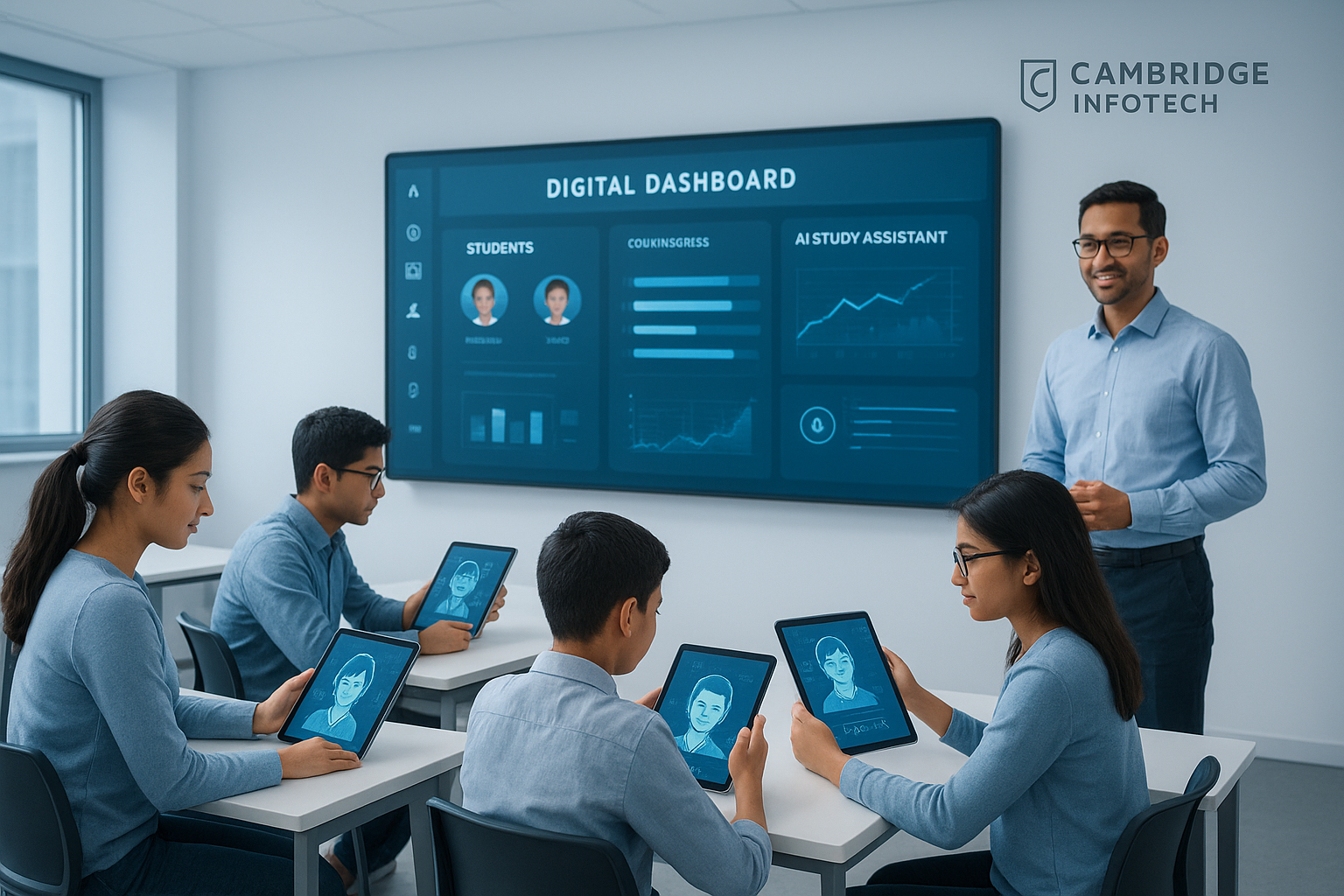
Cambridge Infotech utilizes AI learning technologies to give instructors real-time dashboards showing student performance patterns. This allows trainers to adjust their teaching strategies immediately, improving classroom outcomes.
4. Improved Engagement and Motivation
Traditional learning environments often struggle to maintain student motivation. AI changes this dynamic through gamified learning, interactive simulations, and adaptive feedback systems.
AI-powered learning platforms can detect disengagement—like when a student skips videos or shows inconsistent activity—and reintroduce motivation through quizzes, challenges, or rewards.
By making learning more interactive, Artificial Intelligence in Education transforms passive listeners into active participants. This keeps students inspired, reducing dropout rates and improving knowledge retention.
5. Data-Driven Decision Making
Educational institutions generate massive amounts of data daily—attendance records, assessments, enrollment statistics, and more. However, manually interpreting this data is time-consuming.
With AI in education, data analytics becomes intelligent and actionable. AI algorithms analyze student performance trends and predict outcomes, helping administrators make informed decisions about curriculum design, resource allocation, and teaching methods.
For instance, Cambridge Infotech leverages AI-driven personalized education analytics to understand which courses produce the best results, which students need additional support, and which technologies improve learning effectiveness.
This shift toward data-driven education ensures institutions remain agile, efficient, and focused on measurable results.
6. Accessibility and Inclusive Learning
Artificial Intelligence in Education also breaks down barriers for learners with disabilities or language challenges. Voice-to-text transcription, real-time translation, and adaptive content tools make learning more inclusive.
Students with visual impairments can use AI-driven screen readers, while those with hearing difficulties can access instant captioning. Multilingual AI assistants translate lessons into native languages, ensuring equal access for all.
At Cambridge Infotech, inclusivity is a core value. AI tools for students and teachers ensure that every learner—regardless of background or ability—can learn effectively and confidently.
7. Predictive Learning and Early Intervention
One of the most powerful advantages of AI in education is its predictive capability. AI systems can identify learning difficulties before they become major obstacles.
For example, if a student repeatedly performs poorly in assessments, the AI platform alerts teachers and suggests targeted interventions. This proactive approach minimizes dropouts and maximizes student success.
Artificial Intelligence in Education ensures that students receive the right help at the right time—making learning both responsive and preventive.
8. Lifelong Learning and Career Readiness
The world is evolving fast, and learning can no longer stop after graduation. AI-powered learning platforms make lifelong learning accessible by offering micro-courses, certifications, and self-paced programs.
Professionals can continuously upskill and stay industry-ready, while educators can learn new teaching techniques powered by data and analytics.
Institutes like Cambridge Infotech use AI learning technologies to offer flexible, personalized courses in fields such as cybersecurity, data analytics, and cloud computing—helping learners align with modern job markets.
9. Cost-Effective and Scalable Education
AI doesn’t just improve quality—it reduces costs. By automating administrative work and optimizing resources, institutions can operate more efficiently. Virtual labs, online assessments, and smart scheduling systems reduce infrastructure costs while maintaining educational quality.
This scalability allows Artificial Intelligence in Education to reach more learners at lower costs, especially in developing regions where resources are limited.
10. Sustainable and Future-Ready Education Systems
Finally, AI in education promotes sustainability. Paperless classrooms, digital assessments, and virtual collaboration tools minimize waste and carbon footprints.
Beyond environmental benefits, AI learning technologies ensure that institutions stay adaptable to future trends—such as augmented reality learning, blockchain-based certifications, and skill-based credentialing.
Cambridge Infotech is leading this change by embedding Artificial Intelligence in Education into its curriculum, ensuring that students not only learn about AI but learn through AI.
AI has proven that education can be smarter, fairer, and more responsive than ever before. Its benefits are not limited to efficiency—they extend to empathy, accessibility, and empowerment.
Real-World Applications & Case Studies of AI in Education
The transformation brought by Artificial Intelligence in Education isn’t theoretical anymore—it’s visible in classrooms, campuses, and learning platforms worldwide. From intelligent tutoring systems to AI-driven career guidance, institutes and companies alike are leveraging AI learning technologies to enhance learning outcomes, reduce inefficiencies, and personalize education at scale.
Let’s explore how these applications are shaping the educational landscape and how Cambridge Infotech is embracing them to redefine learning experiences in India and beyond.
1. Personalized Course Recommendations
One of the most common uses of AI in education is adaptive course recommendation. Platforms powered by AI learning technologies analyze each learner’s previous performance, learning pace, and interest areas to suggest the most suitable modules.
For example, if a student performs well in Python programming but struggles in data visualization, the AI system automatically recommends refresher lessons in visualization tools like Tableau or Power BI.
At Cambridge Infotech, this principle is applied in real-time through AI-powered learning platforms that tailor course suggestions for cybersecurity, data science, and cloud computing learners. Each learner receives a unique roadmap designed to align with their strengths and career goals.
This kind of AI-driven personalized education ensures no two learners follow the same path—and that every student achieves measurable growth.
2. Intelligent Tutoring and Virtual Mentors
Institutes and EdTech companies are deploying Intelligent Tutoring Systems (ITS) that act as AI mentors. These systems simulate human tutors by providing hints, explanations, and feedback.
AI chatbots, for example, can answer frequently asked questions about lessons, assignments, or exams anytime. This level of accessibility is a game-changer for students in remote or self-paced learning environments.
Artificial Intelligence in Education empowers teachers to support students even outside the classroom. A Cambridge Infotech learner, for instance, might interact with an AI tutor after hours to clarify doubts on ethical hacking or cloud computing concepts—without waiting for the next live session.
Such AI tools for students and teachers reduce dependency on fixed class hours and improve engagement by ensuring help is always available.
3. Automated Assessment and Feedback Systems
Traditionally, grading assignments or tests is a time-intensive process for educators. With AI learning technologies, assessments can now be automated—grading not only multiple-choice questions but also essays, coding exercises, and even project work.
These systems use Artificial Intelligence in Education to evaluate context, coherence, and understanding, providing detailed feedback instantly. Teachers can then review AI-generated insights to identify where students need additional support.
At Cambridge Infotech, automated evaluation tools are being used in technical training courses to help trainers focus more on mentoring rather than manual grading. This accelerates learning and ensures consistent assessment quality.
4. Predictive Analytics for Student Success
The predictive power of AI in education is revolutionizing student management. AI models can analyze attendance, grades, participation, and behavioral data to predict which students might be at risk of underperforming.
By detecting early warning signs, institutes can intervene proactively—assigning mentors, extra classes, or personalized support.
This approach has been implemented successfully by Cambridge Infotech, where predictive analytics tools track learner engagement in cybersecurity and cloud computing programs. Early detection of challenges helps instructors ensure that every learner reaches their goals.
Predictive systems also guide academic planning by forecasting which subjects or certifications will see the highest demand in the coming years—helping institutes stay ahead of industry trends.
5. Real-Time Language Translation and Accessibility Tools
Artificial Intelligence in Education is also improving inclusivity. Real-time translation tools break down language barriers, allowing students from diverse linguistic backgrounds to learn seamlessly.
For instance, AI captioning tools can transcribe lectures into multiple languages simultaneously, while voice assistants can convert speech into text for students with hearing impairments.
Cambridge Infotech’s digital training platforms incorporate these accessibility features to ensure every learner—whether from Bengaluru or beyond—can access content comfortably.
This application of AI in education aligns perfectly with the vision of global, inclusive learning.
6. Virtual Reality (VR) and Augmented Reality (AR) Learning
When combined with AI, immersive technologies like VR and AR create deeply engaging learning experiences. Imagine studying human anatomy with 3D simulations or practicing cybersecurity scenarios in a virtual lab.
AI enhances these systems by personalizing virtual environments based on student performance. If a learner excels, AI increases the challenge level; if not, it adjusts the simulation accordingly.
At Cambridge Infotech, AI-powered learning platforms are being explored to integrate such immersive learning for cybersecurity training—allowing students to simulate ethical hacking exercises safely and realistically.
This fusion of AI learning technologies with immersive tools represents the next evolution in education.
7. AI for Administrative Efficiency
Beyond teaching, Artificial Intelligence in Education streamlines campus operations—automating admissions, scheduling, and even placement coordination. Chatbots assist with inquiries about courses, fees, and enrollment steps, while AI dashboards help management track institutional performance.
Cambridge Infotech utilizes AI-assisted data dashboards to optimize training batches, instructor availability, and student performance tracking. This ensures better planning, smoother communication, and faster response times for both staff and learners.
8. AI-Enhanced Placement and Career Guidance
Career guidance is another area where AI in education delivers high value. Intelligent systems match students’ skills, certifications, and preferences with suitable job opportunities.
These tools analyze thousands of job descriptions and market trends to suggest personalized career paths. For example, a student skilled in networking and cloud computing may be guided toward DevOps or cybersecurity roles.
At Cambridge Infotech, AI-driven personalized education is complemented by AI-based placement tools that prepare learners for real-world job demands. Resume analyzers, mock interview bots, and skill-matching engines ensure that every graduate is career-ready.
9. Case Study: Cambridge Infotech’s AI Integration Journey
Cambridge Infotech, a premier technology training institute in Bengaluru, has been pioneering the use of Artificial Intelligence in Education to enhance learning outcomes and student success.
Through the implementation of AI learning technologies, the institute personalizes every learner’s experience—from adaptive course recommendations to automated performance tracking. Its AI-powered learning platforms allow students to study anytime, anywhere, with smart assistance that guides their progress.
Moreover, instructors benefit from predictive analytics that identify struggling students early, enabling timely intervention. The result is a student-centered ecosystem where education is personalized, practical, and performance-driven.
The institute’s placement cell also uses AI in education to match graduates with job opportunities that suit their skill sets, streamlining the transition from classroom to career.
By embedding AI into every layer of its operations, Cambridge Infotech has positioned itself as a leader in next-generation, AI-driven education.
Artificial Intelligence in Education is no longer an abstract concept—it’s a proven force driving success, engagement, and innovation in institutions like Cambridge Infotech. From adaptive learning to predictive analytics and immersive training, AI continues to make education smarter, fairer, and more human.
Challenges, Ethics & The Future of AI in Learning
While the opportunities created by Artificial Intelligence in Education are enormous, every revolution brings its share of challenges. AI has improved personalization, accessibility, and efficiency, but educators and institutions must also address its ethical, social, and technical limitations to ensure that this innovation remains human-centered.
1. Data Privacy and Security Concerns
At the heart of AI learning technologies lies data—student grades, behavioral patterns, attendance, and even emotional responses. The collection of such sensitive information raises serious privacy concerns.
If not managed responsibly, the same data that enables AI-driven personalized education could expose students to identity risks or biased profiling. Institutions must establish strong governance frameworks, transparent consent policies, and robust cybersecurity protocols to protect learners.
Cambridge Infotech, for instance, follows strict data-protection standards, ensuring that every piece of learning data used in AI-powered learning platforms is encrypted and anonymized before analysis. The goal is to create trust while maintaining performance insights.
2. Bias and Fairness in AI Systems
AI models learn from historical data. If that data reflects social or cultural bias, the system might unintentionally reinforce inequities. For example, an automated grading tool trained on limited language samples might misjudge non-native speakers.
The role of Artificial Intelligence in Education must therefore include fairness audits and regular human review. Educators need to test algorithms for inclusivity and adapt them continuously to reflect diverse student populations.
At Cambridge Infotech, trainers and developers work together to evaluate every AI module—ensuring that adaptive learning with AI treats every learner equitably, regardless of background or prior exposure.
3. Over-Dependence on Technology
Another challenge is striking the right balance between technology and human interaction. While AI in education automates many tasks, excessive reliance can limit critical thinking and creativity. Students might become too dependent on instant AI feedback instead of engaging deeply with material.
To counter this, Artificial Intelligence in Education should be viewed as a support tool—not a replacement for teachers. The human mentor remains essential for emotional intelligence, moral guidance, and contextual understanding.
Cambridge Infotech emphasizes blended learning, where AI tools for students and teachers enhance—not replace—live mentorship, teamwork, and discussion-based sessions.
4. Cost and Infrastructure Barriers
Implementing AI learning technologies requires significant investment in infrastructure, software, and skilled personnel. For smaller institutions, these costs can be prohibitive.
Cloud-based AI-powered learning platforms offer a solution by lowering setup costs, but consistent funding and staff training remain necessary. Collaboration between government, industry, and educational institutions can make AI integration more sustainable and equitable.
Cambridge Infotech continues to demonstrate that scalable AI adoption is achievable through partnerships and modular deployment—proving that innovation and affordability can coexist.
5. Ethical Use of Student Data and Automation
Ethical concerns go beyond privacy—they include transparency and accountability. Students and parents should understand how AI systems make decisions, what data they use, and how outcomes are determined.
Institutions leveraging Artificial Intelligence in Education must commit to open communication. Explaining how an algorithm recommends courses or grades assignments builds confidence among learners and faculty alike.
At Cambridge Infotech, every AI-assisted process is backed by human validation. Automated results are reviewed by instructors to ensure fairness, keeping human oversight central to the institute’s philosophy.
6. Skill Gap Among Educators
The rise of AI in education introduces a new challenge: preparing educators to use it effectively. Teachers must understand AI fundamentals to interpret its recommendations accurately. Without adequate training, even the best technology can fail.
Professional development programs in AI literacy, data analysis, and digital pedagogy are now essential. Cambridge Infotech addresses this through regular faculty workshops on the latest AI learning technologies and best practices in AI-driven personalized education.
7. The Future of AI in Learning
Despite these challenges, the future of Artificial Intelligence in Education is extraordinarily bright. Over the next decade, expect to see deeper integration of generative AI, augmented-reality classrooms, and hyper-personalized learning paths that adjust to each learner’s cognitive style.
a. AI and Immersive Learning
Virtual and augmented reality powered by AI will bring subjects to life—allowing learners to explore molecular biology in 3D or simulate cybersecurity breaches in controlled digital labs.
Cambridge Infotech is already exploring AI-powered learning platforms that combine immersive simulation with real-time feedback, giving students hands-on experience that mirrors real industry challenges.
b. AI for Global Collaboration
AI-driven translation, real-time captioning, and cross-language communication will enable global classrooms. Learners from different countries can collaborate effortlessly, erasing linguistic and geographic barriers.
Artificial Intelligence in Education will make global exchange of knowledge not only possible but natural.
c. AI and Career Forecasting
Future AI learning technologies will go beyond teaching—they’ll predict emerging careers and recommend skills before the market demands them. For institutes focused on employability, this is transformative.
Cambridge Infotech’s career-mapping AI modules already analyze industry trends and match student skill data to potential roles, ensuring learners stay job-ready in dynamic markets.
8. Building Ethical, Human-Centered AI Education
To make this vision sustainable, educational institutions must design ethical frameworks around AI use. These should include:
-
Transparency: clearly explaining AI decision-making.
-
Accountability: ensuring human oversight at every level.
-
Inclusivity: designing for diverse learner populations.
-
Security: safeguarding data through strong encryption and consent mechanisms.
The aim of Artificial Intelligence in Education should never be to replace humans but to amplify human potential. When implemented responsibly, AI creates a world where learning is continuous, personalized, and equitable.
9. Cambridge Infotech’s Vision for AI-Empowered Education
Cambridge Infotech envisions an education system where AI in education is seamlessly embedded into every learner’s journey—from foundational skill building to career placement.
The institute’s upcoming initiatives include integrating AI tools for students and teachers that monitor progress, recommend courses, and provide instant support. Through partnerships with industry experts, Cambridge Infotech ensures its learners gain not only technical knowledge but also practical exposure to how Artificial Intelligence in Education is reshaping global workplaces.
By focusing on innovation, accessibility, and ethics, Cambridge Infotech continues to stand as a model of responsible AI adoption in training and professional education.
 Conclusion – The Smarter Future of Education with Artificial Intelligence
As we’ve explored throughout this article, Artificial Intelligence in Education is not just an emerging trend — it’s a global movement transforming how knowledge is delivered, absorbed, and applied. From predictive analytics to adaptive content and AI-powered classrooms, the shift toward AI learning technologies is creating smarter, more inclusive educational systems that truly understand every learner’s needs.
According to UNESCO’s Artificial Intelligence in Education Initiative, AI can accelerate progress toward equitable and high-quality education worldwide. Similarly, research from EdTech Magazine highlights that AI adoption in learning platforms improves student engagement and performance by over 30%.
At Cambridge Infotech, we see these transformations happening daily. Students enrolled in our AI Course in Bangalore and Data Science Training programs experience how Artificial Intelligence in Education is changing traditional classrooms into dynamic, data-driven ecosystems.
AI and Career-Driven Learning
The future workforce will depend on skills that blend creativity, technology, and critical thinking. The World Economic Forum’s Future of Jobs Report predicts that AI and data roles will dominate global employment markets by 2030.
At Cambridge Infotech, our courses are designed to align with this future. Learners can explore specialized paths like Machine Learning Course in Bangalore, Cybersecurity Course, and Digital Marketing Course — each enriched with AI applications, case studies, and real-time project work.
This ensures that every student doesn’t just understand AI theoretically but also learns to implement AI tools for students and teachers in real-world environments — a skillset that’s in high demand across industries.
The Cambridge Infotech Advantage
Our AI-integrated programs empower learners to adapt to the future of AI in learning. Whether it’s understanding AI-driven personalized education, mastering intelligent data systems, or exploring adaptive learning with AI, students gain both knowledge and hands-on experience.
We also utilize Microsoft AI Learning Tools and Google for Education Classroom AI features to provide a globally aligned learning experience that prepares cambridgeinfotech.io/cybersecurity-course-in-bangalore students for cutting-edge roles.
Cambridge Infotech’s trainers are industry professionals who not only teach AI concepts but demonstrate their application in real-time business scenarios. Combined with dedicated placement support, our approach ensures you are career-ready and AI-confident from day one.
Take the Next Step
Education powered by Artificial Intelligence is no longer a concept of the future — it’s here, and it’s transforming careers right now.
If you’re ready to elevate your learning experience, explore our industry-recognized courses:
Or get in touch directly to discuss your learning goals — Enroll Now at Cambridge Infotech.
Join the movement where Artificial Intelligence in Education meets real-world innovation. Empower your future today with Cambridge Infotech — because the future belongs to those who learn with intelligence.