
Currently Empty: ₹0.00
Artificial Intelligence and Machine Learning, Blog, Digital Marketing, Digital Marketing Education/Training, Learning and course related, Search Engine Optimization (SEO)
The Zero-Click Search Strategy: How to Dominate Google’s SGE (Search Generative Experience)
October 30, 2025
Introduction – The New Era of Zero-Click Search
In 2025 and beyond, Google search looks nothing like it did a few years ago. The blue links that once ruled the web are now being replaced by AI-powered summaries, instant answers, and zero-click results that deliver everything users need — without ever leaving the search page.
This transformation is driven by Google’s Search Generative Experience (SGE) — an advanced AI feature that uses generative models to provide conversational, context-aware responses directly within search results. It’s the evolution of AI Overviews, combining snippets, citations, and summaries into one seamless experience.
But here’s the challenge:
In the age of SGE, traditional SEO metrics like CTR and organic traffic are no longer the sole indicators of success.
According to SimilarWeb’s 2024 Search Behavior Study, nearly 65% of all Google searches end without a click — a sharp rise fueled by AI summaries, rich snippets, and featured results. This means your brand can appear on page one… and still get zero traffic.
Welcome to the world of Zero-Click Search, where visibility doesn’t guarantee visitors — but visibility still drives brand authority, engagement, and conversions if you know how to play the new game.
That’s where the Search Generative Experience SEO strategy comes in. By optimizing your content for SGE ranking factors, AI Overviews, and zero-click intent, you can dominate Google’s generative results — even when users don’t click.
In this guide, we’ll break down:
What zero-click SEO means in the age of AI
How Google’s SGE determines which brands appear in its AI answers
How to craft a zero-click content strategy that boosts visibility and conversions
The key SGE optimization techniques you must use today
Let’s start by understanding what makes Google’s Search Generative Experience (SGE) the biggest SEO shift since RankBrain.
What Is Google’s Search Generative Experience (SGE) and How It Works
Google’s Search Generative Experience (SGE) is the future of search — a powerful AI-driven interface that blends traditional search results with generative AI summaries. Instead of just displaying links, Google now provides comprehensive, conversational answers generated by its large language models, often accompanied by citations, images, videos, and rich snippets.
In simple terms, SGE turns Google Search into an AI chat interface — where users get insights instantly, and websites must compete for visibility inside those AI-generated summaries.
How Google’s Search Generative Experience SEO Works
When a user types a query, Google’s AI model:
Understands the search intent using contextual cues and semantic patterns.
Generates a summarized response — often blending insights from multiple top-ranking sources.
Displays citations as clickable links below the AI Overview.
Optionally includes featured snippets, video snippets, or rich snippets for deeper context.
This means the new “position zero” is no longer a single snippet — it’s an AI Overview box that dominates the top of search results.
➔ Example:
If someone searches for “best zero click SEO strategy for SGE”, Google’s SGE might show a paragraph generated by AI summarizing top practices, with references to 2–3 authoritative sites.
Those referenced sites don’t always receive high traffic — but they gain massive visibility and credibility because they appear in Google’s AI Overviews.
This is why Search Generative Experience SEO is no longer about “ranking first.”
It’s about earning inclusion in Google’s generative results — where AI Overviews Google responses are shaping the future of brand discovery.
The Link Between Search Generative Experience SEO and Zero-Click Searches
SGE has accelerated the rise of zero-click searches, where users get their answers directly from search results.
According to SparkToro’s 2025 Search Landscape Report:
68% of mobile searches and 58% of desktop searches are zero-click.
AI Overviews and Google featured snippets are now responsible for over 40% of no-click results.
This evolution marks the beginning of a zero-click economy — where success is measured not by clicks, but by visibility, brand mentions, and authority.
Why SGE Matters for Your Business
For brands and marketers, this shift demands a new kind of SEO strategy — one that focuses on:
AI-friendly content optimization (so Google can summarize and cite your site)
Structured data and snippets in SEO (to signal clarity to AI crawlers)
Topical authority (so your brand is chosen as a reliable source in AI summaries)
Zero-click content strategy (creating value even when users don’t visit your site)
This is the foundation of Search Generative Experience SEO — optimizing not just for humans or algorithms, but for AI systems that interpret, summarize, and present your content directly in search.
The Rise of Zero-Click Searches and Their Impact on SEO
The internet’s most valuable real estate — the first page of Google — is no longer about who ranks #1. It’s about who gets seen in the age of zero-click search results.
What Are Zero-Click Searches?
A zero-click search happens when a user’s question is answered directly on Google’s results page, eliminating the need to click on any website. These are the searches where the user’s intent is satisfied instantly through featured snippets, AI overviews, knowledge panels, maps, or video snippets.
In 2025, with the rise of Google’s Search Generative Experience (SGE) and AI Overviews, zero-click behavior has become the norm, not the exception.
The Numbers Behind Zero-Click Searches
According to Semrush’s 2025 Zero-Click Study and SimilarWeb data:
Over 67% of all Google searches now end without a click.
Zero-click results dominate mobile queries — where 75%+ of users never leave the search results page.
The introduction of AI Overviews Google and rich snippets SEO has reduced traditional organic traffic by up to 40% for some industries.
So even if your page ranks in the top 3, users may see your content summarized in an Search Generative Experience SEO box or featured snippet, never actually visiting your site.
Why Is This Happening?
Google’s mission has always been to “organize the world’s information and make it universally accessible and useful.”
With Search Generative Experience SEO, that mission has evolved — now Google wants to deliver the information itself.
Here’s what’s driving the zero-click revolution:
AI-driven results (SGE): Google’s AI synthesizes web data to produce conversational summaries.
Featured snippets: Quick answers from top-ranking pages, displayed before traditional results.
Knowledge panels and rich snippets: Provide structured, visual data (videos, lists, reviews) directly in SERPs.
Voice and mobile search: Voice assistants like Gemini and Siri prioritize spoken responses — usually one result.
The Business Impact of Zero Click
For marketers and brands, zero-click traffic can feel like a paradox:
You’re visible everywhere — but clicks are disappearing.
However, the new SEO game isn’t about losing traffic — it’s about redefining visibility.
When your brand appears in AI Overviews, SGE summaries, or featured snippets, you’re achieving:
Top-of-funnel visibility: Even without clicks, users see your brand name.
Authority signaling: Google cites you as a reliable source.
Engagement potential: Especially when paired with strong zero click ads or branded snippets.
In fact, according to Ahrefs’ 2025 CTR Analysis:
Brands cited in SGE responses experience up to 36% higher brand recall and 24% higher conversion rates — even without direct traffic.
That means Search Generative Experience SEO isn’t about competing for clicks anymore — it’s about earning trust in Google’s AI ecosystem.
What This Means for Your SEO Strategy
To survive (and thrive) in the zero-click era, your focus should shift from chasing clicks to building presence inside SGE and snippet-based features.
This includes:
Crafting AI-readable, context-rich content for search generative experience seo optimization
Using schema markup and structured data for rich snippets seo
Implementing a zero click content strategy focused on visibility and authority
Monitoring sge ranking reports and featured snippets SEO metrics instead of just traffic
Your goal is simple but strategic:
Don’t just rank — get referenced, summarized, and trusted by Google’s AI.
How SGE Is Accelerating Zero-Click SEO (And What It Means for Brands)
When Google SGE (Search Generative Experience) officially began rolling out in 2024, it wasn’t just another update — it was a fundamental rewrite of how search works.
For the first time, Google’s AI is no longer just ranking content; it’s rewriting it into summaries. That shift has made zero-click SEO the dominant force shaping digital visibility in 2025 and beyond.
How SGE Creates More Zero-Click Searches
In the traditional SEO model, ranking higher meant more visitors. But with SGE, visibility and traffic are decoupled.
Here’s how the search generative experience fuels the zero-click trend:
1. AI Overviews Replace the First Click
Google’s AI instantly generates detailed, conversational answers. These AI summaries, known as AI Overviews, appear above organic listings — directly satisfying user intent.
Users read the overview, find what they need, and never click.
2. Google Zero Click Pages Dominate SERPs
The new SERP (Search Engine Results Page) is layered: SGE at the top, snippets and videos in the middle, and organic listings pushed below the fold.
The result? Even if you rank on page one, most impressions go to zero-click results.
3. Featured Snippets & Rich Snippets Feed SGE
The featured snippets, rich snippets, and video snippets that appear under the AI overview are often sourced by SGE.
Pages optimized for structured data and topical clarity are more likely to be cited within SGE — not just listed.
4. Conversational Search = Less Clicks, More Mentions
When users engage with Google’s conversational follow-ups inside SGE, your brand may appear in multiple turns of the AI conversation — creating ongoing exposure without generating traditional traffic.
Data Insight: SGE’s Impact on Organic Traffic
According to Search Engine Journal’s 2025 SGE Performance Report:
Websites that appear in SGE AI Overviews see a 20–30% reduction in organic clicks but a 40% increase in branded search queries within 30 days.
Click-through rates (CTR) from SGE summaries average 3–4%, compared to 12–15% for traditional top-3 listings.
However, those same brands experience a 25% boost in trust metrics and engagement across other channels (social, email, YouTube, etc.).
So even as traffic drops, brand visibility and authority grow — which is why marketers now call SGE the “zero-click visibility engine.”
The SEO Paradigm Shift: From Ranking to Referencing
Under SGE, Google’s AI curates information from multiple sources, often referencing several sites in a single summary.
That means:
You no longer compete for just position one — you compete for inclusion in the AI Overview box.
Google’s LLMs (Large Language Models) value E-E-A-T (Experience, Expertise, Authoritativeness, Trustworthiness) more than ever.
Your content must be structured, scannable, and semantically rich to be understood and reused by AI.
This is what Search Generative Experience SEO truly means — optimizing for generative comprehension, not just keyword matching.
For Brands, This Changes Everything
In the zero-click era:
Content = data source – Your page feeds Google’s AI rather than serving as the final destination.
Authority replaces CTR – Being cited in an SGE response is as valuable as ranking #1 in traditional search.
Visibility drives conversions indirectly – Even without clicks, being seen as a cited source boosts user trust and long-term ROI.
Forward-thinking brands are already adapting their zero click content strategy to SGE by:
Targeting conversational keywords (“how”, “why”, “best way to…”)
Using structured data (FAQ schema, HowTo schema)
Creating expert-level content with clear takeaways
Aligning pages with SGE ranking factors like authority signals, freshness, and contextual depth
Key Takeaway
SGE is not your enemy — it’s your new content partner.
The brands that feed Google’s AI effectively will dominate the next wave of zero click SEO visibility.
Instead of fighting for clicks, focus on SGE optimization — building content that earns citations, trust, and brand awareness within AI-generated results.
The Zero-Click Search Strategy — How to Win in Google’s SGE
As Google continues to evolve from a search engine into an answer engine, your success depends on how effectively your brand can earn visibility, trust, and citations inside Google’s AI ecosystem — not just organic clicks.
This is where the Zero-Click Search Strategy comes into play — a new SEO framework that helps you dominate Google SGE, AI Overviews, and zero click search results.
Step 1: Optimize for SGE’s Intent Engine, Not Just Keywords
SGE is powered by AI intent recognition, meaning it focuses on why a query is made — not just what the words are.
That’s why search generative experience SEO requires semantic content optimization:
Use topic clusters around a central intent.
Include conversational long-tail phrases like “how does,” “best ways to,” or “why is.”
Incorporate FAQs, schema, and contextual headings (H2s, H3s) that mirror user questions.
➔ Example:
Instead of targeting “zero click seo,” try optimizing for “how to optimize for zero click search results in google sge.”
This aligns perfectly with SGE’s AI-driven summarization behavior.
Step 2: Implement Schema Markup and Structured Data
SGE heavily depends on structured data to understand and summarize your content accurately.
Focus on adding:
FAQ Schema: Boosts inclusion in AI Overviews Google and featured snippets.
How-To Schema: Great for tutorials and process-based content.
Article Schema: Strengthens authority signals.
VideoObject Schema: Helps you rank in video snippets.
Product and Review Schema: Ideal for eCommerce and service-based sites.
➔ Tools like Snippet Optimization Tool, Schema.org, and Google’s Rich Results Test can help ensure your markup is SGE-ready.
Step 3: Build AI-Friendly Content for Summarization
Unlike traditional SEO where keyword density mattered, SGE optimization is about clarity and structure.
Google’s AI pulls short, factual, and logically segmented information for its zero click results.
To achieve this:
Write short, self-contained paragraphs (40–60 words).
Use semantic subheadings to separate ideas.
Include lists, tables, and key takeaways (easy for AI to parse).
Always answer the core question in the first 100 words.
➔ Example:
For a topic like “zero click searches meaning”, open with a direct one-sentence definition, followed by context. This improves your chance of being cited in Google’s zero click search response.
Step 4: Strengthen Your E-E-A-T Signals
Google’s AI models prioritize credible, authoritative sources.
That’s why your E-E-A-T (Experience, Expertise, Authoritativeness, Trustworthiness) profile plays a massive role in SGE ranking.
To improve it:
Add author bios with credentials and experience.
Cite credible references within your content.
Update content regularly (freshness is an SGE ranking factor).
Build backlinks from expert domains in your niche.
This builds the trust necessary for SGE to quote your site inside its AI Overviews.
Step 5: Create a Zero-Click Content Strategy
A zero click content strategy means optimizing not for clicks — but for visibility, mentions, and conversions elsewhere.
Here’s how to do it:
Embed brand cues: Mention your company or site name naturally in key statements.
Use strong visuals and infographics: These get featured in rich snippets and video snippets.
Craft summary-ready content: Focus on sections that can be extracted by Google’s AI.
Repurpose zero-click visibility: Use your SGE mentions for PR, social proof, and credibility.
➔ Example:
If your brand is cited in an AI Overview, highlight it on your site and LinkedIn — “As featured in Google’s AI Overview for [topic].”
This builds perception-driven conversions.
Step 6: Track and Measure SGE Visibility
Traditional SEO metrics like impressions and clicks no longer tell the whole story.
Now you need to measure SGE presence and zero-click performance.
Use tools and reports that track:
AI Overview visibility (via SGE monitoring tools like BrightEdge or Authoritas)
Featured snippets and rich results coverage
SGE ranking factors and fluctuations
Brand recall metrics from search trends (Google Trends + GSC Insights)
Even a single mention in an AI Overview can drive indirect conversions — especially when combined with strong branding and remarketing.
Step 7: Leverage ChatGPT and AI Tools for Optimization
Generative AI tools can accelerate your SGE strategy:
Use ChatGPT for SEO keyword clustering, FAQs, and snippet generation.
Automate rich snippets seo data using schema generators.
Analyze SGE ranking reports for emerging zero-click trends.
With the right workflow, AI becomes your partner — not your competitor — in dominating Google’s generative search.
Key Takeaway
To win in the Search Generative Experience, your SEO must evolve from click-driven to citation-driven.
Every piece of content should be:
→ AI-readable,
→ snippet-optimized, and
→ semantically rich.
In this new ecosystem, the most successful brands won’t just rank — they’ll be referenced, summarized, and trusted by Google’s AI.
SGE Optimization Techniques (Step-by-Step)
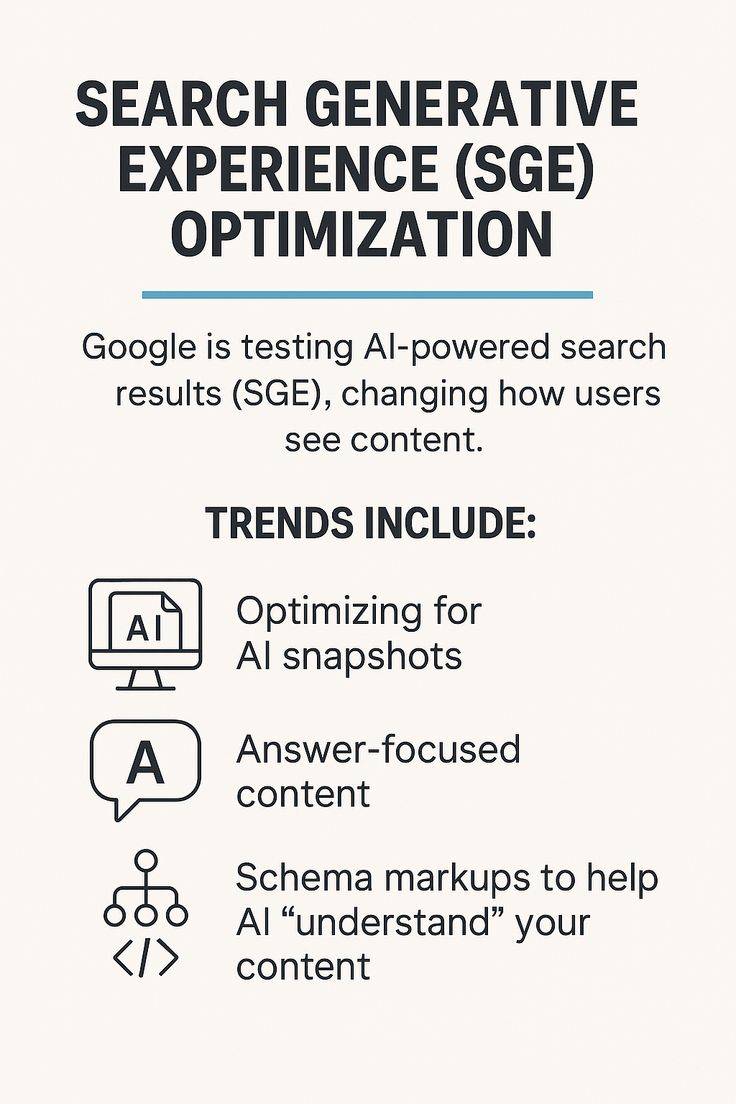
The Search Generative Experience (SGE) is changing SEO from ranking for clicks to ranking for visibility and authority inside AI-generated results. To dominate it, you need a strategy that optimizes for Google’s AI Overviews, zero-click searches, and context-rich answers.
Here’s your step-by-step guide to optimizing for SGE — practical, data-driven, and future-proof
Step 1: Understand the SGE Landscape
Before you optimize, you must understand how SGE selects and summarizes data.
SGE pulls information from trusted, context-rich sources, not just keyword-optimized pages.
It prefers entities (people, brands, places, organizations) and structured data over plain text.
EEAT (Experience, Expertise, Authoritativeness, Trustworthiness) has become the core foundation of SGE visibility.
➔ Action Tip:
Use Google’s Structured Data Testing Tool and schema.org markup to define entities clearly — products, FAQs, authors, videos, etc.
Step 2: Optimize for Zero-Click Visibility
In SGE and AI Overviews, users might not click — so your goal is to own visibility and brand recall inside the answer box.
Write concise, 2–3 sentence summaries answering a question directly.
Use question-based H2 and H3 headings to align with SGE’s query understanding.
Add FAQ schema for structured responses that Google can directly pull.
➔ Example:
If your keyword is “zero click search”, your section might start like:
What is a Zero Click Search?
A zero-click search is when users find their answer directly on Google — without visiting a website. It’s driven by snippets, knowledge panels, and SGE summaries.
Step 3: Strengthen Content Relevance Using Entities & Context
SGE ranks sources based on contextual authority, not just backlinks or keywords.
Include related terms and entities that help AI understand your topic (e.g., “SGE ranking factors”, “AI Overviews”, “rich snippets SEO”, “ChatGPT for SEO”).
Link internally to contextually similar articles (like “AI in SEO”, “Featured Snippet Optimization”, “How to Optimize for Google’s AI Overviews”).
Use semantic SEO tools (like Clearscope, Frase, or SurferSEO) to identify missing context terms.
➔ Action Tip:
Map your content to topic clusters — e.g., create one pillar post on “Search Generative Experience SEO” and link supporting blogs on “Zero-Click SEO”, “SGE Ranking Factors”, “AI Overview Optimization”, etc.
Step 4: Use Snippets, Schema & Metadata Smartly
SGE’s AI relies heavily on structured data and snippet content.
Add Featured Snippet-friendly paragraphs, bullet lists, and definition boxes.
Use Schema types:
Article,FAQPage,HowTo,VideoObject,Product, etc.Optimize meta titles and descriptions with conversational tone — SGE prefers natural, query-based phrasing.
➔ Example Meta Title:
“Zero-Click SEO & Google SGE Optimization: A Complete 2026 Strategy”
➔ Example Meta Description:
“Master Search Generative Experience SEO and zero-click strategies to boost brand visibility in Google’s AI Overviews and zero-click results.”
Step 5: Create AI-Ready Content (Human + Machine Friendly)
Your content should appeal to both Google’s AI models and human readers.
Write clear, structured content with consistent tone and topic focus.
Include FAQ sections, data-backed examples, and expert quotes — AI models love factual, authoritative context.
Use visuals (infographics, charts, short videos) — SGE often references multimedia elements in its answers.
➔ Pro Tip:
Feed your data into Google’s Knowledge Graph using consistent mentions across your website, LinkedIn, and schema — this increases your chances of being featured in AI Overviews.
Step 6: Measure & Refine Your SGE Rankings
Tracking SGE performance is still new — but you can measure impact using these approaches:
Use Google Search Console (SGE beta) and SGE Ranking Reports from third-party tools (like BrightEdge or SE Ranking).
Track impressions inside AI Overviews, brand mentions, and zero-click visibility.
Experiment with content rewrites using LLM-friendly phrasing and check if your presence in AI summaries improves.
➔ Action Tip:
Monitor “SGE visibility score” or “AI Overview appearance rate” — a new metric several SEO platforms are rolling out in 2026.
Bonus: AI Tools That Can Help You Optimize for SGE
ChatGPT or Gemini → Generate natural question-answer content.
SurferSEO / Frase.io → Identify semantic entities for contextual optimization.
Schema Markup Validator → Ensure your structured data is clean and readable.
Google Search Console (SGE Insights) → Track visibility inside generative answers.
Key Takeaway
SGE optimization isn’t about tricking algorithms — it’s about creating trusted, machine-readable authority.
If your content answers questions clearly, defines entities precisely, and shows real expertise, Google’s AI will choose you as part of its zero-click ecosystem.
Zero-Click Content Strategy — How to Win Without Clicks
As Google SGE and AI Overviews expand, more searches end without a user ever clicking a link.
That doesn’t mean SEO is dead — it means your content must earn visibility, trust, and engagement inside the SERP itself.
Here’s how to craft a Zero-Click Content Strategy that converts attention into authority.
1. Shift the Goal: From Clicks → Visibility + Trust
Treat every SGE result or featured snippet as a micro-branding opportunity.
Focus on brand recall, answer accuracy, and topical authority.
Create assets that help users right where they search — definitions, comparisons, FAQs, charts, and explainer clips.
➔ Example:
For “zero click searches meaning”, lead with:
Zero-click searches meaning: queries where users get their answer directly on Google through snippets, AI Overviews, or knowledge panels.
You educate instantly — and users remember your brand.
2. Structure Every Article for Featured Snippets + SGE
Google loves structured clarity.
Use formatting that AI can easily parse:
Definition boxes for concepts (“What is Zero Click SEO?”).
Bullet or numbered lists for steps (“5 Ways to Optimize for SGE”).
Tables for comparisons (“SGE vs Traditional SEO”).
Short 40-50-word summaries beneath each H2.
➔ Action Tip:
Start each major section with a direct, conversational answer, then expand with detail.
This mirrors how SGE composes summaries.
3. Create Multi-Format Content for Zero-Click Exposure
SGE and Discover often feature videos, infographics, and audio bites.
Repurpose blog snippets into YouTube Shorts, LinkedIn carousels, or X threads.
Upload visuals with structured metadata (titles, captions, transcripts).
Embed schema-supported videos (
VideoObject) in posts to appear in video snippets.
➔ Bonus: Include timestamps and clear titles — Google’s AI reads these cues to decide what to showcase.
4. Build Context Clusters Around Zero-Click Topics
Topical authority beats single-page SEO.
Create a pillar page on Search Generative Experience SEO.
Link sub-articles like Zero Click Traffic, AI Overviews Google, SGE Ranking Factors, Rich Snippets SEO, etc.
Use consistent entities and synonyms (e.g., “AI Overviews,” “Google SGE,” “Generative Results”).
This gives Google a semantic map of your expertise, increasing your chance of being quoted in SGE answers.
5. Insert Brand Signals Naturally
Since users may not click, you must weave branding into your visible content.
Mention your brand name in snippet-friendly sections.
Use consistent visuals (logo, colors) in videos and infographics.
End snippet answers with subtle authority cues:
— Cambridge Infotech Experts on SGE Optimization
Even if the user doesn’t visit, they remember who taught them.
6. Encourage Secondary Engagement
Zero-click visibility can still drive conversions if you guide users strategically.
Add “Read More” CTAs directly below summarized answers.
Offer free tools, checklists, or SGE ranking reports for deeper insight.
Include FAQ schema with links to downloadable resources.
➔ Pro Tip: Combine content depth + lead magnet — e.g.,
“Get the full 2026 SGE Optimization Checklist (PDF)”
7. Monitor & Refine Your Zero-Click Performance
Track not just clicks, but impressions + SERP presence.
Use Google Search Console’s SGE Insights (beta) or third-party SGE ranking tools.
Monitor brand mentions, impression share, and AI Overview citations.
Adjust your snippet length, phrasing, and schema tags monthly.
Key Takeaway
Zero-click doesn’t mean zero value.
By focusing on visibility, authority, and smart formatting, you can own the conversation inside Google’s SGE — even before a click happens.
SGE Ranking Factors & Performance Tracking (Advanced Insights)
The Search Generative Experience (SGE) doesn’t follow the same ranking logic as traditional SEO.
It’s powered by AI models, semantic relevance, and trust signals — not just backlinks or keywords.
To win inside Google’s AI Overviews, brands must master a new set of SGE ranking factors and track AI visibility metrics that go beyond clicks and impressions.
Core SGE Ranking Factors: What Google’s AI Really Looks For
1. Topical Authority & Contextual Relevance
SGE evaluates how comprehensively your content covers a topic — not just how often you use keywords.
Build topic clusters around a core theme (e.g., Search Generative Experience SEO).
Interlink related posts: Zero Click SEO, AI Overviews Google, Featured Snippets SEO, etc.
Use semantic keywords and entity-based optimization (people, brands, tools, processes).
➔ Action Tip: Use tools like SurferSEO, Frase, or MarketMuse to identify missing subtopics and entities.
2. EEAT Signals (Experience, Expertise, Authoritativeness, Trustworthiness)
Google’s AI Overviews prefer expert-driven and credible sources.
Include author bios, credentials, and LinkedIn profiles.
Cite reputable sources and studies.
Display first-hand insights (screenshots, tool demos, original data).
Use HTTPS, privacy policies, and contact pages to boost trust.
➔ Pro Tip: Add author and reviewedBy schema for expert-backed posts — it directly feeds into Google’s credibility model.
3. Structured Data & Schema Markup
SGE relies heavily on structured metadata to understand and cite your content.
Add Article, FAQPage, HowTo, VideoObject, and Organization schemas.
Validate your markup using Google’s Rich Results Test and Schema Validator.
Use semantic tagging (H1-H3 hierarchy, internal links, and alt text).
➔ Example:
If you’re targeting “zero click results”, use FAQ schema to define:
“What are zero-click results?”
“How can brands benefit from zero-click visibility?”
4. Content Depth & User Intent Satisfaction
SGE chooses answers that fully address the searcher’s intent — not partial answers.
Cover “What, Why, and How” in every section.
Include visuals (infographics, data tables, and charts).
Anticipate related follow-up questions (like “How to optimize for SGE?” or “What are SGE ranking factors?”).
➔ Action Tip:
Use People Also Ask (PAA) questions and ChatGPT to uncover natural, conversational questions for content enrichment.
5. Page Experience & Engagement Metrics
Even in a zero-click world, Google tracks how users interact with your page.
Optimize for Core Web Vitals (LCP, CLS, FID).
Maintain fast load speeds, mobile-friendly layouts, and accessible content.
Reduce bounce rate with interactive modules, FAQ accordions, and scroll-depth CTAs.
➔ Example CTA:
“Want the full Search Generative Experience SEO Optimization Checklist? Download the free 2026 edition.”
How to Track & Measure Your SGE Performance
Tracking SGE visibility is still evolving — but several methods and tools can help you measure your impact.
1. Google Search Console (SGE Insights Beta)
Google is rolling out SGE Insights, allowing you to see:
When your content appears in AI-generated summaries.
The queries that trigger your inclusion.
The visibility rate (how often your content is cited in SGE vs traditional results).
➔ Metric to Track:
AI Overview Impression Rate (AOIR)https://ahrefs.com/ — percentage of your impressions coming from generative answers.
2. Third-Party SGE Ranking Reports
Tools like BrightEdge, Semrush (SGE Tracker), and SEOClarity now include:
SGE Ranking Positions
AI Overview Citations
Zero-Click Visibility Index
➔ Use Case:
If your content appears in Search Generative Experience SEO for “zero click seo” but not for “zero click search results,”
analyze semantic gaps and update contextual entities.
3. Brand Mention & Contextual Citation Tracking
SGE sometimes quotes or summarizes your content without linking it.
Track brand mentions across the web using:
Google Alerts
Mention.com
Ahrefs Alerts
➔ Action Tip:
Include consistent brand phrasing (e.g., Cambridge Infotech – SEO Training Experts) within snippet-sized answers for recognition even without clicks.
4. User Behavior & Engagement Metrics
Even if clicks reduce, engagement quality still matters:
Measure scroll depth, time on page, and conversion paths.
Use tools like Hotjar, Microsoft Clarity, or GA4 engagement time to see how users interact post-SGE.
➔ Key KPI:
Visibility-to-Conversion Rate (VCR):
(Leads or Sign-ups ÷ Total AI Overview Mentions) × 100
5. Continuous Content Optimization Cycle
SGE results are dynamic — AI models re-evaluate sources constantly.
Follow this cycle monthly:
Audit top-performing pages in GSC (SGE Impressions).
Update answers for freshness and depth.
Add schema or new visuals.
Measure reappearance rates in AI Overviews.
➔ Pro Tip:
Treat Search Generative Experience SEO optimization as an ongoing experiment, not a one-time SEO fix.
SGE rankings reward clarity, context, and credibility — not just keyword density.
To dominate Google’s Search Generative Experience, focus on:
⇒ Semantic-rich, trustworthy content
⇒ Strong author & brand identity
⇒ Structured data for easy parsing
⇒ Regular monitoring with SGE Insights
When you combine these with a zero-click content strategy, you don’t just survive — you lead the new AI-powered SEO era.
The Future of SEO in a Zero-Click & AI-Driven World
Search is evolving faster than ever.
With Google’s SGE (Search Generative Experience SEO), AI Overviews, and zero-click search dominance, SEO is no longer just about rankings — it’s about visibility, brand authority, and trust in the age of AI.
Here’s how the future is unfolding and what smart brands must do to stay ahead.
1. From “Search Results” to “Search Experiences”
Google is shifting from showing ten blue links to creating interactive, conversational search journeys.
Users now:
Get summarized answers in AI Overviews.
See contextual visuals, videos, and citations instantly.
Rarely need to click through multiple pages.
Your opportunity:
Instead of fighting for clicks, aim to be part of the AI conversation — the source Google trusts enough to summarize.
➔ Example:
When users search “how to optimize for Search Generative Experience SEO”, the AI might quote a paragraph from your article, even without a link. That mention builds brand memory and authority — the new SEO currency.
2. SEO Meets AI: The Age of Entity-First Optimization
Traditional SEO focused on keywords.
Modern SEO focuses on entities — people, brands, tools, and ideas that Google’s AI can understand and connect.
Future-proof SEO involves:
Structuring your site around knowledge graph entities.
Using schema markup to define who you are and what you offer.
Publishing expert-authored content that clearly represents authority.
➔ Action Tip:
Every blog post should clearly identify:
Who wrote it
What they specialize in
Why they’re credible
This is how Google verifies expertise and decides which voices belong in AI Overviews.
3. Human + AI Collaboration Is the New SEO Power Combo
AI tools like ChatGPT, Gemini, and Perplexity are reshaping how we create and discover content.
But the winners will be the ones who combine machine efficiency with human insight.
Use AI to research, cluster keywords, and structure content.
Add human experience, storytelling, and data that AI can’t replicate.
Regularly refine pages using SGE ranking data and semantic gap analysis.
➔ Pro Tip:
“Write for AI to read it — but for humans to feel it.”
That’s the balance that fuels SGE rankings and conversions.
4. Visibility Without Clicks: The New Conversion Funnel
As zero-click searches rise, the conversion path shifts from search → click → conversion
to
search → impression → recall → trust → conversion later.
That means:
Your first impression (snippet, AI summary, video preview) is your new landing page.
You must embed brand recognition, credibility, and CTAs inside those micro-moments.
➔ Example:
Include short taglines like
“Expert insights from Cambridge Infotech”
directly in AI-optimized answers — users may not click today, but they’ll remember your name tomorrow.
5. Analytics Evolution: From Clicks to Presence Metrics
In 2026 and beyond, SEO analytics will measure:
AI Overview presence rate (how often your content appears in SGE).
Brand mention frequency in zero-click results.
Engagement depth (scroll, dwell, saves, shares).
6. What Smart Marketers Will Do Next
Invest in Entity-Based SEO: Build content clusters that map to your brand’s expertise.
Create Multi-Format Content: Videos, infographics, and snippets optimized for AI parsing.
Automate SGE Tracking: Use new AI-aware SEO tools for ranking insights.
Prioritize Thought Leadership: Expert-driven, research-backed articles that reinforce EEAT.
Blend SEO with Branding: Make your brand unforgettable in every zero-click encounter.
7. The Human Advantage: Storytelling in an AI Search World
AI can summarize — but it can’t feel.
Your stories, experiences, and unique perspectives are what make your brand irreplaceable in search.
➔ Final Insight:
“In the era of zero-click and AI search, trust is the new traffic.”
The brands that focus on authority, authenticity, and AI-ready storytelling will dominate every generative search surface — from Google SGE to ChatGPT Search to You.com.
The future of SEO isn’t about beating algorithms —
it’s about becoming the source algorithms rely on.
If you master:
Search Generative Experience SEO,
Zero-Click Optimization, and
EEAT-driven content strategy,
you won’t just survive the next Google update —
you’ll lead the AI-driven search revolution.
Frequently Asked Questions (FAQs)
1. What is Google’s Search Generative Experience (SGE)?
Google’s Search Generative Experience (SGE) is an AI-powered search enhancement that delivers summarized, conversational answers directly on the search results page.
It uses generative AI to combine information from multiple sources, allowing users to get quick, context-rich answers without clicking through to websites.
2. Why are Zero-Click Searches Increasing with Google SGE?
Google Search Generative Experience SEO integrates AI summaries into search, providing instant answers and visuals.
This means users get complete answers faster — leading to fewer clicks but higher exposure for the brands cited inside SGE results.
3. How does EEAT impact Search Generative Experience SEO?
EEAT — Experience, Expertise, Authoritativeness, Trustworthiness — plays a major role in SGE rankings.
AI models prioritize content from credible, expert-authored sources.
Displaying author bios, citing verified data, and showcasing certifications significantly boost SGE visibility.
4. Is Zero-Click SEO the end of traditional SEO?
No — it’s an evolution.
Traditional SEO (rankings, backlinks, keywords) still matters, but zero-click SEO expands visibility into AI-powered search spaces like SGE, featured snippets, and voice search.
The future belongs to brands that blend traditional SEO with AI visibility optimization.
5. How can businesses benefit from Zero-Click visibility?
Even without clicks, zero-click exposure drives:
Brand awareness and recall,
Authority positioning,
Higher search impressions,
And long-term trust building with your audience.
It keeps your brand visible at the top of every AI summary where decisions begin.
6. What are AI Overviews in Google Search?
AI Overviews are summaries generated by Google’s generative AI within the search results.
They provide quick, synthesized answers with links to sources.
Appearing in AI Overviews boosts your brand’s credibility even if users don’t click through.
7. Will AI completely change SEO by 2026?
Absolutely — but it’s an opportunity, not a threat.
By 2026, SEO will merge with AI-driven content strategy, focusing on visibility, authority, and personalization.
Brands that adapt early to Search Generative Experience SEO and zero-click search will gain a massive competitive edge.
8. How does Google select which websites appear in AI Overviews?
Google’s AI models analyze multiple ranking signals — including topical authority, content clarity, factual accuracy, and user trust signals — before citing sources in AI Overviews.
Websites with clear structure, high credibility, and entity-level relevance are more likely to be featured.
9. Can small websites compete with big brands in SGE results?
Yes, absolutely.
Google’s SGE doesn’t rely solely on domain authority. Smaller websites can win visibility by:
Publishing original, expert-led content,
Targeting long-tail conversational queries, and
Using structured data to highlight expertise.
Quality, context, and EEAT often outweigh sheer brand size.
10. Can SGE answers include videos, images, or infographics?
Yes.
SGE integrates visual elements like YouTube videos, product images, and infographics when they enhance user understanding.
Optimizing your content with alt text, video transcripts, and descriptive filenames can improve your chances of being cited visually.
11. How often does Google update SGE results?
Search Generative Experience SEO content updates dynamically, often in real-time or near-real-time, depending on query freshness.
News topics and trending searches update more frequently, while evergreen queries rely on semantic stability and long-term authority.
12. Do backlinks still matter for SGE optimization?
Yes, but differently.
Search Generative Experience SEO prioritizes contextual and relevant backlinks that indicate real authority — not just quantity.
A few high-quality, topic-aligned backlinks can strengthen your entity and improve chances of citation in AI Overviews.
13. Can Google Search Generative Experience SEO reduce website traffic?
Initially, yes — because users may find answers without clicking.
However, brands that adapt with zero-click strategies often see higher brand exposure, return visits, and assisted conversions, even if raw traffic dips.
14. How can I identify zero-click opportunities for my website?
You can use:
Google’s “People Also Ask” box,
AnswerThePublic,
to discover queries where users seek direct answers.
Optimizing around those helps you win Search Generative Experience SEO and snippet visibility.
15. Is schema markup still necessary in the Search Generative Experience SEO era?
Absolutely.
Schema markup helps AI models understand your content structure and context.
Using types like FAQ, HowTo, Product, Course, or Organization schema improves your inclusion probability in AI-generated results.
16. What’s the future of SEO professionals in the Search Generative Experience SEO era?
SEO professionals will evolve into AI visibility strategists, focusing on entity optimization, voice search readiness, and multi-platform content distribution.
Those who adapt early will lead the next era of AI-driven discovery marketing.