
Currently Empty: ₹0.00
Artificial Intelligence and Machine Learning, Blog, Cybersecurity, Ethical Hacking, Learning And Course Related
AI vs AI in Cybersecurity: How Hackers Use AI and How Security Teams Fight Back in 2026
January 2, 2026
Cybersecurity is no longer humans versus machines.
In 2026, the real battle is AI vs AI in cybersecurity.
Hackers are using artificial intelligence to automate attacks, scale cybercrime, and bypass traditional defenses. At the same time, security teams are deploying advanced AI systems to detect, predict, and neutralize threats in real time.
This article is a deep, practical, and future-focused guide on AI vs AI in cybersecurity, written to help students, professionals, enterprises, and decision-makers understand what’s really happening behind the scenes.
What is AI vs AI in Cybersecurity?
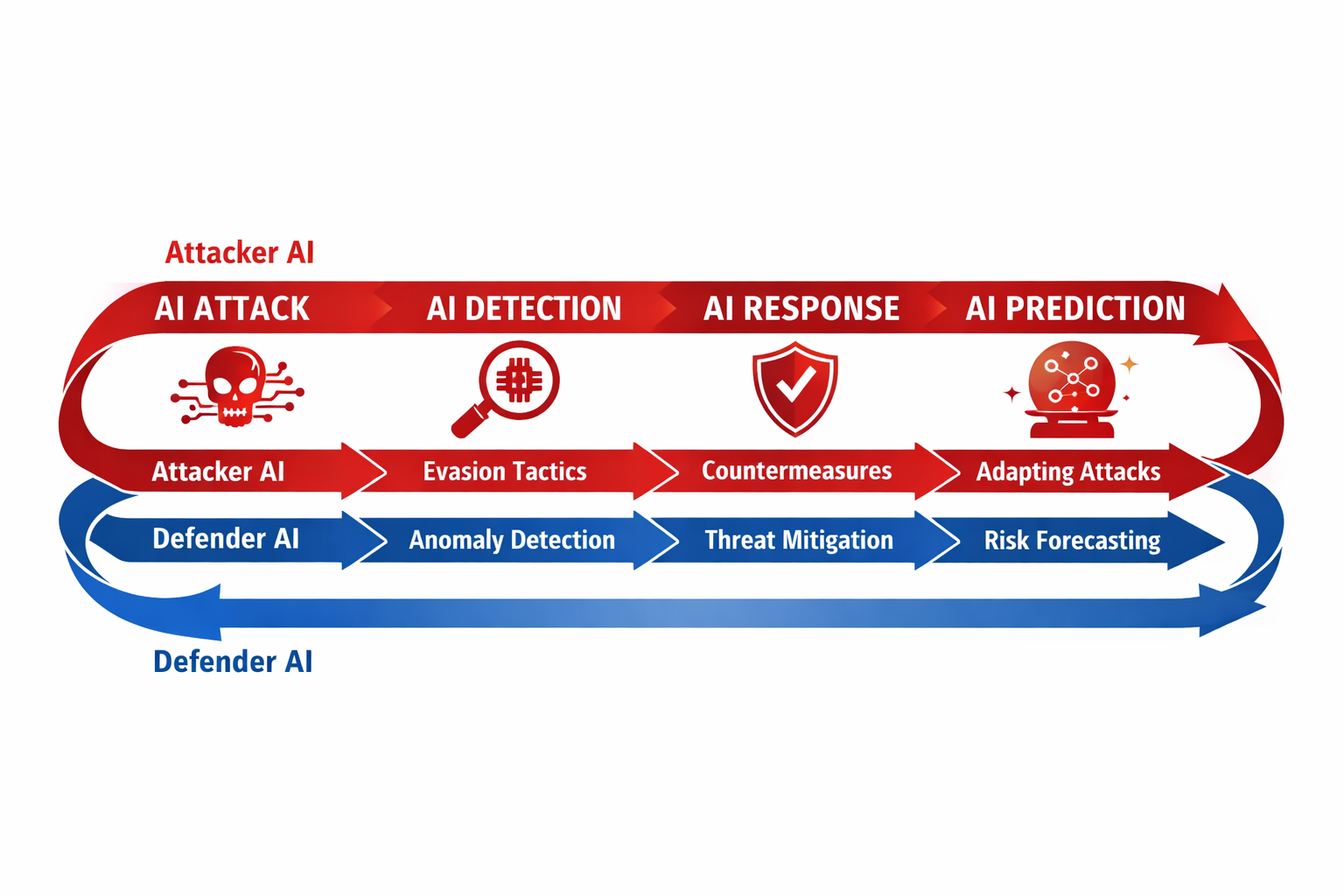
AI vs AI in cybersecurity refers to the ongoing battle where:
Attackers use AI to launch faster, smarter, and more adaptive cyberattacks
Defenders use AI to detect anomalies, predict threats, and automate response
Instead of humans manually monitoring systems, AI systems now fight other AI systems — at machine speed.
This shift has fundamentally changed how cyber warfare works.
Why AI vs AI in Cybersecurity Matters More Than Ever in 2026
The importance of AI vs AI in cybersecurity has exploded due to:
Massive digital adoption in India
Cloud, fintech, and UPI growth
Remote work and SaaS expansion
Explosion of generative AI tools
Rise of deepfake-based fraud
Traditional rule-based security cannot keep up with AI-powered attacks anymore.
That’s why AI vs AI in cybersecurity is now a top priority for enterprises and governments.
How Hackers Use AI in Cyberattacks
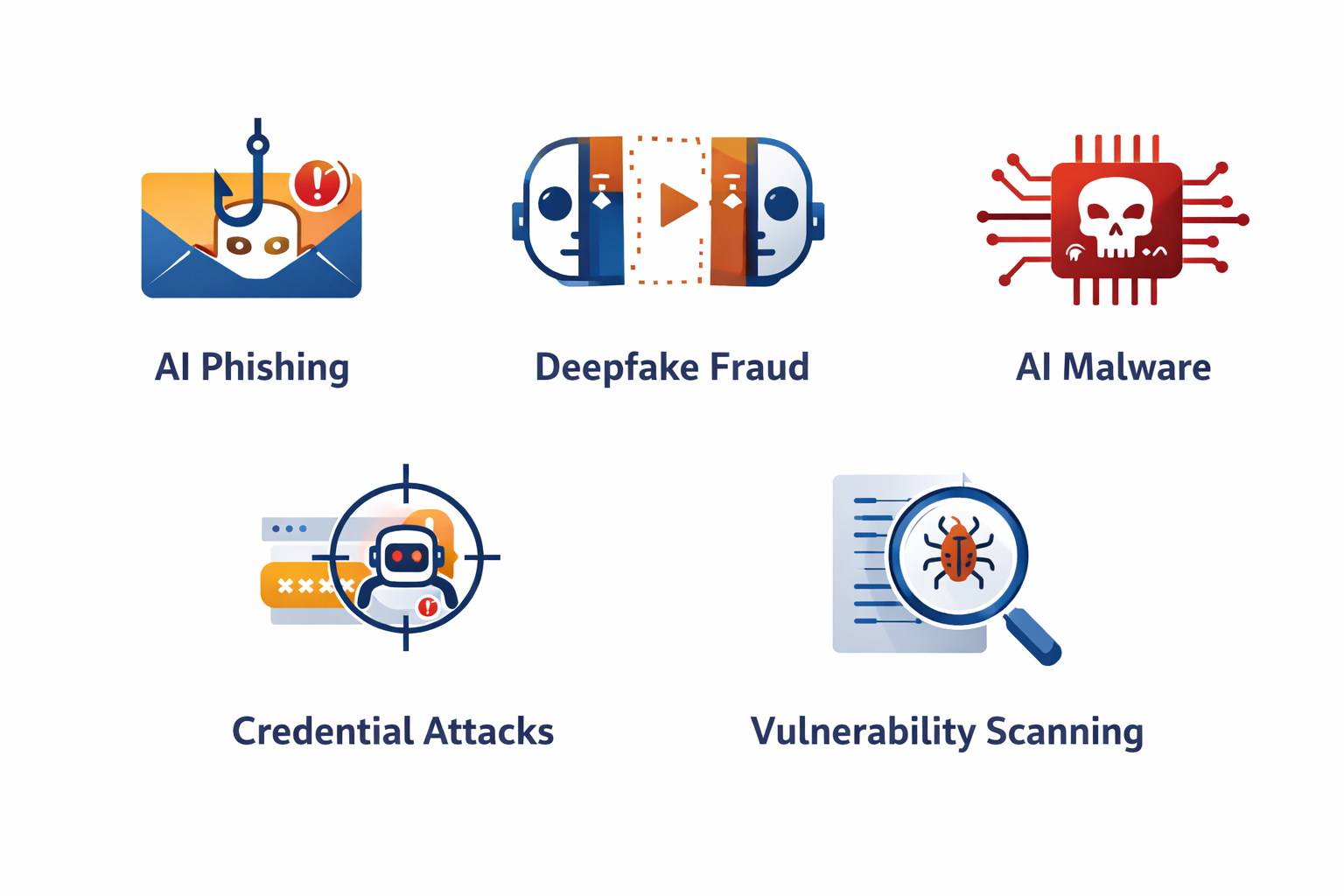
Let’s first understand the offensive side of AI vs AI in cybersecurity.
1. AI-Powered Phishing & Social Engineering
Hackers use generative AI to:
Write perfect phishing emails
Mimic tone, language, and context
Generate localized messages for Indian users
Run thousands of variations automatically
In AI vs AI in cybersecurity, phishing is no longer obvious or poorly written.
2. Deepfake Attacks (Voice, Video & Identity)
Deepfake fraud is one of the fastest-growing threats in AI vs AI in cybersecurity.
Attackers use AI to:
Clone CEO voices
Fake video calls
Impersonate executives
Bypass KYC and identity checks
Several Indian companies have already faced crore-level losses due to AI-based impersonation.
3. AI-Generated Malware
In AI vs AI in cybersecurity, malware is now:
Self-modifying
Polymorphic
Adaptive to environments
AI can:
Rewrite malicious code
Evade signature-based detection
Change behavior dynamically
This makes traditional antivirus almost useless.
4. Automated Vulnerability Discovery
Hackers use AI to:
Scan millions of endpoints
Identify weak configurations
Exploit zero-day vulnerabilities faster than humans
This automation gives attackers a huge advantage in the AI vs AI in cybersecurity battle.
5. AI-Driven Credential Stuffing & Brute Force Attacks
AI helps attackers:
Predict password patterns
Optimize login attempts
Avoid lockout thresholds
This makes credential-based attacks far more effective.
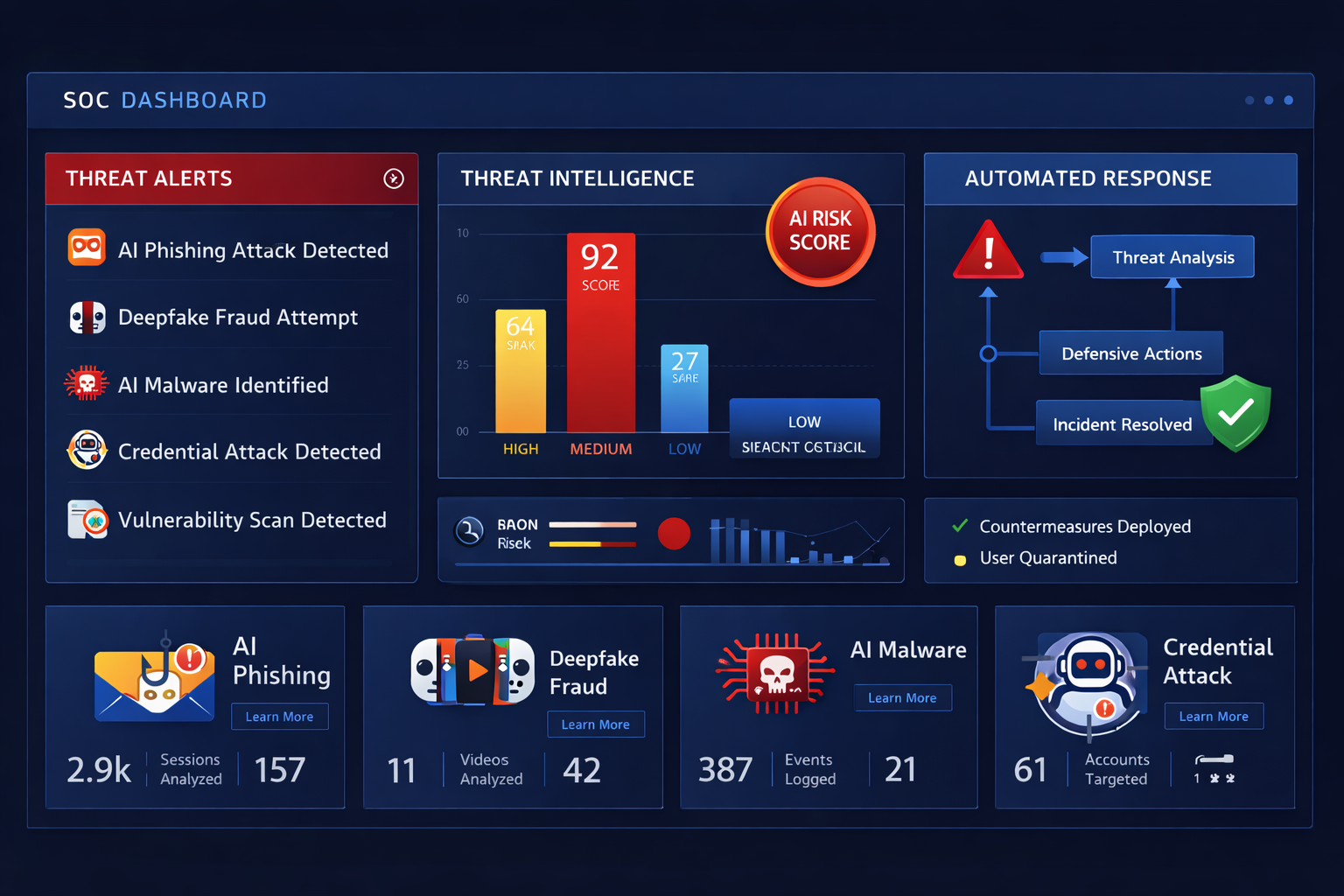
How Security Teams Use AI to Fight Back
Now let’s look at the defensive side of AI vs AI in cybersecurity.
1. AI-Based Threat Detection
Security AI systems analyze:
Network traffic
User behavior
Application logs
Endpoint activity
Instead of fixed rules, AI learns what is normal and flags anomalies — a core advantage in AI vs AI in cybersecurity.
2. Behavioral Analytics (UEBA)
User and Entity Behavior Analytics (UEBA) is critical in AI vs AI in cybersecurity.
AI detects:
Unusual login times
Abnormal file access
Insider threats
Compromised accounts
Even if credentials are valid, AI identifies suspicious behavior.
3. AI-Powered SOC Automation
Modern Security Operations Centers (SOC) rely heavily on AI in AI vs AI in cybersecurity.
AI helps by:
Prioritizing alerts
Reducing false positives
Automating incident response
Speeding up investigations
This reduces burnout and improves response time.
4. Predictive Threat Intelligence
In AI vs AI in cybersecurity, AI doesn’t just react — it predicts.
AI models:
Analyze global threat data
Identify attack patterns
Forecast future attack vectors
This allows proactive defense instead of reactive cleanup.
5. AI-Driven Endpoint & Cloud Security
AI continuously monitors:
Cloud workloads
Containers
APIs
Endpoints
This real-time visibility is essential in AI vs AI in cybersecurity, especially for cloud-first organizations.
AI vs AI in Cybersecurity: Real-World Attack vs Defense Example
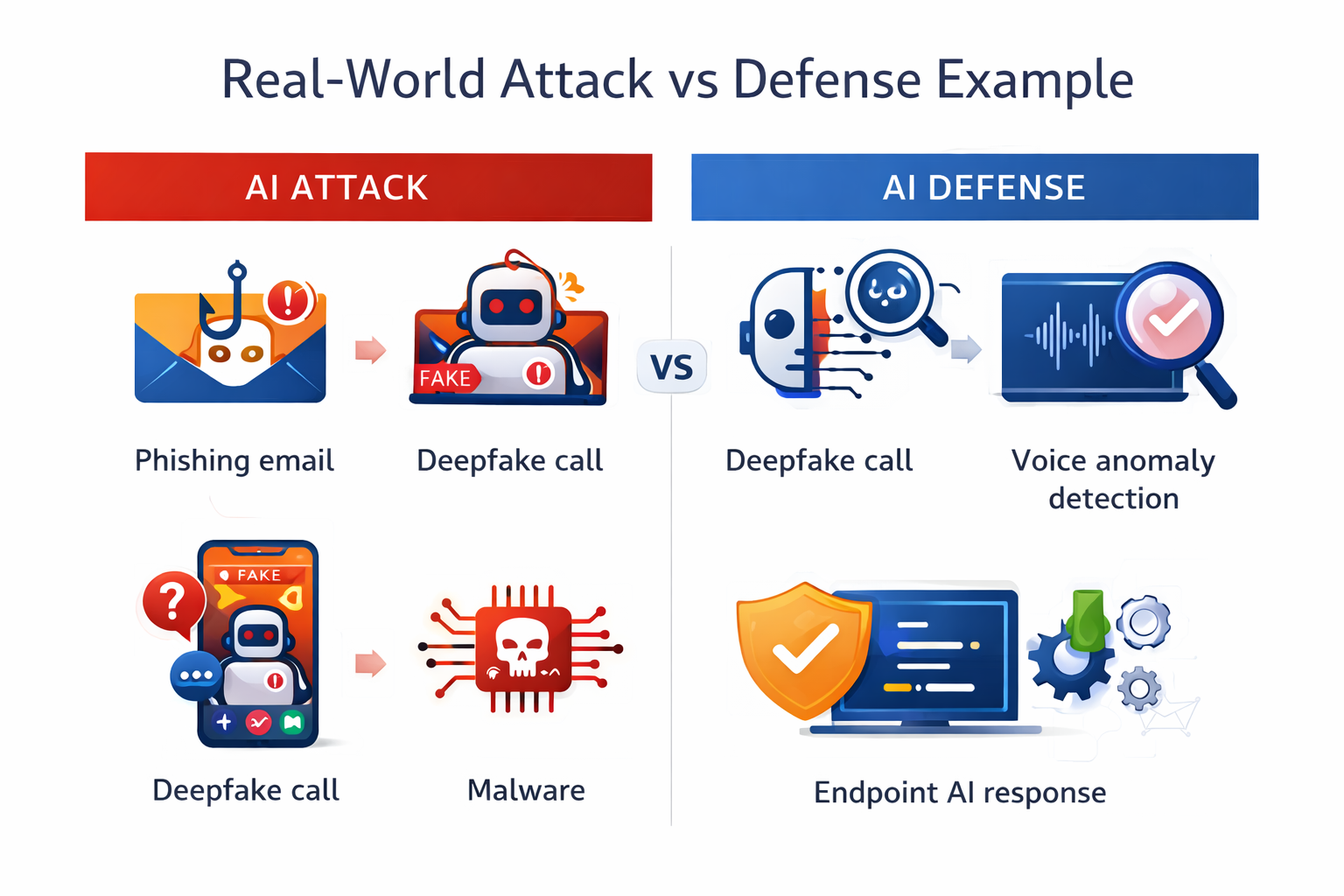
Scenario: AI-Based Phishing Attack
Attack Side (AI):
Generates personalized phishing email
Uses social media data
Mimics internal communication style
Defense Side (AI):
Detects unusual sender behavior
Analyzes semantic patterns
Flags abnormal click behavior
Auto-isolates compromised account
This is AI vs AI in cybersecurity in action — machine speed versus machine intelligence.
Limitations & Risks of AI vs AI in Cybersecurity
While powerful, AI vs AI in cybersecurity has challenges:
Data Bias
Poor training data leads to blind spots.
Adversarial AI Attacks
Hackers intentionally manipulate AI models.
Over-Automation Risk
Blind trust in AI can be dangerous.
Skill Gap
Organizations lack skilled AI security professionals.
Understanding these risks is crucial when deploying AI vs AI in cybersecurity solutions.
🇮🇳 Why AI vs AI in Cybersecurity is Critical for India
India is uniquely vulnerable because of:
Rapid digital payments adoption
Massive user base
Growing startup ecosystem
High cybercrime volume
Government initiatives, banks, fintech, and IT services are heavily investing in AI vs AI in cybersecurity to protect national digital infrastructure.
Skills Required to Work in AI vs AI in Cybersecurity
If you want a career in AI vs AI in cybersecurity, focus on:
This domain offers high salaries, long-term relevance, and global demand.
Cambridge Infotech Career Advantage: Why Choose Cambridge Infotech for Your Tech Career
In today’s competitive job market, learning skills alone is not enough. What truly matters is career readiness — industry-relevant skills, real-world exposure, and placement support.
This is where Cambridge Infotech’s Career Advantage stands out.
Cambridge Infotech is not just a training institute; it is a career transformation partner for students, freshers, and working professionals who want to succeed in fast-growing domains like AI, Data Science, Cybersecurity, Cloud, and Software Technologies.
What is the Cambridge Infotech Career Advantage?
The Cambridge Infotech Career Advantage is a holistic learning and career development approach that focuses on:
Industry-aligned curriculum
Hands-on, practical training
Career-focused mentorship
Job-oriented outcomes
Long-term professional growth
Unlike traditional institutes that focus only on theory, Cambridge Infotech prepares learners for real corporate environments.
Why Choose Cambridge Infotech? (Key Career Advantages)
1. Industry-Relevant & Future-Ready Curriculum
Cambridge Infotech continuously updates its curriculum based on:
Industry trends
Employer expectations
Emerging technologies
Courses are designed to match real job roles, not outdated syllabi.
This ensures learners are prepared for current and future job markets, especially in domains like AI, cybersecurity, and data science.
2. Hands-On Practical Training (Not Just Theory)
One of the biggest career advantages of Cambridge Infotech is its practical-first learning approach.
Learners gain:
Real-time project experience
Case studies based on industry scenarios
Tool-based hands-on sessions
Problem-solving exposure
This practical experience helps students build confidence and job-ready skills.
3. Expert Trainers with Real Industry Experience
Cambridge Infotech trainers are:
Industry professionals
Experienced practitioners
Subject matter experts
They don’t just teach concepts — they share real-world insights, best practices, and common mistakes from the industry.
This mentorship-driven approach gives learners a clear advantage during interviews and on-the-job performance.
4. Career-Oriented Learning, Not Course-Centric Learning
Cambridge Infotech focuses on career outcomes, not just course completion.
This includes:
Skill mapping for specific job roles
Interview-oriented training
Resume and portfolio guidance
Industry expectations alignment
Every learner is guided with a career-first mindset, making the transition from learning to employment smoother.
5. Placement Assistance & Career Support
A major reason to choose Cambridge Infotech is its career and placement support ecosystem.
Support includes:
Resume building workshops
Mock interviews
Soft skills and communication training
Placement guidance and referrals
This structured support helps learners stand out in competitive hiring processes.
6. Job-Ready Skills for High-Growth Domains
Cambridge Infotech focuses on high-demand and future-proof skills, such as:
These domains offer:
Strong job demand
Career stability
Attractive salary growth
Learning these skills gives students a long-term career advantage, not just short-term jobs.
7. Focus on Confidence, Communication & Professional Skills
Technical skills alone are not enough.
Cambridge Infotech also helps learners develop:
Communication skills
Interview confidence
Professional mindset
Workplace readiness
This holistic development ensures learners are corporate-ready, not just technically skilled.
How Cambridge Infotech Improves Career Outcomes
Learners benefit through:
Better interview performance
Increased employability
Faster job readiness
Improved career clarity
Long-term professional growth
This is the true Cambridge Infotech Career Advantage.
Who Should Choose Cambridge Infotech?
Cambridge Infotech is ideal for:
Students who want job-ready skills
Freshers struggling to crack interviews
Professionals looking to upskill or switch careers
Anyone aiming for future-proof tech roles
Is Cambridge Infotech Worth Choosing?
If your goal is not just to learn — but to build a successful, long-term tech career, then Cambridge Infotech is a strong choice.
With its focus on practical learning, industry relevance, career guidance, and placement support, Cambridge Infotech provides a clear career advantage in today’s competitive job market.
Career Roles in AI vs AI in Cybersecurity
Popular roles include:
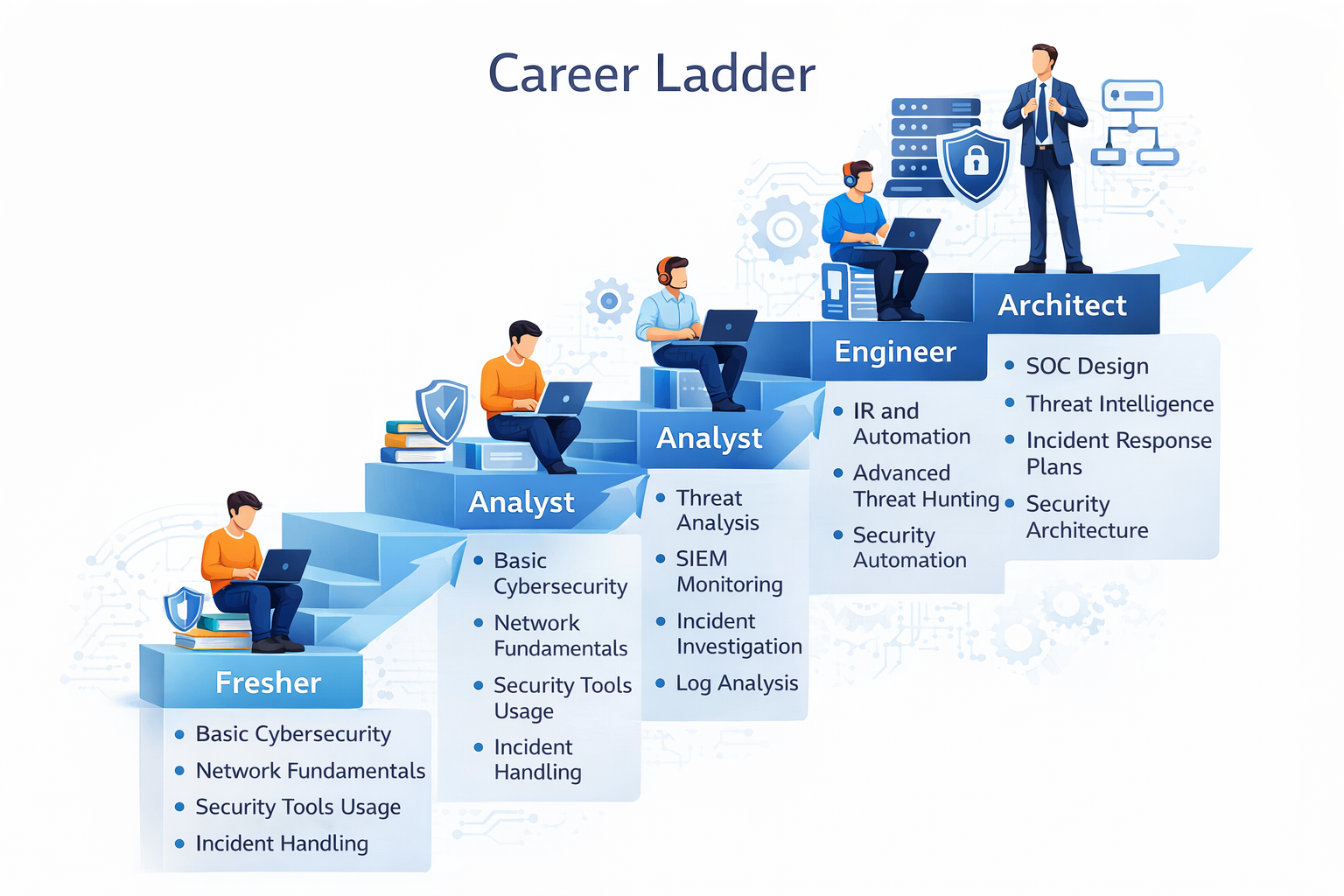
These roles are growing rapidly due to AI vs AI in cybersecurity adoption.
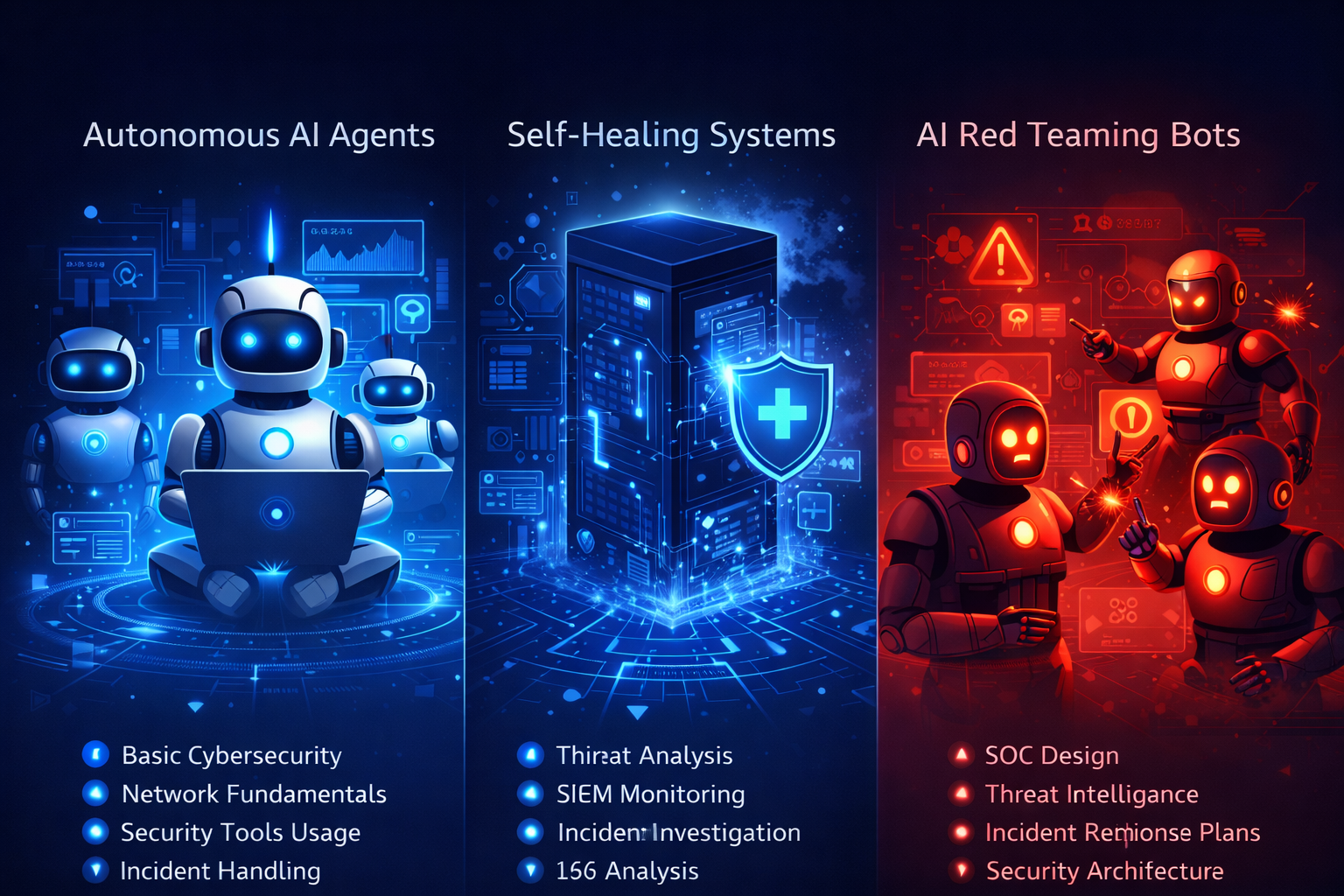
Future of AI vs AI in Cybersecurity (2026–2030)
The future of AI vs AI in cybersecurity will include:
Autonomous defense systems
Self-healing infrastructure
AI-driven red teaming
Agentic AI security bots
Regulation-aware AI models
The cyber battlefield will become fully autonomous.
➜ Key Takeaways
AI vs AI in cybersecurity is the new normal
Hackers and defenders both use advanced AI
Traditional security is no longer enough
AI enables speed, scale, and prediction
Skills in this field are future-proof
➜ Final Thoughts
The war is no longer humans vs hackers.
It is AI vs AI in cybersecurity.
Organizations that fail to adopt AI-driven security will fall behind.
Professionals who master this domain will lead the future.
If you’re serious about cybersecurity, AI vs AI in cybersecurity is not optional — it’s essential.
Frequently Asked Questions (FAQs)
What is AI vs AI in cybersecurity?
AI vs AI in cybersecurity refers to a scenario where hackers use artificial intelligence to launch advanced cyberattacks, while security teams use AI-powered systems to detect, prevent, and respond to those attacks. Instead of manual defense, AI systems now fight other AI systems at machine speed.
How do hackers use AI in cyberattacks?
Hackers use AI to automate phishing, generate deepfake voice and video attacks, create self-modifying malware, scan vulnerabilities faster, and bypass traditional security controls. In AI vs AI in cybersecurity, attackers leverage AI for speed, scale, and precision.
How do security teams use AI to stop cyberattacks?
Security teams use AI for threat detection, behavioral analytics, anomaly detection, predictive threat intelligence, and automated incident response. AI helps security systems identify unusual patterns and stop attacks in real time, which is critical in AI vs AI in cybersecurity.
Why is AI vs AI in cybersecurity important in 2026?
AI vs AI in cybersecurity is important in 2026 because cyberattacks have become more sophisticated due to generative AI, deepfakes, and automation. Traditional rule-based security can no longer handle these threats, making AI-driven defense essential for organizations.
What are the biggest risks of AI in cybersecurity?
The biggest risks include biased AI models, adversarial AI attacks, over-automation, lack of explainability, and a shortage of skilled professionals. While AI vs AI in cybersecurity improves defense, improper implementation can create new vulnerabilities.
Is AI cybersecurity replacing human security professionals?
No. AI is not replacing humans but augmenting them. In AI vs AI in cybersecurity, AI handles speed and scale, while humans provide decision-making, strategy, and oversight. Human expertise is still critical.
What skills are required for a career in AI cybersecurity?
To work in AI vs AI in cybersecurity, you need cybersecurity fundamentals, basic machine learning knowledge, Python scripting, threat modeling, cloud security skills, SOC tools experience, and an understanding of AI ethics and governance.
What are the career opportunities in AI vs AI in cybersecurity?
Popular roles include AI Security Engineer, Cyber Threat Intelligence Analyst, SOC Automation Engineer, Security Data Scientist, and AI Risk & Governance Specialist. These roles are growing rapidly due to increased AI adoption in cybersecurity.
How does AI help detect deepfake and phishing attacks?
AI analyzes voice patterns, language behavior, metadata, and user activity to identify anomalies. In AI vs AI in cybersecurity, defensive AI detects subtle inconsistencies that humans often miss, helping stop deepfake and phishing attacks.
Is AI vs AI in cybersecurity relevant for Indian companies?
Yes. India’s rapid digital payments growth, cloud adoption, fintech expansion, and large user base make AI vs AI in cybersecurity extremely relevant. Indian enterprises and government organizations are actively investing in AI-driven security solutions.
RELATED BLOGS:
Cybersecurity Course in Banaswadi – Skills Needed, Jobs, and Salary
Best Cybersecurity Jobs in 2026 for Freshers
IT Careers in 2026: Best Job-Oriented Skills, Salaries & Career Roadmap
Best Computer Courses in Kammanahalli | Cambridge Infotech 2026
Top AI Careers in Demand by 2026: Best Future Guide | Cambridge Infotech