
Currently Empty: ₹0.00

Programming languages are the backbone of modern technology. From building responsive websites and mobile apps to powering artificial intelligence, cloud platforms, and cybersecurity systems, programming languages drive every digital innovation we rely on today.
At Cambridge Infotech, we understand that choosing the right programming language is the first and most important step toward a successful tech career. Whether you are a beginner starting from scratch or a professional looking to upskill, selecting the right language can shape your future in the IT industry.
This guide covers the most in-demand programming languages in 2026, their applications, career paths, and how to choose the best one for your goals.
Why Learning Programming Languages is Essential
Programming is no longer limited to software developers alone. Almost every industry today depends on technology and automation. Learning a programming language gives you a competitive edge and opens doors to limitless career opportunities.
Key benefits include:
High Industry Demand
Companies across IT, finance, healthcare, education, e-commerce, and manufacturing need skilled programmers.
Excellent Career Growth & Salary Potential
Programming roles consistently rank among the highest-paying jobs worldwide.Stronger Problem-Solving Skills
Coding enhances analytical thinking and logical reasoning.Global Career Opportunities
Programmers can work remotely or explore international job markets.Versatility Across Industries
From AI and cybersecurity to cloud computing and data analytics, programming skills are universally valuable.
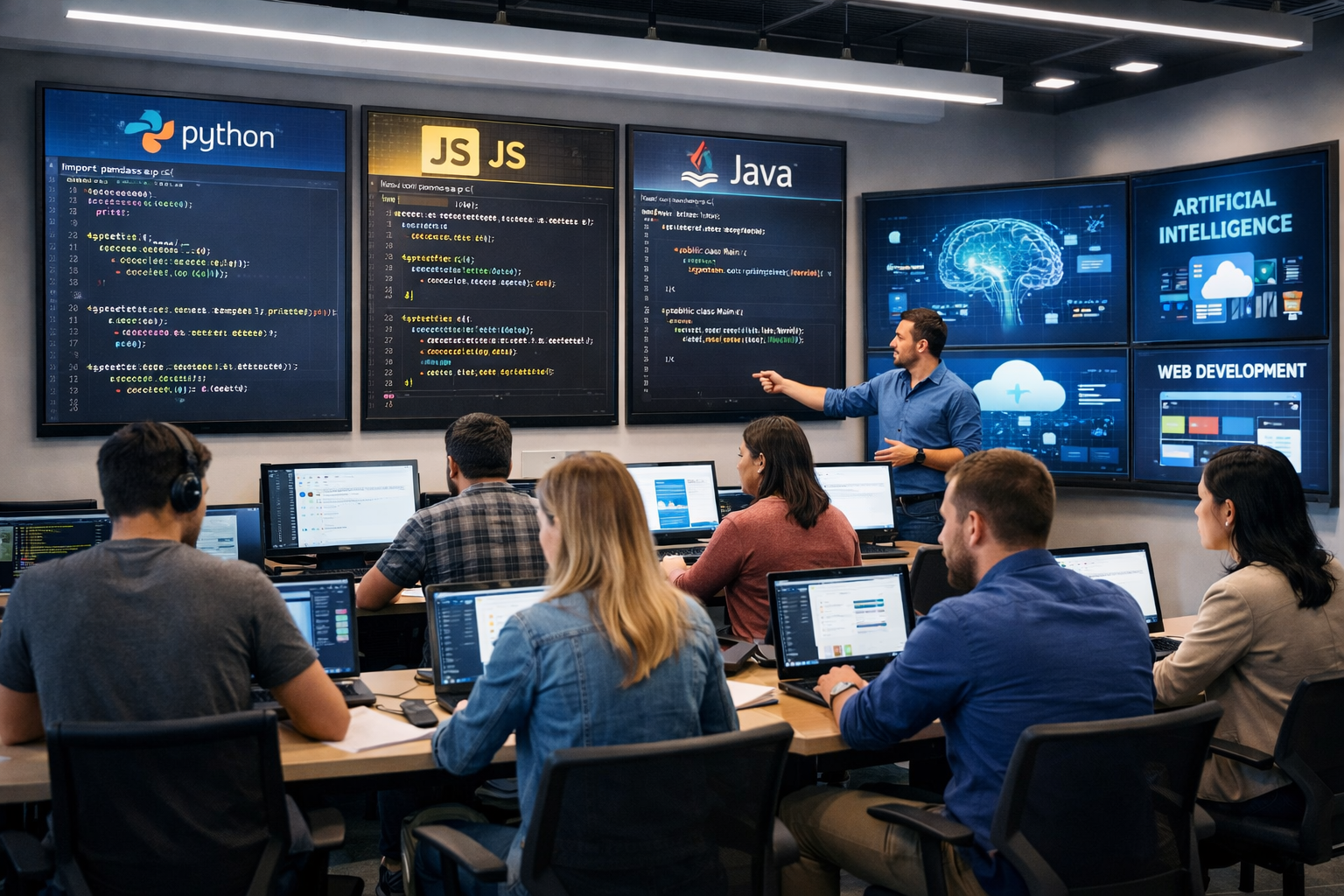
Top Programming Languages to Learn in 2026
With hundreds of programming languages available, choosing the right one can be overwhelming. Here’s a breakdown of the most popular programming languages and their applications:
Python
- Why Learn Python?: Known for its simplicity and readability, Python is ideal for beginners. It’s widely used in data science, machine learning, and web development.
- Applications: AI, automation, backend development, and scientific computing.
- Popular Frameworks: Django, Flask, TensorFlow.
JavaScript
- Why Learn JavaScript?: JavaScript is the backbone of web development, enabling interactive and dynamic websites.
- Applications: Frontend and backend development (with Node.js), mobile app development.
- Popular Frameworks: React, Angular, Vue.js.
Java
- Why Learn Java?: Java is a versatile, object-oriented language used in enterprise applications and Android development.
- Applications: Mobile apps, web applications, big data technologies.
- Popular Frameworks: Spring, Hibernate.
C++
- Why Learn C++?: C++ is a powerful language for system programming and game development.
- Applications: Game engines, operating systems, high-performance applications.
- Popular Frameworks: Unreal Engine, Qt.
SQL
- Why Learn SQL?: SQL is essential for managing and querying databases.
- Applications: Data analysis, database management, business intelligence.
- Popular Tools: MySQL, PostgreSQL, Microsoft SQL Server.
Go (Golang)
- Why Learn Go?: Go is known for its efficiency and simplicity, making it ideal for cloud-based applications.
- Applications: Cloud computing,
- microservices, DevOps
- Popular Frameworks: Gin, Beego.
Rust
- Why Learn Rust?: Rust is gaining popularity for its memory safety and performance.
- Applications: System programming, web assembly, game development.
- Popular Frameworks: Rocket, Actix.
How to Choose the Right Programming Language for Your Career
Follow this simple roadmap:
Define Your Career Path
Web Development → JavaScript, Python
Data Science & AI → Python, SQL
Mobile App Development → Java, Kotlin, Swift
Cloud & DevOps → Go, Python
Game Development → C++
Check Market Demand
Review job portals to identify in-demand skills.Consider Learning Difficulty
Beginners should start with Python or JavaScript.Think Long-Term
Choose a language that aligns with future technologies like AI, Cloud, and Cybersecurity.Practice & Experiment
Try sample projects before finalizing your learning path.
Common Mistakes to Avoid When Learning Programming Languages
Skipping fundamentals
Learning without practice
Ignoring documentation
Chasing too many languages at once
Giving up too early
Consistency and patience are the keys to mastering programming.
Why Choose Cambridge Infotech for Learning Programming Languages?
At Cambridge Infotech, we offer career-oriented programming courses designed to meet industry standards.
What makes us different:
Expert Trainers with real-world experience
Hands-on Project-Based Learning
Updated Curriculum aligned with 2026 trends
Job-Oriented Training Programs
Resume Building & Interview Preparation
100% Career Guidance & Placement Support
Our programming courses include:
Conclusion
Programming languages are the gateway to innovation, growth, and a successful tech career. In 2026 and beyond, professionals with strong coding skills will remain at the heart of digital transformation. By choosing the right programming language and enrolling in industry-focused training, you position yourself for long-term career success.
At Cambridge Infotech, we empower students with practical skills, modern technologies, and career support to build future-ready professionals.
Start your journey today and become a part of the next generation of tech leaders.
“Web Development Roadmap 2025” by Cambridge InfoTech outlines the evolving landscape of web development, emphasizing the importance of staying updated with emerging technologies and trends. By 2025, developers will need to master advanced tools like AI-driven development, progressive web apps (PWAs), and serverless architectures. The roadmap highlights the growing significance of cybersecurity, accessibility, and performance optimization in creating user-centric web experiences. Additionally, frameworks like React, Vue.js, and Angular will continue to dominate, while new languages and tools may emerge. To succeed, developers must adopt a continuous learning mindset, focusing on cross-platform development, cloud integration, and sustainable coding practices to meet the demands of the future web.
“Web Application Examples & Development 2025” by Cambridge InfoTech explores the future of web applications, showcasing innovative examples and trends shaping the industry. By 2025, web applications will leverage cutting-edge technologies like AI, machine learning, and blockchain to deliver smarter, more secure, and personalized user experiences. Examples include AI-powered chatbots, decentralized finance (DeFi) platforms, and immersive AR/VR-based applications. The development process will increasingly rely on low-code/no-code platforms, enabling faster deployment and greater accessibility. Additionally, the focus will shift toward creating scalable, cloud-native applications with robust cybersecurity measures. Developers will need to prioritize responsive design, real-time functionality, and sustainability to stay competitive in the rapidly evolving digital landscape.
“Web Development Courses” by Cambridge InfoTech highlights the importance of structured learning to excel in the ever-evolving field of web development. It emphasizes that enrolling in comprehensive courses can help aspiring developers master essential skills such as HTML, CSS, JavaScript, and popular frameworks like React and Angular. Advanced courses also cover emerging trends like AI integration, progressive web apps (PWAs), and cloud-based development. The article underscores the value of hands-on projects, industry-relevant certifications, and mentorship in building a successful career. Whether you’re a beginner or an experienced developer, these courses provide the tools and knowledge needed to stay ahead in the competitive web development landscape
CATEGORIES
Programming Languages
Database
Learn HTML Programming in 2025: A Beginner’s Guide to Web Developmen
App Development
Web Development
Full Stack Developer
Project Management
Data Science & Analytics
Cloud Computing
Cybersecurity Program
Operating Systems
Devops and Automation
Artificial Intelligence
Software Testing & QA
Six Sigma Leadership Program
Graphic Design
Microsoft Office
Tally Accounting
SAP Course
CompTIA
Spoken English Course