1. Introduction: The New DNA of Digital Marketing in 2026
Digital marketing in 2026 looks nothing like it did even two years ago. The shift has been so rapid and so transformative that the fundamentals of the industry have changed. Today, AI in Digital Marketing is not an advanced feature, an optional skill, or a “nice-to-have.” It has become the new DNA of digital marketing, powering everything from content creation and SEO to ads, analytics, customer behavior, and campaign automation.
Marketing teams that once depended on manual research, intuition-based decisions, or slow content workflows are now being replaced by AI-driven systems that learn, optimize, and execute faster than human teams alone ever could.
This is why companies — especially in India’s fastest-growing digital hubs like Bangalore, Hyderabad, Pune, Gurgaon, and Chennai — have shifted to AI-first marketing approaches to stay competitive, reduce costs, and scale results.
Why AI Is No Longer “Optional” in 2026
1. The Data Explosion: Marketers Can’t Keep Up Manually
India generates more digital data today than at any point in history — browsing behavior, search activity, online purchases, social media interactions, voice searches, app usage, and more.
Understanding these patterns is impossible without AI.
AI tools now:
-
Read millions of data points instantly
-
Identify purchase intent
-
Predict what a customer will do next
-
Recommend the best marketing actions in real time
This gives brands a scientific edge — replacing guesswork with AI-driven decisions that improve accuracy and ROI.
2. The Personalization Shift: Every User Wants “Netflix-Style Content”
Consumers in 2026 expect personalized experiences from every brand:
✔ Personalized emails
✔ Personalized product recommendations
✔ Personalized content
✔ Personalized ads
But personalization requires analyzing user interests, search queries, purchase history, and behavior signals — something humans cannot process at scale.
This is where AI in Digital Marketing steps in:
-
AI segments audiences automatically
-
AI creates personalized messages for each user
-
AI predicts the right message at the right time
- AI improves engagement and conversions
In short, personalization has become a core expectation, and AI is the only way to deliver it consistently.
3. The Automation-First World: Faster, Smarter, More Accurate Marketing
In 2026, companies no longer want marketers who “do tasks.”
They want marketers who build systems that run automatically.
Marketing automation, powered by AI, now handles:
-
Social media scheduling
-
Paid ads optimization
-
Email flows
-
Lead scoring
-
Content generation
-
SEO automation
-
Reporting & analytics
Tasks that once took hours now take minutes.
Campaigns that once required full teams now run autonomously.
Business owners and marketers save time, money, and effort — while getting better results.
This is why careers like AI Digital Marketer, SEO Automation Specialist, AI Content Strategist, and Marketing Automation Manager are exploding in demand across India.
What Readers Will Learn in This Blog (Practical, Tool-Based, Actionable Insights)
This is not a theory-based article.
This blog is designed to be a practical roadmap for anyone who wants to understand and master AI in Digital Marketing in 2026.
Readers will learn:
✔ How AI is transforming every branch of digital marketing
From SEO to social media, ads, automation, content creation, and analytics.
✔ The exact AI tools used by top companies and marketers
Including tools for content writing, SEO, ads optimization, social media automation, marketing analytics, and more.
✔ How AI increases leads, conversions, and ROI for businesses
With examples of AI-driven workflows and campaign strategies.
✔ The new skillset required for digital marketers in 2026
What companies expect, how students should prepare, and which AI marketing skills matter most.
✔ The future of AI-powered marketing jobs in India
Salary trends, job opportunities, hiring demand, and career paths.
✔ How to start learning digital marketing with AI-tools
Including the best courses, practical projects, and industry-ready learning paths.
What Is AI in Digital Marketing? (Simple, Clear, 2026 Definition)
AI in Digital Marketing refers to the use of Artificial Intelligence, Machine Learning, Generative AI, and automation systems to plan, create, execute, optimise, and scale digital marketing campaigns. Instead of humans doing repetitive tasks, AI helps marketers:
-
Predict customer behaviour
-
Automate content creation
-
Analyse SEO trends
-
Optimise ad campaigns
-
Personalise user experiences
-
Improve conversions
-
Reduce costs and errors
In 2026, AI in Digital Marketing isn’t optional — it’s the foundation of every successful growth strategy.
The Shift: How AI Is Reshaping the Digital Marketer’s Role
Digital marketing in 2026 is not just evolving — it is being completely redesigned. The role of a digital marketer, once defined by manual execution, repetitive tasks, and human-dependent optimization, has now shifted into an AI-augmented, automation-driven, data-intelligent profession.
Earlier, marketers spent most of their time:
-
writing content manually
-
running endless A/B tests
-
tracking metrics in spreadsheets
-
handling reporting
-
optimizing ads manually
-
segmenting audiences by hand
-
managing repetitive tasks across platforms
Today, AI handles most of this automatically.
The marketer’s job now is to guide, strategize, and operate at a much higher creative and analytical level.
Let’s break down how this shift is happening.
From Manual Tasks → Intelligent Decision-Making
2026 is the year where marketers spend less time “doing” tasks and more time making decisions.
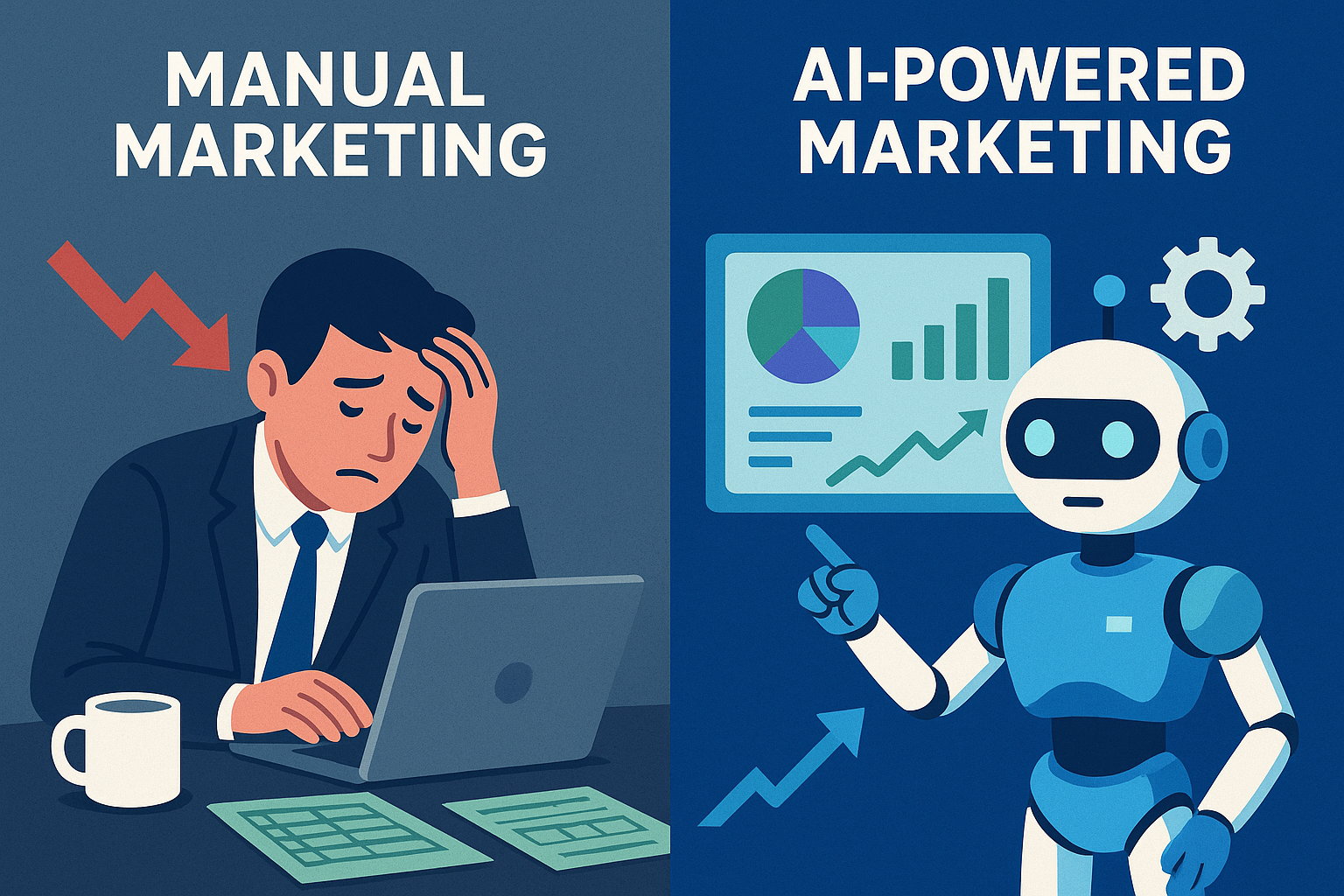

AI now performs the execution-heavy work, while marketers focus on:
-
designing strategy
-
analyzing AI-generated insights
-
identifying opportunities
-
improving customer journeys
-
building creative concepts
-
developing data-driven campaigns
Examples of this shift:
Traditional marketer (before AI):
Writes long articles manually
Optimizes keywords using guesswork
Researches trends manually
Adjusts Google Ads bids manually
Creates dozens of content variations
Schedules social posts daily
Segments audiences by hand
Uses AI tools to generate first drafts, outlines & ideas
Uses AI-based SEO tools to find high-ranking keywords
Uses predictive analytics to forecast campaign performance
Lets AI auto-adjust ad bids in real time
Generates 10–20 content variations instantly
Automates entire social media calendars
Lets AI segment audiences based on behavior
This has transformed digital marketing from a tactical job into a strategic, high-impact role.
AI as the Co-Pilot for Creativity, Analysis, and Optimization
AI is not replacing digital marketers — AI is becoming their co-pilot.
AI boosts creativity
-
Generating blog outlines, drafts, captions, ad copies
-
Suggesting headline variations
-
Producing image creatives using generative AI
-
Helping build creative concepts faster
AI boosts analysis
AI tools now:
-
detect user behavior patterns
-
identify campaign weaknesses
-
forecast trends
-
analyze customer journeys
-
provide ready-made insights that used to take hours
AI boosts optimization
AI tools optimize everything in real-time:
-
SEO (rank tracking, keyword clustering, on-page recommendations)
-
Google Ads (bid adjustments, ad rotation, audience matching)
-
Social media (scheduling, engagement prediction)
-
Email marketing (send-time optimization, segmentation)
-
Landing pages (conversion predictions, heatmaps)
A marketer who works with AI doesn’t just work faster —
They work 10x smarter.
Stats & Trends (2026): The New Digital Marketing Reality
Here are the India + global 2026 predictions and current trends that prove how big this shift is:
1. Automation Is Becoming the Standard
-
45% of all digital marketing tasks will be automated by 2026
(content, analytics, research, reporting, and optimization) -
Ad automation tools reduce manual campaign work by 60%
2. AI Adoption Among Marketers Is Exploding
-
80% of companies in India already use at least one AI-based marketing tool
-
65% of marketers say AI is essential for staying competitive
-
Generative AI usage in marketing has grown 350% since 2023
3. AI-Enabled Marketers Are in Higher Demand
India’s hiring trends show:
-
Salary packages are 25–40% higher for marketers with AI skills
-
Companies now require knowledge of:
4. Businesses Rely on AI for Better ROI
-
AI-driven personalization increases conversions by 35%
-
Predictive analytics reduce wasted ad spend by 20–40%
-
AI-powered SEO increases organic traffic by 50–300%
5. The Future Belongs to AI-Augmented Marketers
By 2028:
-
out of 3 marketing roles will require deep AI knowledge
-
Manual-only marketers will be outdated
-
AI skills will become a mandatory part of every job description
2026 marks the biggest transformation in the history of digital marketing.
Marketers who embrace AI are becoming strategists, innovators, and decision-makers.
Those who ignore AI will struggle to keep up with:
-
speed
-
accuracy
-
competition
-
campaign performance
-
hiring demand
The world is shifting — and so must digital marketers.
Why Digital Marketers MUST Embrace AI in 2026
In 2026, digital marketing is no longer about effort — it’s about efficiency, intelligence, and speed. The professionals and brands that thrive are not the ones working the hardest, but the ones working the smartest. This is exactly why AI in Digital Marketing has become a mandatory skill.
If you want better results, higher campaign success, career growth, and real business impact, embracing AI is no longer optional — it is survival.
Let’s break down why.
1. Faster Execution & Reduced Workload
One of the biggest advantages of AI in Digital Marketing is drastic speed improvement.
Earlier, marketers spent hours (or even days) creating and launching campaigns. In 2026, AI-powered systems reduce execution time by 60–80%.
How AI makes campaigns faster:
-
AI generates blog drafts, ad copies, captions, and email templates in seconds
-
AI designs banners, thumbnails, and visuals automatically
-
AI builds landing pages using smart templates
-
AI searches, clusters, and maps keywords instantly
-
AI schedules posts and runs ads without manual effort
Automated routine tasks:
With AI in Digital Marketing, repetitive and time-consuming tasks are now automated:
-
Weekly and monthly performance reports
-
Keyword research and competitor analysis
-
Audience segmentation and retargeting
-
Content planning and scheduling
-
A/B testing and optimization
This means marketers can spend more time on strategy, creativity, and growth, instead of repetitive execution work.
2. Hyper-Personalization at Scale
Modern customers expect brands to understand them personally.
Generic marketing no longer works.
This is where AI in Digital Marketing changes everything.
AI systems now enable hyper-personalization at massive scale — something human teams could never achieve manually.
Real-Time Customer Behavior Prediction
AI tools track:
-
User browsing behavior
-
Search intent
-
Purchase history
-
Page interaction data
-
Click patterns
-
Device usage
-
Location trends
Based on this data, AI predicts:
-
What the user is likely to buy next
-
When they are most likely to convert
-
Which message will influence their decision
AI-Generated Dynamic Experiences
Using AI in Digital Marketing, systems now automatically create:
-
Dynamic landing pages personalised for each user
-
Smart product recommendations
-
AI-generated ads based on user interests
-
Personalized email copies in real time
Impact of Hyper-Personalization
Brands using AI-powered personalization experience:
-
Up to 35–40% increase in conversion rates
-
Higher customer engagement
-
Better retention
-
Lower ad wastage
This is why mastering AI in Digital Marketing is critical for future-ready marketers.
3. Data-Driven Decisions (Not Guesswork)
Marketing in the past was based on:
-
Instinct
-
Gut feeling
-
Trial and error
In 2026, it is based on data intelligence.
With AI in Digital Marketing, decisions are powered by:
-
Predictive analytics
-
Trend forecasting
-
Behavioral modelling
-
Real-time performance signals
Conversion Forecasting
AI algorithms can now:
-
Predict which leads are most likely to convert
-
Score customers based on buying readiness
-
Identify high-value users
-
Forecast future sales patterns
Predictive Ad Spend Optimization
AI systems automatically:
-
Allocate ad budgets to high-performing audiences
-
Pause underperforming ads
-
Shift budget toward better keywords
-
Predict which creatives will perform best
This makes AI in Digital Marketing one of the most powerful profit-optimization tools in modern businesses.
4. Competing With AI-Enabled Brands
The reality of 2026 is simple:
AI-enabled brands outperform traditional brands.
They grow faster.
They convert better.
They spend smarter.
They scale quicker.
Why AI-Powered Brands Win
Brands using AI in Digital Marketing:
-
Launch campaigns faster
-
Optimize in real time
-
Deliver personalised user experiences
-
Make smarter, data-backed decisions
-
Reduce operational costs
-
Increase ROI consistently
Case-Style Examples (Without Naming Companies)
➔ E-commerce Brand Example
A mid-sized online store adopted AI-powered recommendation engines.
Result:
-
42% higher average order value
-
30% increase in repeat purchases
-
55% faster campaign rollout
➔ EdTech Brand Example
A coaching platform used AI-driven email marketing personalization.
Result:
-
3X higher email open rates
-
2X higher click-through rates
-
28% increase in course enrollments
➔ B2B SaaS Brand Example
A software company implemented AI-based lead scoring and ad optimization.
Result:
-
40% reduction in lead acquisition cost
-
Better-quality leads
-
Faster sales cycles
These examples prove one thing:
Without AI in Digital Marketing, brands struggle to compete.
➔ Summary
To survive and grow in 2026, every marketer must:
Work faster
Personalise smarter
Rely on data, not guesswork
Compete with AI-powered brands
Mastering AI in Digital Marketing is not a trend — it is a necessity.
The 2026 AI Tech Stack Every Digital Marketer Must Master
In 2026, successful digital marketers aren’t just creative — they are tool-powered strategists.
To dominate in AI in Digital Marketing, marketers need a strong AI tech stack that automates work, improves precision, and multiplies performance. These tools act as your digital workforce, handling everything from research and content to ads optimization and real-time analytics.
Below is a clear, category-wise breakdown of the AI tech stack every digital marketer must master.
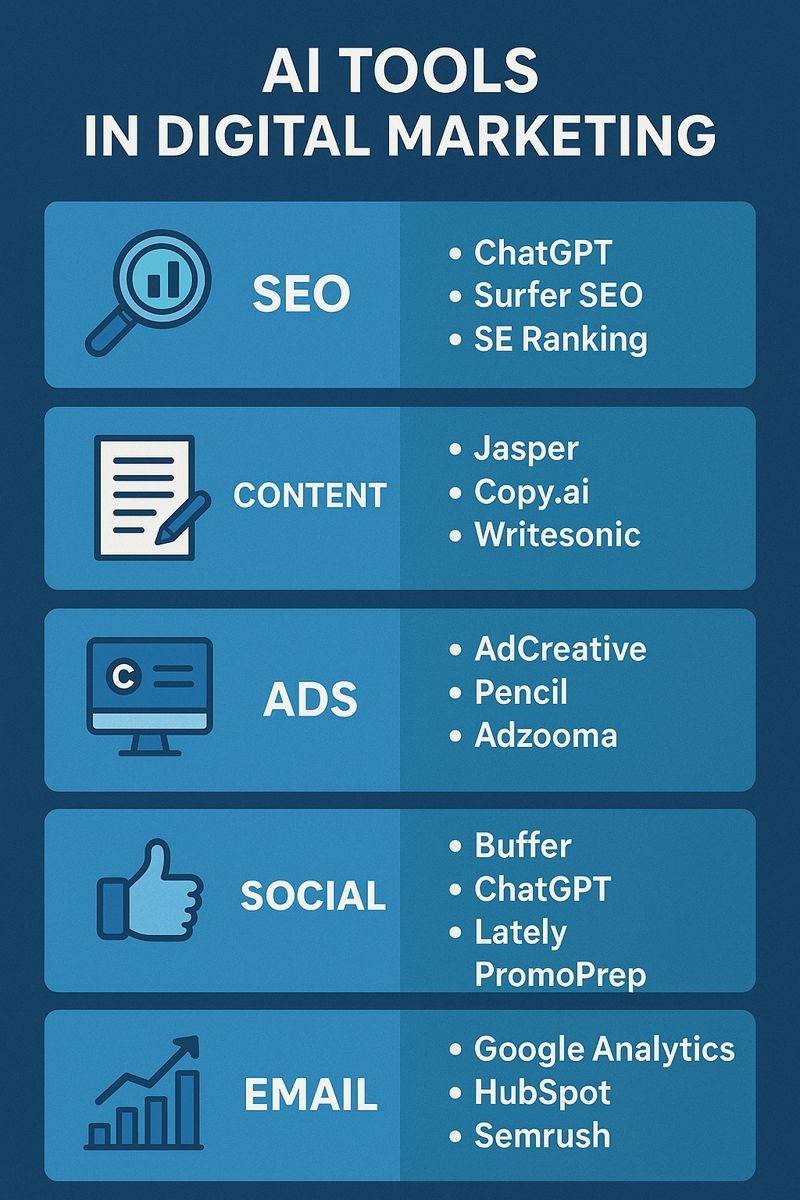

1. AI Content Creation & Copywriting Tools
Content is still king, but in 2026 it is AI-assisted content that wins.
These tools help create:
-
Blog articles
-
Landing page copies
-
Social media captions
-
Email campaigns
-
Video scripts
➔ Essential Tools to Master:
Use AI writing assistants like:
➔ Why These Tools Matter:
-
Generate long-form SEO content
-
Improve copywriting speed
-
Produce high-converting ad text
-
Create personalized messaging at scale
This category alone makes AI in Digital Marketing 10x faster and more effective.
2. AI SEO & Keyword Intelligence Tools
SEO is no longer manual keyword research — it’s AI-driven search intelligence.
These tools help with:
-
Keyword clustering
-
Search intent mapping
-
Competitor content analysis
-
SERP prediction
-
Content optimization
➔ Must-Have AI SEO Tools:
-
Surfer SEO
-
Semrush
-
Ahrefs
-
RankMath
➔ How They Help Marketers:
-
Identify high-intent keywords
-
Optimize content faster
-
Predict ranking potential
-
Improve organic traffic and visibility
SEO powered by AI makes digital marketing strategies more predictable and scalable.
3. AI Paid Ads & Campaign Optimization Tools
Paid advertising in 2026 is algorithm-driven.
-
Audience targeting
-
Budget allocation
-
Ad creative testing
-
Performance optimization
➔ Platforms Marketers Must Master:
➔ AI-Powered Capabilities:
-
Smart bidding
-
Lookalike audience prediction
-
Auto-optimized creatives
-
Real-time budget shifting
This is core to mastering AI-driven performance marketing.
4. AI Social Media Automation Tools
Social media in 2026 is no longer manual posting.
AI tools help with:
-
Auto content scheduling
-
Optimal posting time prediction
-
Comment replies via AI
-
Trend and hashtag detection
➔ Tools Every Marketer Should Know:
-
Hootsuite
-
Buffer
-
Sprout Social
-
Predis.ai
➔ Why This Matters:
-
Faster content calendars
-
Higher engagement rates
-
Smarter trend-based content
-
Better audience retention
This is how modern brands scale social presence using AI in Digital Marketing.
5. AI Email Marketing & Marketing Automation Platforms
Email marketing in 2026 is driven by behavioral AI.
These tools automate:
-
Personalized email sequences
-
Dynamic subject lines
-
Send-time optimization
-
Smart segmentation
➔ Essential Platforms:
➔ Key AI Features:
-
Predictive open-rate optimization
-
Smart A/B testing
-
Automated lead nurturing
-
Revenue-focused email flows
AI-powered email is a core growth engine for conversion-focused marketing.
6. AI Analytics, Reporting & Decision Intelligence Tools
Data without intelligence is useless.
AI turns raw data into actionable insights.
➔ Tools Marketers Must Master:
➔ AI Capabilities:
-
Conversion prediction
-
Funnel leakage detection
-
Automated report generation
-
Real-time decision recommendations
This makes marketing efforts more accurate, profitable, and scalable.
7. No-Code / Low-Code AI Tools for Smart Marketers
2026 digital marketers are not waiting for developers — they build systems themselves.
No-code tools help create:
-
Chatbots
-
Smart funnels
➔ Tools to Learn:
-
Zapier
-
Make
-
Peltarion
➔ Why This Matters:
-
Faster execution
-
Lower development cost
-
Independent campaign creation
-
Advanced automation without coding
– By mastering this AI Tech Stack for Digital Marketing, marketers in 2026 can:
Automate content
Rank faster with AI-driven SEO
Scale ads with smart algorithms
Dominate social media with automation
Increase conversions with AI email marketing
Make better decisions using predictive analytics
This is the real meaning of AI-powered Digital Marketing in 2026.
AI Tools for Content Creation & SEO (2026 Edition)
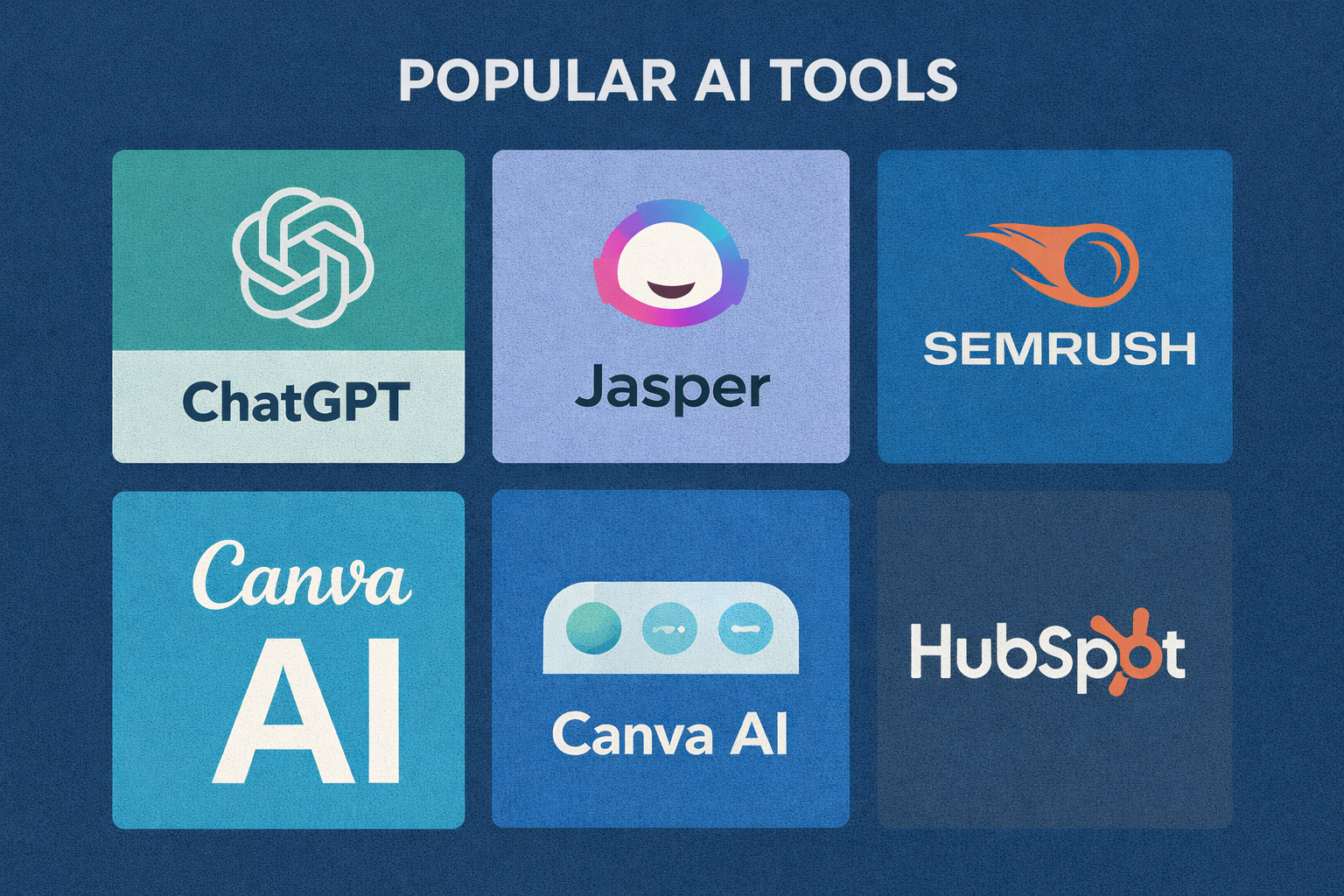

In 2026, content and SEO are no longer manual tasks — they are powered by AI in Digital Marketing.
Every high-performing brand today uses AI to create faster, optimize smarter, and rank higher. If you are serious about growth, mastering AI in Digital Marketing content and SEO tools is no longer optional — it’s essential.
This section breaks down the most powerful AI tools every digital marketer must learn in 2026.
1. Generative AI Content Tools
Generative AI has completely transformed how content is created inside AI in Digital Marketing.
Instead of spending hours on research and drafting, marketers now use AI to generate high-quality, conversion-focused content in minutes.
How These Tools Are Used:
AI helps you create:
-
SEO blog articles
-
YouTube/video scripts
-
High-converting ad copies
-
Social media captions
-
Website landing pages
-
Sales emails
Top Content Creation Tools Marketers Use:
-
ChatGPT – for long-form blogs, strategy research, and content ideation
-
Jasper AI – for brand-focused marketing copy
-
Writesonic – for ad creatives and landing page text
-
Frase – for SERP-based content structuring
-
Surfer AI – for real-time content optimization
Real-World Use Cases:
With AI in Digital Marketing, marketers can:
-
Publish high-quality blogs faster
-
Create A/B versions of ad copy instantly
-
Personalize email campaigns at scale
-
Produce platform-specific captions in minutes
This drastically reduces time to market and improves content performance.
2. AI SEO & Ranking Intelligence Tools
SEO in 2026 is no longer just about keywords — it’s about AI-driven search intelligence, a core component of AI in Digital Marketing.
These tools help marketers understand how search engines think, what users want, and how to outperform competitors.
Most Powerful AI SEO Tools:
-
Semrush (AI-powered keyword intent analysis)
-
Ahrefs (AI-based backlink and competitor tracking)
-
Screaming Frog (AI-assisted site crawling engine)
What These Tools Help You Do:
-
Discover high-intent keywords automatically
-
Analyze competitor strategies in real-time
-
Optimize meta titles and descriptions
-
Automate internal linking recommendations
-
Predict ranking potential for content
With proper use of AI in Digital Marketing, SEO becomes predictable, scalable, and data-driven.
3. AI in Technical SEO
Technical SEO has become one of the most powerful applications of AI in Digital Marketing.
Earlier, technical audits took hours or even days. In 2026, AI performs these tasks in minutes.
What AI Now Automates in Technical SEO:
-
Website crawling and indexing analysis
-
404, 500, and redirect error detection
-
Page speed bottleneck identification
-
Mobile usability checks
-
Duplicate content detection
How AI Improves Technical SEO:
AI tools now provide:
-
Automated schema and structured data suggestions
-
Smart internal link architecture
-
Predictive crawl budget optimization
-
Prioritized issue fixing recommendations
This ensures websites are search-engine ready, fast, and conversion-optimized.
Why This Matters for Marketers (Practical Impact)
When marketers properly use AI in Digital Marketing for content and SEO, they:
Rank faster on Google
Reduce manual effort
Outperform competitors
Increase organic traffic
Improve content ROI
This is no longer an advantage — it’s a requirement for success in 2026.
AI for Paid Ads (Meta, Google, LinkedIn)
Paid advertising has undergone a massive transformation because of AI in Digital Marketing.
In 2026, manual ad management is almost obsolete. Brands that win in performance marketing are using AI in Digital Marketing to automate decisions, maximize returns, and scale campaigns intelligently across Google, Meta (Facebook & Instagram), and LinkedIn.
Let’s break down how AI is dominating paid advertising.
1. Smart Campaign Optimization
AI now acts as a real-time media buyer in AI in Digital Marketing systems.
Instead of guessing which ad will perform better, AI automatically tests, learns, and scales winners.
What AI Automates in Campaigns:
-
AI-generated ad variations (headlines, hooks, CTAs)
-
Automated A/B testing of copy and creatives
-
Smart budget prediction and real-time distribution
-
Predictive bidding models that adjust bids automatically
How This Transforms Results:
With AI in Digital Marketing, marketers can:
-
Reduce wasted ad spend
-
Increase click-through rates (CTR)
-
Improve conversion rates
-
Scale profitable campaigns faster
This makes campaign execution smarter, faster, and more precise.
2. AI Creative Generation for Ads
Visual and creative production is one of the biggest applications of AI in Digital Marketing.
Instead of hiring large creative teams, marketers now use AI tools to generate:
-
Ad images
-
Banner creatives
-
Short videos
-
Thumbnails
-
Dynamic product ads
Must-Know Creative AI Tools:
-
Canva AI – for instant ad design and visual copy
-
Adobe Firefly – for AI-powered creative asset generation
-
Meta Advantage+ – for automated creative combinations inside Meta ads
How These Tools Help:
-
Generate multiple ad creatives in minutes
-
Personalize images for different audience segments
-
Auto-adjust dimensions for different platforms
-
Test creative combinations automatically
This dramatically improves creative speed and performance.
3. AI Tools for Ad Performance Analytics
This is where AI in Digital Marketing becomes truly powerful — analytics and decision intelligence.
Instead of manually reading reports, AI now tells marketers what to fix and how to scale.
Advanced AI Ad Analytics Tools:
-
Madgicx – automates scaling and budget optimization
-
Optmyzr – Google Ads AI optimization engine
-
Revealbot – rules-based AI optimization
What These Tools Do:
-
Identify underperforming ads automatically
-
Suggest winning creatives
-
Predict future ad performance
-
Automate pausing and scaling decisions
-
Generate ROI-focused reports
This removes emotional decision-making and replaces it with pure data-backed intelligence.
Why This Matters in 2026
Brands that master AI in Digital Marketing for paid ads achieve:
Lower cost per lead
Higher ROAS (Return on Ad Spend)
Faster testing and scaling
Better audience targeting
Stronger competitive advantage
In 2026, paid ads without AI are no longer “advanced” — they are outdated.
AI for Social Media Growth & Automation
Social media in 2026 is no longer about posting consistently — it’s about posting intelligently using AI in Digital Marketing.
Brands that dominate social platforms today rely on AI in Digital Marketing to automate content creation, optimize publishing, and analyze audience behavior at scale. This shift has turned social media from a manual task into a data-backed growth engine.
Let’s break down how AI is transforming social media marketing.
1. Social AI Content Engines
Content creation for social media is one of the most powerful real-world applications of AI in Digital Marketing.
Instead of manually creating videos and captions, marketers now use AI tools that can repurpose, edit, and optimize content within minutes.
What These Tools Do:
-
Convert long videos into short-form reels
-
Auto-generate subtitles and captions
-
Edit audio and video using text commands
-
Create viral-style content formats
Must-Know AI Tools for Social Content:
-
Opus Clip – turns long videos into viral short clips
-
Descript – AI-powered video and audio editing
-
Flick – AI captions and hashtag generation
-
Copy.ai – AI-powered social media captions
Practical Impact:
Using AI in Digital Marketing, marketers can:
-
Produce more content in less time
-
Maintain consistent posting
-
Increase reach through optimized captions
-
Improve engagement rates
This directly fuels faster audience growth.
2. AI Scheduling & Publishing Tools
Scheduling in 2026 is completely automated due to AI in Digital Marketing.
AI doesn’t just schedule posts — it predicts the best time to publish.
What AI Scheduling Tools Do:
-
Predict optimal posting times
-
Auto-suggest content slots
-
Manage multiple platforms from one dashboard
-
Recommend improvements to posting strategy
Leading AI Scheduling Tools:
How This Helps Brands:
With AI in Digital Marketing, social media teams:
-
Save hours every week
-
Eliminate manual publishing
-
Optimize reach automatically
-
Keep consistent brand activity
This ensures growth without burnout.
3. AI Sentiment & Trend Analysis
Listening is more powerful than posting — and AI makes listening smarter.
AI in Digital Marketing now powers sentiment analysis and trend prediction so brands can understand what audiences actually feel.
What AI Sentiment Tools Do:
-
Track brand mentions in real-time
-
Analyze positive/negative/neutral sentiment
-
Detect trending topics early
-
Identify potential reputation risks
Advanced AI Listening Tools:
Why This Matters:
With AI in Digital Marketing, brands can:
-
Create trend-based content faster
-
Prevent brand crises early
-
Improve customer experience
-
Build stronger community relationships
In 2026, brands that ignore AI-driven social growth are left behind.
AI for Email Marketing & Automation
Email marketing in 2026 is no longer about sending the same message to everyone.
It is about real-time personalization, predictive automation, and smart engagement, all powered by AI in Digital Marketing.
Brands that win in email today use AI in Digital Marketing to automate workflows, optimize messaging, and deliver highly personalized experiences at scale.
Let’s break down how AI is transforming email marketing.
1. AI Email Copy Tools
Writing high-converting emails used to take hours of brainstorming and testing. Now, AI in Digital Marketing tools generate optimized email copy in minutes.
What These Tools Do:
-
Write subject lines that improve open rates
-
Generate persuasive email body content
-
Personalize messages based on user behavior
-
Create follow-up and re-engagement emails
Leading AI Email Copy Tools:
-
SmartWriter – hyper-personalized cold emails and outreach
-
Mailchimp AI content generator – smart subject lines and copy
Practical Results:
With AI in Digital Marketing, marketers achieve:
-
Higher open rates
-
Better click-through rates
-
Faster content production
-
More consistent communication
2. AI Automation Workflows
Modern email marketing thrives on automation — and AI in Digital Marketing has made it intelligent.
AI now predicts user behavior and triggers emails automatically at the perfect moment.
What AI-Based Automations Handle:
-
Welcome email sequences
-
Lead nurturing campaigns
-
Abandoned cart recovery
-
Re-engagement flows
-
Upsell and cross-sell emails
Most Powerful Automation Platforms:
-
HubSpot AI – predictive automation and behavior-based workflows
-
ActiveCampaign – AI-driven engagement predictions
How This Improves Performance:
Using AI in Digital Marketing, marketers:
-
Reduce manual work
-
Increase automation accuracy
-
Improve customer experience
-
Deliver messages at the right time
3. AI Personalization Tools
Generic emails don’t convert in 2026. Only hyper-personalized emails powered by AI in Digital Marketing perform well.
AI now creates individualized email experiences for every single user.
What AI Personalization Does:
-
Customizes subject lines per user
-
Dynamically changes content blocks
-
Recommends products and offers
-
Adjusts tone and messaging style
Advanced AI Personalization Platforms:
-
ConvertKit AI personalization engine
-
Klaviyo AI-driven segmentation and personalization
Real-World Impact:
With AI in Digital Marketing, brands experience:
-
Higher engagement
-
Better lead quality
-
More repeat customers
-
Stronger long-term relationships
Why This Matters in 2026
Email powered by AI in Digital Marketing is no longer just communication — it is a revenue machine.
Smarter segmentation
Better timing
Higher conversions
Automated nurturing
Predictable customer journeys
AI in Customer Behavior Analysis & CRO (2026 Playbook)
Understanding user behavior is no longer based on assumptions. In 2026, AI in Digital Marketing allows brands to see, predict, and optimize every customer action.
Customer Behavior Analysis and Conversion Rate Optimization (CRO) are now powered by AI in Digital Marketing, turning raw data into real-time decisions that increase leads, sales, and engagement.
Let’s break down the most powerful AI-driven tools and methods.
1. Heatmaps & Behavior Tracking (AI-Powered User Intelligence)
Traditional analytics only show numbers — AI shows behavior.
With AI in Digital Marketing, heatmaps and session tracking tools now provide intelligent insights into how users interact with your website.
What These Tools Track:
-
Mouse movement patterns
-
Click behavior
-
Scroll depth
-
Rage clicks
-
Drop-off points
AI-Powered Heatmap Tools:
-
Hotjar AI – smart heatmaps and session intelligence
-
Microsoft Clarity AI – automatic behavior insights
How This Improves Performance:
Using AI in Digital Marketing, marketers can:
-
Identify friction points in funnels
-
Detect confusing UI elements
-
Optimize buttons and CTAs
-
Reduce bounce rates
-
Increase session time
This turns guesswork into visual, data-backed decisions.
2. AI A/B Testing Engines
A/B testing in 2026 no longer requires manual hypothesis building — AI in Digital Marketing creates and tests variations automatically.
AI tools can now:
-
Generate multiple landing page versions
-
Test headlines, layouts, and CTAs
-
Automatically send traffic to winning versions
AI-Powered A/B Testing Platforms:
-
VWO (AI-based testing and personalization suggestions)
-
AI-driven alternatives to Google Optimize with built-in predictive testing engines
What Marketers Achieve:
With AI in Digital Marketing, teams:
-
Launch tests faster
-
Reduce human bias
-
Improve conversion rates continuously
-
Scale winning page structures automatically
This creates a culture of continuous improvement powered by AI.
3. AI Conversion Forecasting Tools
The future of marketing is not just analyzing performance — it is predicting outcomes, which is a core benefit of AI in Digital Marketing.
AI can now forecast:
-
Likely conversion rates
-
Revenue projections
-
Customer lifetime value
-
Funnel drop-off probability
AI-Powered Forecasting Tools:
-
Pecan AI
-
H2O.ai analytics
Practical Business Impact:
Using AI in Digital Marketing, businesses can:
-
Forecast expected ROI before launching campaigns
-
Allocate budgets more intelligently
-
Identify high-value audiences
-
Reduce risk and wasted spend
Why This Matters in 2026
Brands that master AI in Digital Marketing for CRO and behavior analysis achieve:
Higher conversion rates
Better UX
Smarter funnel optimization
Predictable business growth
Better customer experiences

AI + Marketing Analytics (The Brain of 2026)
Modern marketing without analytics is guesswork. In 2026, AI-powered analytics tools will replace manual dashboards, fragmented reporting, and spreadsheet-driven decisions. AI does not just report performance— it predicts outcomes, recommends next steps, and automates insights that traditionally took teams days or weeks.
1. AI Dashboards (Your Central Marketing Intelligence Hub)
AI dashboards unify data from all marketing platforms—Google Ads, Meta Ads, CRM, website analytics, email marketing tools—and convert it into actionable insights in seconds.
Looker Studio AI
-
Auto-generates insights from Google Analytics, Google Ads & YouTube
-
Predicts campaign performance dips before they happen
-
Creates automated visualizations & anomaly alerts
-
Reduces manual reporting time by 90%.
Power BI with Microsoft Copilot
-
Converts plain English queries into charts (“Show revenue growth by channel”)
-
Predicts marketing spend allocation for maximum ROI
-
Builds dashboards automatically using AI-driven suggestions
-
Ideal for omnichannel marketing teams and enterprise analytics
2. Predictive Analytics (From Reporting to Revenue Forecasting)
Predictive analytics is the most in-demand marketing skill of 2026. AI uses past customer data, ad interactions, and website behavior to forecast what will happen next — enabling proactive decision-making.
Customer Lifetime Value (CLV) Prediction
AI accurately forecasts:
-
Who will become high-value customers
-
How much revenue a customer will generate over time
-
Which channels produce the longest-retaining customers
-
Which segments are likely to upgrade or purchase more
Why it matters:
Brands can prioritize high-value segments and reduce wasteful ad spend.
3. Churn Prediction (Stop Losing Customers Before They Leave)
AI predicts which users are likely to:
-
Unsubscribe
-
Stop engaging
-
Abandon carts
-
Cancel subscriptions
Based on:
-
Email engagement
-
Website visits
-
Recent purchases
-
Session frequency
-
Customer support interactions
Why it matters:
Marketers can automate win-back flows before revenue is lost.
Ad ROI Forecasting (Future-Proof Budget Planning)
Predicts:
-
How much each campaign will generate
-
Which audiences are most profitable
-
What budget shifts will improve ROI
-
Seasonality and trend-based performance cycles
Why it matters:
Marketers can plan campaigns with 80–95% accuracy, eliminating guesswork.
The Skills Digital Marketers Need in 2026 to Succeed With AI
AI has transformed digital marketing from a manual, tool-driven profession into a strategic, data-powered, AI-operated ecosystem. In 2026, digital marketers who thrive are not the ones who “use tools”—but the ones who orchestrate AI, understand data, and build intelligent marketing systems.
Here are the essential skills every digital marketer MUST master to stay relevant, employable, and future-proof.
1. Prompt Engineering (The New Communication Skill)
AI tools are only as powerful as the prompts you give them.
In 2026, prompt engineering is equivalent to knowing how to operate a computer in the early 2000s—every marketer needs it.
Why It Matters:
-
Better prompts → higher-quality content
-
Faster workflows and automated campaigns
-
More accurate SEO and competitor research
-
AI-generated ads, videos, and social posts
What Marketers Must Learn:
-
Writing marketing-specific prompts
-
Creating templates for content, ads, SEO
-
Context-aware prompting for personalized outputs
-
Multi-step prompts for long-form or complex tasks
Marketers who master prompt engineering outperform those who don’t—by 5× in productivity.
2. AI Data Literacy (Understanding the Numbers That AI Generates)
With AI in Digital Marketing, marketers now work with dashboards that predict customer behavior, campaign ROI, and revenue.
AI Data Literacy Means:
-
Understanding AI-generated insights
-
Reading predictive analytics
-
Evaluating customer segments created by AI
-
Making decisions based on pattern recognition, not assumptions
Why This Skill Is Crucial:
Marketers who understand data:
✔ run better campaigns
✔ optimize budgets intelligently
✔ identify real customer needs
✔ outperform competitors with evidence-based decisions
Data literacy is no longer optional—it’s the core of AI-powered marketing.
3. AI Tool Stack Mastery (Knowing Which Tools to Use for What)
In 2026, a marketer must know how to build a full AI tool stack:
Why This Matters:
Companies now hire marketers who know:
-
Which AI tools reduce workload
-
Which tools improve ROI
-
Which help track customer behavior
-
Which automate content production
Tool mastery = higher productivity + better results + more career opportunities.
4. Understanding Machine Learning Basics (No Coding Needed)
Digital marketers don’t need to become data scientists—but they DO need to understand how AI models work.
Marketers Should Understand:
-
How predictive models make decisions
-
What training data means
-
How algorithms evaluate user behavior
-
How AI identifies patterns in campaigns
How This Helps:
-
Better collaboration with tech teams
-
More accurate AI-driven strategies
-
Ability to detect when AI insights are incorrect
-
Smarter campaign optimization
Machine learning literacy makes a marketer more intelligent, strategic, and valuable.
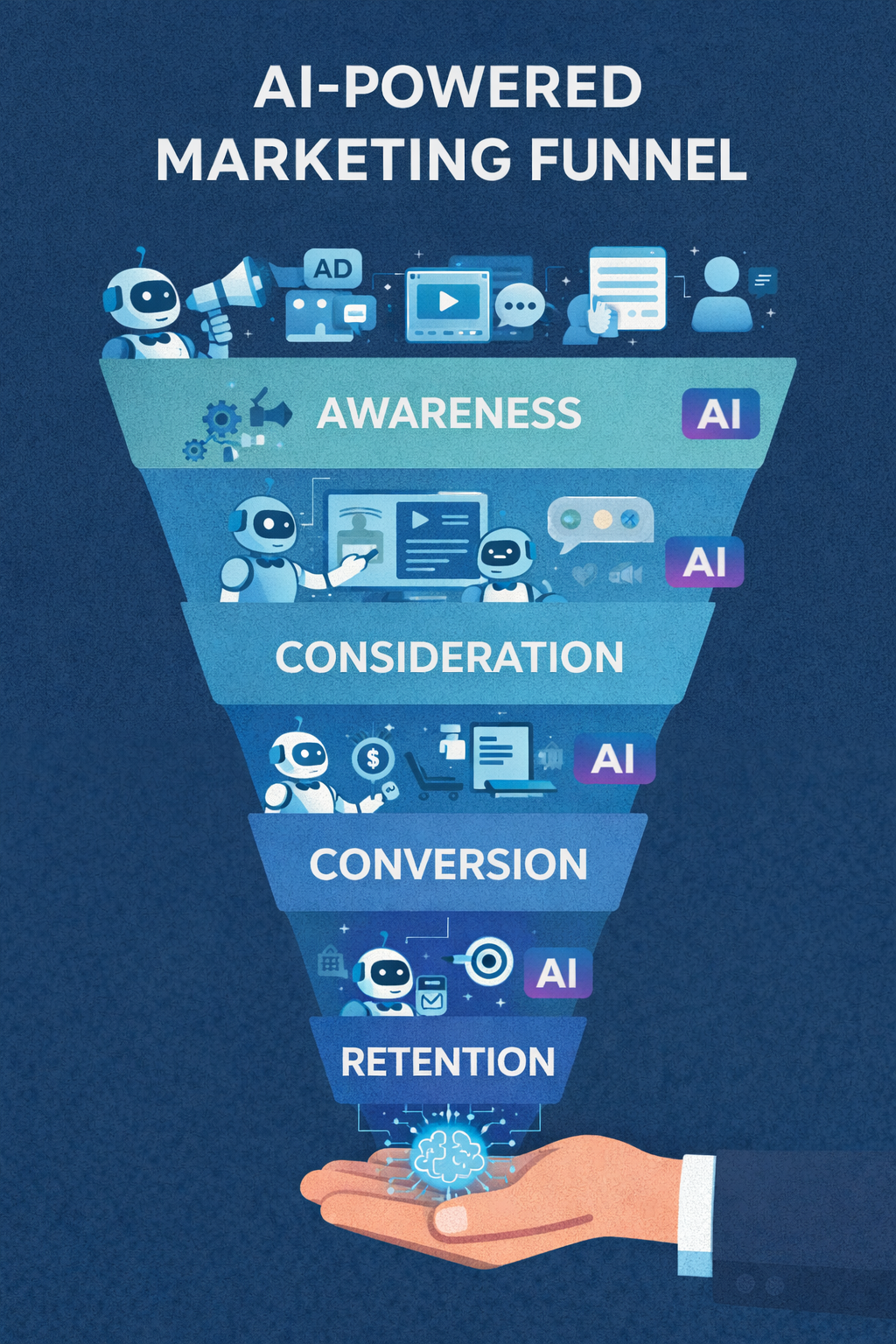
5. Full-Funnel AI Strategy Creation (The Most Valuable Skill of 2026)
Marketers must know how to design an AI-powered funnel:
-
AI for reaching the right audience
-
AI for creating personalized content
-
AI for driving engagement
-
AI for automated nurturing
-
AI for conversion forecasting
-
AI for retention and remarketing
What This Skill Enables:
-
Better customer journeys
-
Higher conversion rates
-
Predictable ROI
-
Fully automated revenue pipelines
This is the skill companies will pay the highest salaries for.
6. AI Ethics & Data Privacy (The Skill No One Can Ignore)
As more companies adopt AI in Digital Marketing, ethical marketing becomes a critical part of every professional’s job.
Marketers Must Know:
-
Data privacy rules (GDPR, DPDP India 2023)
-
Responsible AI usage
-
Avoiding biased AI-generated content
-
Transparency in AI-driven decisions
-
Ethical data collection & tracking
Why Companies Care:
Brands can face massive penalties if they mishandle data or misuse AI.
Marketers who understand AI ethics will be preferred for leadership roles and high-trust positions.
How Beginners Can Start Learning AI for Digital Marketing (Step-by-Step)
Your 30-day roadmap to becoming AI-ready — even if you’re starting from zero.
AI is no longer optional for digital marketers. Whether you want a better-paying job, more clients, or faster results, learning AI gives you a massive competitive edge. The good news? You don’t need a technical background — you just need a clear roadmap.
Below is a simple, beginner-friendly, 30-day AI mastery plan designed for absolute newcomers.
Step 1: Understand the Basics of AI in Marketing (Days 1–5)
Before touching tools, learn what AI does and why it matters.
What to learn first:
-
How AI generates content
-
How AI analyzes customer behavior
-
How recommendation engines work
-
What predictive marketing means
-
Basics of automation in Google, Meta & LinkedIn ads
Free learning resources:
-
YouTube channels: HubSpot, Moz, Marketing AI Institute
Outcome:
You understand how AI powers SEO, ads, analytics, social media, and automation.
Step 2: Start Using AI Tools for Content, SEO & Ads (Days 6–12)
Hands-on practice makes you job-ready faster.
Begin with these free tools:
-
ChatGPT / Google Gemini — content writing, keyword ideas, ad copy
-
Canva AI — creatives, social posts, ad graphics
-
Surfer AI (free trial) — SEO content optimization
-
Semrush AI Writing Assistant (free credits) — keyword insights
-
Meta Advantage+ tools — automated audiences & creatives
Simple practice tasks:
-
Create a blog outline
-
Generate 10 Instagram captions
-
Create 5 AI-powered ad variations
-
Optimize a sample landing page for SEO
Outcome:
You start building technical confidence using real AI marketing tools.
Step 3: Learn AI Automation (Days 13–18)
Automation = high-income skill for digital marketers in 2026.
Start with easy tools:
-
Zapier (AI automation builder)
-
HubSpot AI (email + CRM automation)
-
Mailchimp AI (personalized email content)
Practice tasks:
-
Set up an automated welcome email
-
Create an abandoned cart flow
-
Automate lead capture → Google Sheet → WhatsApp message
Outcome:
You can automate workflows most companies still do manually.
Step 4: Learn AI Analytics & Predictive Insights (Days 19–24)
In 2026, marketers who interpret AI insights earn 40–60% more.
Tools to practice:
-
Google Analytics 4 AI Insights
-
Meta AI Performance Breakdown
-
Looker Studio AI reports
-
Power BI with Copilot
Practice tasks:
-
Build a simple AI-powered dashboard
-
Predict which audience might convert better
-
Analyze website heatmaps (Clarity AI / Hotjar AI)
Outcome:
You can make smarter decisions based on AI-generated insights — a top hiring skill.
Step 5: Build AI Marketing Projects for Your Portfolio (Days 25–30)
Your portfolio is what gets you hired — not certificates alone.
Project ideas for beginners:
-
AI-powered content strategy for a brand (use ChatGPT + Surfer AI)
-
AI-optimized ad campaign (Meta/Google simulation)
-
AI-driven email automation flow (Mailchimp/HubSpot)
-
AI-based customer segmentation dashboard (Looker Studio AI)
Where to showcase it:
-
LinkedIn
-
Your portfolio website (use Notion/Canva free templates)
-
GitHub (for dashboards or automation funnels)
Outcome:
You now have real, measurable, job-worthy AI marketing work to show employers.
Learning AI for Digital Marketing is no longer a “bonus” — it’s the new baseline skill for high-paying marketing jobs.
Follow the 30-day roadmap above, practice consistently, and if you want to accelerate your learning with expert guidance, Cambridge Infotech gives you the most industry-ready AI Digital Marketing training in Bangalore.
Real-World Examples: Brands Growing Faster With AI (2026 Edition)
AI in Digital Marketing has already reshaped how modern businesses grow.
Below are practical, real-world case-study-style examples that show exactly how companies are using AI to drive traffic, conversions, and revenue.
Example 1: E-commerce Brand Increases Sales by 42% With AI-Powered Personalization
A mid-sized e-commerce clothing brand integrated:
-
AI product recommendation engines
-
AI-based personalized email flows
-
Dynamic AI-driven landing pages
What changed?
✔ Users started seeing products based on their browsing behavior
✔ Email open rates increased by 31%
✔ Add-to-cart conversions rose sharply
Outcome:
The brand saw a 42% increase in total monthly sales within 60 days.
AI tools used: Predictive personalization + email automation + behavior analytics.
Example 2: Real Estate Company Reduces Cost-per-Lead by 55% Using AI Ad Optimization
A real estate services provider used AI in Digital Marketing to automate:
-
Ad copy variations
-
Audience targeting
-
Predictive bidding
-
High-intent lead scoring
What changed?
✔ The AI system eliminated wasted ad spend
✔ Ads automatically optimized based on real-time performance
✔ Leads were filtered to focus only on high-intent prospects
Outcome:
The company achieved a 55% reduction in cost-per-lead (CPL) and nearly 2x more monthly inquiries.
AI tools used: AI ad optimizers + predictive bidding models.
Example 3: EdTech Startup Boosts Enrolments Using AI Content Automation
An online learning platform used AI to automate:
-
SEO-optimized blog creation
-
Programmatic landing pages
-
AI-powered YouTube script generation
What changed?
✔ They increased content publishing speed by 4x
✔ Website traffic jumped organically
✔ Students found more relevant content based on their skills
Outcome:
Within three months, the platform saw a 70% increase in organic traffic and a 35% boost in student enrolments.
AI tools used: Generative AI + SEO AI + content automation.
Example 4: Local Restaurant Chain Grows Social Media Reach by 5X Using AI Video Tools
A regional restaurant chain used:
-
AI video repurposing
-
AI caption generation
-
AI trend detection
What changed?
✔ Reels and Shorts were created 8x faster
✔ Posts matched current viral trends
✔ Engagement became consistent across all locations
Outcome:
The brand saw a 5X increase in monthly social media reach and a 52% rise in footfall.
AI tools used: Opus Clip, Descript, Flick AI.
Example 5: B2B SaaS Company Improves MQL Quality With AI Lead Scoring & Forecasting
A SaaS software company implemented:
-
AI scoring models
-
Predictive analytics dashboards
-
Smart email nurturing
What changed?
✔ Leads were automatically categorized by intent
✔ Sales teams spent time only on the high-value prospects
✔ AI predicted which leads would convert
Outcome:
Marketing-qualified leads (MQLs) improved by 37%, and conversion-to-demo increased significantly.
AI tools used: AI CRM + predictive analytics + automation.
Why These Examples Matter
These case studies prove that AI in Digital Marketing is not just a trend — it’s the growth engine of 2026.
Whether you’re running ads, creating content, automating workflows, or analyzing data, AI gives brands:
-
Higher ROI
-
Better conversions
-
Faster execution
-
Data-driven decisions
Future of AI in Digital Marketing (2026–2030 Predictions)
The next 4 years will completely redefine how marketing teams operate.
AI in Digital Marketing is shifting from tool → assistant → full autonomous workforce.
Below are the most accurate industry-backed predictions for 2026–2030.
1. AI Agents Will Replace Most Junior-Level Marketing Roles
By 2030, AI agents will handle what entry-level marketers currently do, including:
-
Creating ad copies
-
SEO audits
-
Social media scheduling
-
Competitor analysis
-
Reporting & weekly dashboards
-
Basic customer segmentation
-
A/B test setup
Why?
Because AI can now:
✔ Think
✔ Execute
✔ Optimize
✔ Learn from results
AI agents such as autonomous SEO bots, ad bots, and analytics bots will minimize manual work by 80–90%.
What does this mean for marketers?
Roles won’t disappear — they will evolve.
Marketers need to shift from “doing tasks” to “managing intelligent systems.”
2. Autonomous Ad Management Will Become the New Normal
Between 2026 and 2030, Google, Meta, and LinkedIn will phase out traditional manual campaign controls.
AI systems will:
-
Build entire campaigns
-
Generate dozens of ad variations
-
Test creatives automatically
-
Optimise budgets in real-time
-
Predict which audiences convert
-
Pause underperforming ads
-
Scale top-performing creatives instantly
Marketers will act as strategists, not operators.
Imagine this:
You give the AI a goal → the AI performs every step → you approve the final output.
This is already possible, but by 2030, it will become the default advertising model.
3. AI-Generated Influencers & Fully Synthetic Content Will Explode
We will see a sharp rise in AI-generated personalities, including:
-
Virtual influencers
-
AI-driven brand ambassadors
-
100% AI-created promotional videos
-
Synthetic human-like podcast hosts
-
AI spokespeople for ads
-
AI voiceovers & narrators
These AI influencers will:
✔ Post daily
✔ Engage with fans
✔ Generate content automatically
✔ Represent brands 24/7
Brands will save massive costs on influencer partnerships, production teams, and talent hiring.
4. Interactive AI Content Will Replace Static Content
Between 2026–2030, digital content will shift from “read-only” to “serve-me” mode.
Examples:
-
AI-driven interactive blog pages
-
Personalized landing pages that change per visitor
-
Dynamic emails that rewrite themselves based on user behavior
-
Product pages with real-time AI chat advisors
-
AI-generated product demos on the fly
In short:
Content won’t be consumed. It will react, adapt, and talk back.
5. Fully Automated AI Campaign Cycles Will Run Without Human Intervention
By 2030, an entire marketing campaign can be:
Planned → Created → Launched → Monitored → Optimized → Reported
…without a human clicking a single button.
AI systems will:
-
Generate a strategy
-
Create content
-
Build landing pages
-
Design ad creatives
-
Launch campaigns
-
Optimize performance
-
Scale winning audiences
-
Produce reports
-
Suggest improvements automatically
Marketing managers will supervise, approve, and refine — not execute.
6. Predictive AI Will Make Marketing “Future-Aware”
Predictive engines will be powerful enough to:
-
Forecast conversions
-
Predict revenue
-
Forecast trending content topics
-
Identify future viral social media patterns
-
Predict ad ROI before spending money
-
Estimate customer behaviour weeks ahead
Instead of reacting, marketers will pre-act, based on predictions with 90% accuracy.
7. AI Will Make Marketing Hyper-Personalized Across Every Platform
From 2026–2030, expect:
✔ Personalized websites
✔ Personalized ads
✔ Personalized video recommendations
✔ Personalized chatbot journeys
✔ Personalized course suggestions
✔ Personalized pricing models (dynamic pricing)
AI-driven personalization will make marketing campaigns feel 1:1 — not 1:1000.
Why This Future Matters
Because the marketers who learn AI now will be the ones who:
-
Lead teams in 2030
-
Get the highest-paying jobs
-
Run autonomous marketing campaigns
-
Win in a competitive marketplace
-
Stay relevant in the AI-first era
AI in Digital Marketing is not just a trend — it is the operating system of the future economy.
FAQs: AI in Digital Marketing (2026 Edition)
1. Will AI replace digital marketing jobs?
AI will replace repetitive junior-level tasks, not strategic marketers.
Entry-level roles like basic copywriting, SEO audits, and report creation may become automated.
However, AI will create new job roles such as:
-
AI Marketing Specialist
-
AI Ads Strategist
-
AI Content Engineer
-
Marketing Automation Expert
-
Predictive Analytics Marketer
Marketers who upskill in AI will be in high demand from 2026–2030.
2. How is AI used in SEO?
AI enhances SEO by:
-
Automating keyword research
-
Analyzing top-ranking competitors
-
Suggesting content updates
-
Fixing technical issues
-
Predicting keywords that will rank
-
Writing optimized content outlines
-
Identifying user search intent
AI-powered SEO tools (Surfer AI, Semrush AI, Ahrefs AI) help marketers rank faster and more efficiently.
3. Do I need technical knowledge to learn AI for Digital Marketing?
No. You don’t need coding or machine learning knowledge.
What you need is:
-
Understanding of digital marketing basics
-
Ability to use AI tools
-
Knowledge of prompts
-
Awareness of data and analytics
With guided training (like at Cambridge Infotech), anyone can master AI marketing in 2–3 months.
4. Is learning AI in Digital Marketing good for freshers?
Yes — freshers with AI skills have a big advantage over traditional digital marketing students.
Companies prefer candidates who can:
-
Use AI tools
-
Automate tasks
-
Interpret analytics
-
Increase productivity
Freshers who combine digital marketing + AI can secure higher salaries and faster growth.
5. What skills do I need to start learning AI orchestration?
To start learning AI orchestration, you don’t need deep coding expertise. The essential skills include AI fundamentals, prompt engineering, workflow design, logic building, and basic understanding of tools like Zapier, Make, LangChain, and API integrations. Soft skills like problem-solving and structured thinking also play a major role.
6. Why is AI becoming important for digital marketing?
Because AI helps marketers:
-
Understand customer behavior
-
Predict trends
-
Reduce workload
-
Create personalized experiences
-
Automate repetitive tasks
-
Improve ROI
-
Optimize ad spends
-
Make better data-driven decisions
AI-driven marketing is now a necessity, not an option.
7. What AI tools are commonly used in digital marketing?
Popular AI tools include:
-
ChatGPT, Gemini, Claude → content, SEO, ads
-
Jasper AI, Writesonic → content & copywriting
-
Surfer SEO, Clearscope, SEMrush → SEO optimization
-
Zapier, Make, HubSpot AI → automation
-
Hootsuite AI, Buffer AI → social automation
-
Google Ads AI, Meta Advantage+ → ad automation
These tools help marketers improve efficiency and results.
8. Does AI help with customer support?
Yes. AI tools like chatbots and virtual assistants can:
-
Answer customer queries
-
Resolve common issues
-
Assist 24/7
-
Reduce workload
-
Improve response time
-
Qualify leads before connecting to sales
This enhances customer experience significantly.
9. Is AI difficult to learn for digital marketers?
No. Most AI tools are user-friendly and require no coding. Marketers only need basic understanding of prompts, data interpretation, and tool usage. With practice, anyone can become AI-proficient.
10. What skills do digital marketers need to work with AI?
Important skills include:
-
Prompt engineering
-
Understanding of automation
-
Basic analytics
-
SEO knowledge
-
Ad campaign management
-
Workflow design
-
Creative thinking
-
Tool proficiency (ChatGPT, SEMrush, Zapier, etc.)
Conclusion: Marketers Who Adopt AI Win — Those Who Don’t Will Be Replaced
By now, one thing is absolutely clear:
AI in Digital Marketing is not the future — it is the present reality.
Brands, agencies, startups, and even freelancers who embrace AI are growing faster, cheaper, and smarter than ever before.
And those who ignore AI?
They will fall behind… not because they lack talent, but because they lack tools.
Final Takeaway: AI Is the New Competitive Advantage
The marketers who succeed from 2026–2030 will be those who:
-
Use AI to automate repetitive work
-
Rely on data—not instincts—for decisions
-
Create content faster than the competition
-
Run ads that optimize themselves
-
Analyze customer behavior with AI-driven accuracy
-
Build campaigns 5x faster with AI co-pilots
This isn’t optional anymore.
This is the new standard of digital marketing.
Your Next Step: Start Using AI Tools Today
You don’t need to master everything overnight.
Just start with one AI tool → see the impact → scale up from there.
Here’s your immediate action plan:
-
Pick 2–3 AI tools (content + SEO + ads optimization)
-
Build your first AI-assisted campaign
-
Automate one weekly task
-
Analyze results using AI analytics
-
Level up into more advanced AI marketing systems
Small steps now → massive results later.
For practical AI learning and industry-ready courses, Cambridge Infotech is the place to start.
RELATED BLOGS:
Why Cybersecurity Will Dominate the Future IT Job Market 2026
The Most Powerful Artificial Intelligence Topics In ( 2025 )
Top AI Careers in Demand by 2026: Best Future Guide | Cambridge Infotech
Powerful Current Trends in Artificial Intelligence You Can’t Ignore In ( 2025 )